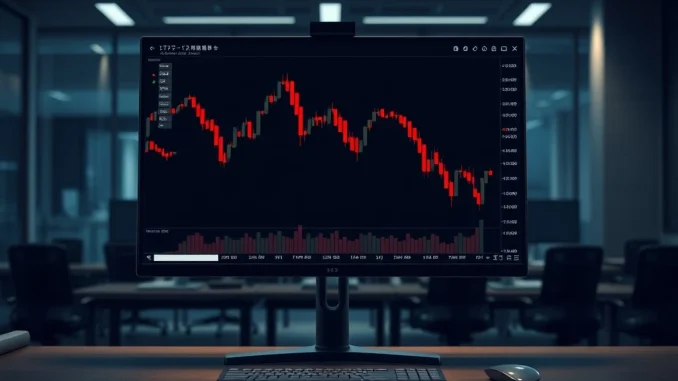
NEW YORK, April 1, 2026 – The global cryptocurrency market confronts a stark reality as the first quarter of 2026 closes with historic weakness. Major digital assets Bitcoin and Ethereum have recorded their poorest Q1 performances on record, sending shockwaves through investor portfolios and raising fundamental questions about market stability. Preliminary data from CoinMarketCap and Glassnode reveals a combined market capitalization decline exceeding 35% for the quarter, a drop not seen since the bear market of 2022. This severe downturn reflects a potent cocktail of falling on-chain liquidity, rising global macroeconomic uncertainty, and shifting regulatory postures that have collectively eroded confidence. The opening months of 2026 have delivered a sobering reminder of the asset class’s volatility, challenging the long-term growth narrative that dominated previous years.
Analyzing the Historic Q1 2026 Crypto Market Decline
Data analytics firm Glassnode published a report on March 31 detailing the unprecedented scale of the sell-off. Bitcoin, the flagship cryptocurrency, closed Q1 2026 down approximately 42% from its January opening price, marking its weakest first-quarter performance since 2018. Ethereum fared marginally worse, declining roughly 45% over the same period. Crucially, on-chain metrics point to a liquidity crisis at the core of the downturn. The aggregate balance of stablecoins on centralized and decentralized exchanges fell by over $80 billion during the quarter, according to data from DefiLlama. This massive outflow of stablecoin liquidity—the primary trading pair for most crypto assets—severely reduced market depth, amplifying price volatility on even modest sell orders.
Market analysts at Kaiko Research corroborate this view, noting that average daily trading volumes across major spot exchanges plummeted by nearly 60% compared to Q1 2025. “We are witnessing a classic liquidity crunch,” stated Clara Mendez, Head of Research at Kaiko. “The combination of retail investor retreat and institutional caution has created a vacuum. Without sufficient buy-side liquidity, even planned selling from ETFs or mining operations creates disproportionate downward pressure.” The timeline of the decline shows a consistent downward trajectory throughout January and February, with a brief stabilization in early March collapsing under renewed macroeconomic fears.
Global Uncertainty and Its Direct Impact on Digital Assets
The crypto market’s struggles are inextricably linked to a fraught global landscape. Rising geopolitical tensions, particularly renewed trade conflicts between major economies, have triggered a broad flight to traditional safe-haven assets like the U.S. dollar and gold. Simultaneously, stubborn inflation in several G7 nations has forced central banks to maintain or even tighten monetary policy, keeping real interest rates elevated. This environment is particularly toxic for speculative, high-growth assets like cryptocurrencies, which thrive on cheap capital and risk appetite.
- Macroeconomic Headwinds: Sustained high-interest rates have increased the opportunity cost of holding non-yielding assets like Bitcoin. Bond yields offering guaranteed returns have drawn capital away from volatile crypto markets.
- Regulatory Overhang: While no single major regulation was passed in Q1, ongoing, fragmented regulatory discussions in the U.S., EU, and UK have created a climate of uncertainty, deterring new institutional entry.
- Derivative Market Contagion: The sharp decline triggered significant liquidations in the perpetual futures market, estimated at over $12 billion in long positions by analytics platform Coinglass. These forced sales created cascading selling pressure in the spot market.
Expert Analysis on Market Structure and Sentiment
Dr. Aris Kalyvas, Chief Economist at blockchain analytics firm IntoTheBlock, emphasizes a structural shift. “Our data shows network activity for both Bitcoin and Ethereum has plateaued. New address growth is stagnant, and transaction fees have collapsed, indicating reduced utility demand,” Kalyvas explained in an interview. “This isn’t just a price correction; it’s a stress test of the underlying adoption thesis. The market is repricing assets based on current usage, not future potential.” This perspective is echoed by traditional finance institutions. A quarterly note from Fidelity Digital Assets cited the “maturation of the market’s discounting mechanism,” suggesting prices are now more closely tied to verifiable on-chain fundamentals and less driven by narrative alone.
Historical Context and Comparative Performance Analysis
Placing Q1 2026 in historical context reveals its exceptional nature. Previous bearish quarters, such as Q2 2022 following the Terra/Luna collapse, were driven by a specific, catastrophic event within the crypto ecosystem. The current weakness, however, stems from external macroeconomic forces combined with an internal liquidity drain, making it a more complex and potentially prolonged challenge. The table below compares key Q1 performance metrics for Bitcoin across several years.
| Year | Q1 Price Change | Primary Driver | Average Daily Volume (Spot) |
|---|---|---|---|
| 2023 | +72% | Post-FTX recovery, banking crisis safe-haven narrative | $32B |
| 2024 | +57% | Spot Bitcoin ETF approvals in the U.S. | $48B |
| 2025 | -8% | Profit-taking after all-time highs, ETF flow normalization | $41B |
| 2026 | -42% | Global macro uncertainty, liquidity withdrawal, regulatory overhang | $19B |
The Road Ahead: Recovery Catalysts and Critical Watchpoints
The path forward for Bitcoin, Ethereum, and the broader crypto market hinges on several observable factors. First, a reversal in the stablecoin liquidity trend is essential. Analysts will monitor the aggregate stablecoin supply for signs of re-entry. Second, clarity on the regulatory front, particularly final rules from the U.S. Securities and Exchange Commission on asset classification and custody, could remove a significant overhang. Third, the macroeconomic picture must improve, with markets anticipating a definitive pivot toward rate cuts from major central banks to reinvigorate risk appetite.
Institutional and Retail Investor Sentiment Divergence
Interestingly, sentiment appears to be bifurcating. Retail investor fear, as measured by the Crypto Fear & Greed Index, has been stuck in “Extreme Fear” for over nine consecutive weeks. Conversely, some institutional players see a long-term accumulation opportunity. “Our clients are asking detailed questions about miner capitulation metrics and MVRV ratios, which are entering historically oversold territory,” noted Maya Rodriguez, a digital asset strategist at Grayscale Investments. “This is a sign of sophisticated, valuation-focused interest, not panic.” However, public market vehicles like the spot Bitcoin ETFs have seen net outflows for most of the quarter, indicating a cautious stance from the broader financial advisor community.
Conclusion
The weak Q1 2026 performance of Bitcoin and Ethereum represents a pivotal moment for the cryptocurrency market. It underscores the sector’s growing, albeit painful, integration with global macroeconomic forces. The historic decline was not caused by a single hack or collapse but by a confluence of tightening liquidity, persistent inflation, and regulatory ambiguity. For investors, the quarter serves as a stark lesson in the non-correlated asset narrative’s limits. Moving forward, the market’s recovery will likely be contingent on a return of stablecoin liquidity and a favorable shift in the global interest rate environment. While the long-term blockchain thesis remains intact for many, the events of early 2026 have firmly reset expectations, prioritizing demonstrable utility and robust financial infrastructure over speculative momentum.
Frequently Asked Questions
Q1: How bad was Bitcoin’s Q1 2026 performance compared to its history?
Bitcoin’s approximate 42% decline in Q1 2026 marks its worst first-quarter performance since 2018. It significantly underperforms the bullish Q1 periods seen in 2023 and 2024 following major catalysts like ETF approvals.
Q2: What is the main reason for the crypto market’s severe drop in liquidity?
The primary cause is a massive withdrawal of stablecoins from trading platforms, exceeding $80 billion in Q1. Stablecoins are the main trading pairs for crypto, so their exit drastically reduces market depth and amplifies price swings.
Q3: Are there any potential positive catalysts for a market recovery in 2026?
Potential catalysts include a reversal of stablecoin outflows, definitive and clear regulatory frameworks from major economies like the U.S. and EU, and a shift in global central bank policy toward interest rate cuts.
Q4: How does this downturn affect everyday cryptocurrency users?
For users, transaction fees on networks like Ethereum are currently very low due to reduced demand. However, the value of holdings has decreased significantly, and the ecosystem may see reduced funding and development for newer applications.
Q5: Is this situation similar to the “crypto winter” of 2022?
While both are severe downturns, the drivers differ. The 2022 crash was triggered by internal failures (Terra, Celsius, FTX). The 2026 weakness is more driven by external macroeconomic factors and a broad liquidity drain, making comparisons difficult.
Q6: What should investors watch to gauge a potential market bottom?
Key indicators include a stabilization and growth in the aggregate stablecoin supply, a reduction in the rate of long liquidations in derivatives markets, and on-chain metrics showing accumulation by long-term holders at current price levels.
Updated insights and analysis added for better clarity.
This article was produced with AI assistance and reviewed by our editorial team for accuracy and quality.