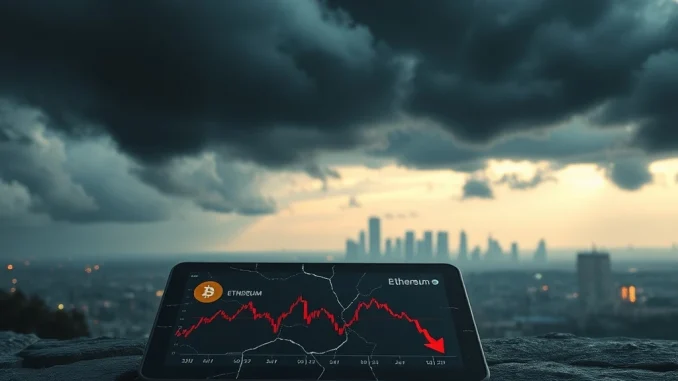
Global, May 2025: The cryptocurrency market faces intense pressure this week as a wave of extreme fear washes over investors. Bitcoin (BTC) and Ethereum (ETH), the two largest digital assets by market capitalization, have recorded significant declines, dragging broader market sentiment to multi-month lows. Concurrently, decentralized finance (DeFi) protocols and non-fungible token (NFT) markets present a complex, fragmented picture, showing pockets of resilience amid the widespread downturn. This period of volatility underscores the market’s sensitivity to macroeconomic cues and internal ecosystem dynamics.
Crypto Market Sentiment Hits Extreme Fear Territory
The Crypto Fear & Greed Index, a widely referenced sentiment gauge, has plummeted into “Extreme Fear” territory, a zone not consistently seen since late 2023. This index aggregates data from volatility, market momentum, social media, surveys, and dominance metrics. Analysts point to several converging factors for the current climate. Firstly, renewed macroeconomic uncertainty regarding interest rate trajectories has dampened risk appetite across all speculative asset classes. Secondly, recent on-chain data reveals increased movement of Bitcoin from long-term holder wallets to exchanges, often a precursor to selling pressure. Finally, a lack of positive catalytic news has left the market vulnerable to negative momentum. Historical analysis shows that periods of extreme fear have often, but not always, preceded significant price bottoms, making current levels a critical watchpoint for institutional and retail traders alike.
Bitcoin and Ethereum Lead the Downward Charge
Bitcoin (BTC) has breached several key technical support levels, falling below a psychologically important price point that had held for the preceding quarter. Its dominance rate—the percentage of the total crypto market cap that Bitcoin represents—has seen erratic movement, indicating a flight to relative safety is not uniform. Ethereum (ETH) has mirrored and at times exceeded Bitcoin’s losses, with its decline exacerbated by concerns over network congestion fees and potential delays in upcoming protocol upgrades. The correlation between the two assets remains high, demonstrating their continued role as the primary drivers of overall market direction. The table below summarizes the recent performance of both assets against key benchmarks.
| Asset | 7-Day Performance | Key Support Level Tested | 30-Day Volatility Index |
|---|---|---|---|
| Bitcoin (BTC) | -12.5% | $58,000 | High |
| Ethereum (ETH) | -14.8% | $3,100 | Very High |
On-Chain Data Tells a Story of Caution
Beyond price action, on-chain analytics reveal a market shifting to a defensive posture. The Mean Dollar Invested Age metric for Bitcoin is rising, suggesting older coins are being spent or moved—a behavior typical during market stress. Furthermore, exchange netflows have turned positive for both BTC and ETH, indicating more assets are moving onto trading platforms than off them, which can signal preparation for selling. However, it is crucial to distinguish between speculative selling and strategic portfolio rebalancing by large-scale holders, whose motives are not always clear from raw data alone.
DeFi and NFT Markets Show Divergent Signals
While the core cryptocurrency market struggles, the DeFi and NFT sectors are not moving in perfect lockstep, revealing the growing complexity of the blockchain ecosystem.
- DeFi Resilience: Total Value Locked (TVL) across major DeFi protocols has declined but at a slower rate than the spot prices of underlying assets. This suggests some users are opting to remain within yield-bearing protocols rather than converting entirely to fiat. Lending platforms show increased borrowing activity, potentially for leveraged long positions or short-term liquidity needs.
- NFT Market Fragmentation: The NFT space exhibits a clear tiered response. Blue-chip collections like CryptoPunks and Bored Ape Yacht Club have seen floor prices soften and trading volume dry up significantly. In contrast, niche communities and utility-focused NFT projects (e.g., those tied to gaming or membership) show more stable trading activity, indicating value perception is shifting from pure speculation to functional use.
This divergence highlights that market participants are making more nuanced decisions based on specific sector fundamentals, rather than executing a blanket sell-off of all crypto-related assets.
The Macroeconomic Backdrop and Regulatory Horizon
The current crypto market downturn cannot be viewed in isolation. It coincides with a period of global economic recalibration, where traditional markets are also experiencing volatility. Central bank policies, inflation data, and geopolitical tensions create a headwind for high-growth, high-risk assets. Simultaneously, the regulatory landscape for digital assets continues to evolve. While some jurisdictions are clarifying frameworks, which is a long-term positive, the interim uncertainty can contribute to investor caution. Market veterans often note that such periods of consolidation and fear are integral to the maturation process of a nascent asset class, weeding out excess leverage and shifting focus to projects with sustainable fundamentals.
Conclusion
The cryptocurrency market is currently navigating a phase of extreme fear, with Bitcoin and Ethereum bearing the brunt of the sell-off. This sentiment shift is rooted in a combination of macroeconomic pressures, on-chain selling signals, and a lack of immediate positive catalysts. However, the nuanced performance of DeFi and NFT sub-sectors suggests the market’s internal structure is maturing. While short-term price action remains volatile and driven by sentiment, these periods historically force a re-evaluation of project viability and long-term value propositions. The coming weeks will be critical in observing whether current levels establish a foundation for recovery or if further tests of investor conviction lie ahead.
FAQs
Q1: What does “Extreme Fear” mean on the Crypto Fear & Greed Index?
The “Extreme Fear” reading indicates that market sentiment is overwhelmingly negative based on a composite of data points including volatility, trading volume, social media buzz, and surveys. It suggests investors are primarily driven by fear of loss rather than greed for gains.
Q2: Why are Bitcoin and Ethereum prices so correlated?
Bitcoin and Ethereum are the two largest and most liquid cryptocurrencies. They are often used as benchmark assets and gateway investments for both retail and institutional players. During broad market stress or euphoria, they tend to move together as capital flows in or out of the crypto asset class as a whole.
Q3: Is DeFi safer during a market downturn?
Not necessarily safer, but it can behave differently. While DeFi token prices often fall with the broader market, the underlying protocols (lending, trading) may still see usage from those seeking yield or specific financial utilities, leading to a divergence between protocol TVL and spot token prices.
Q4: What typically happens after a period of extreme fear?
Historically, periods of extreme fear have sometimes marked local price bottoms, as selling pressure exhausts itself. However, this is not a guaranteed timing signal. Such periods can also lead to prolonged consolidation before a clear trend reversal emerges.
Q5: How do NFT markets react differently than cryptocurrency markets?
NFT markets are less liquid and more driven by community sentiment, rarity, and utility for specific projects. While they are generally correlated with crypto market trends, high-profile or utility-based collections can demonstrate price stability or independent momentum based on their own roadmaps and community engagement, unlike purely financial crypto assets.
Updated insights and analysis added for better clarity.
This article was produced with AI assistance and reviewed by our editorial team for accuracy and quality.