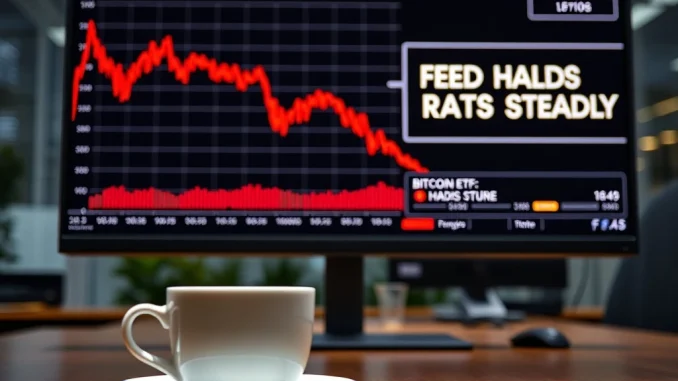
New York, January 2026: The United States Bitcoin spot exchange-traded fund (ETF) market has witnessed a significant shift in capital flows, with approximately $1.875 billion exiting these products over a critical eight-day period. This substantial withdrawal coincided directly with the Federal Reserve’s latest policy announcement, where officials opted to pause their interest rate-cutting cycle, maintaining the benchmark rate between 3.50% and 3.75%. The synchronized movement of capital away from Bitcoin ETFs and the central bank’s decision highlights a growing atmosphere of institutional caution, placing speculative digital assets under renewed pressure as traditional monetary policy takes center stage.
Bitcoin Spot ETF Outflows Signal Shifting Sentiment
Data from financial analytics firm SoSOValue reveals a consistent pattern of withdrawals from US-listed Bitcoin spot ETFs beginning on January 16. The outflows culminated in a single-day record for the year on January 21, when investors pulled $708.71 million from these funds. This eight-day streak of negative flows represents one of the most concentrated periods of capital exit since the landmark approval of these ETFs, challenging the narrative of unwavering institutional adoption.
Analysts point to several concurrent factors driving this trend. The primary catalyst is the macroeconomic backdrop shaped by the Federal Reserve. Institutional allocators, who had previously moved into Bitcoin ETFs amid expectations of a sustained rate-cutting cycle, are now reassessing risk exposure as that timeline extends. Furthermore, Bitcoin’s price performance has provided little incentive to hold. The asset is down approximately 11% over the past 13 months and trades more than 30% below its all-time high set in October 2025, eroding the ‘store of value’ thesis in the short term.
The Federal Reserve’s Policy Pause and Market Implications
The Federal Open Market Committee’s (FOMC) decision to hold rates steady removed immediate policy uncertainty but introduced a new phase of waiting. By signaling a pause, the Fed indicated that the cost of borrowing will remain elevated for the foreseeable future. This environment typically dampens enthusiasm for non-yielding, high-volatility assets like Bitcoin, as it increases the opportunity cost of holding them compared to interest-bearing securities.
Historical analysis supports this dynamic. Market analyst Ali Martinez noted on platform X that Bitcoin has frequently experienced heightened volatility during FOMC announcement weeks. A common pattern has emerged where the asset dips following the policy statement, even when traders anticipate a dovish outcome. The current cycle appears to be following this script, with the ETF outflows beginning in anticipation of the Fed’s meeting and accelerating afterward.
- Rate Environment: The Fed Funds rate remains at 3.50%-3.75%.
- Policy Signal: A pause in the cutting cycle suggests a “higher for longer” stance.
- Market Reaction: Risk assets, including crypto, face headwinds from sustained higher rates.
On-Chain Data Reflects a Cautious Ecosystem
The weakness is not confined to ETF flows. On-chain metrics, which track activity directly on the Bitcoin blockchain, paint a picture of declining retail participation and weakening fundamental demand. Cauê Oliveira, a contributor at CryptoQuant, observes that on-chain demand is softening. Key indicators such as new address creation and transaction volumes for smaller wallets—often proxies for retail activity—have trended downward.
This decline in grassroots engagement removes a traditional source of market stability and growth. Oliveira suggests that a stronger recovery for Bitcoin would likely require a visible improvement in market sentiment and a resurgence of retail activity on-chain. The current data does not yet support that thesis. Compounding this, fears of a potential US government shutdown have emerged, an event that could tighten liquidity across all financial markets and further pressure speculative holdings.
Global Liquidity and the Crypto Market Squeeze
The tightening is not solely a US phenomenon. Analysts are also monitoring the unwinding of Japan’s famous carry trade. For years, investors borrowed Japanese yen at ultra-low interest rates to invest in higher-yielding assets abroad, including US equities and cryptocurrencies. As global interest rate differentials shift and the Bank of Japan adjusts its own policy, this trade is being reversed, pulling liquidity out of global markets.
This reduction in outbound liquidity from Japan creates an additional layer of pressure on digital asset markets, which have benefited from abundant global capital. The confluence of the Fed’s pause, ETF outflows, and tightening global liquidity creates a challenging trifecta for Bitcoin’s price momentum in the near term.
Institutional Restraint Evident in Premium Data
The cautious behavior of large, sophisticated investors is corroborated by the Coinbase Bitcoin Premium Index. This metric tracks the difference between Bitcoin’s price on Coinbase (predominantly used by US traders) and other global exchanges. A positive premium typically indicates stronger buying demand from US institutions.
Recent data shows this premium has been muted, with only occasional, short-lived spikes. This pattern suggests that while there may be fleeting pockets of optimism or tactical buying, there is no sustained, large-scale institutional accumulation occurring. The overall picture is one of restraint, with major players waiting for clearer signals from both the macroeconomic landscape and Bitcoin’s own price action.
Market Psychology and the Path Forward
The prevailing mood among investors is undeniably cautious. The widely followed Crypto Fear and Greed Index currently reads 26, solidly in “Fear” territory. This sentiment gauge aggregates data from volatility, market momentum, social media, surveys, and dominance to quantify market emotion. A reading this low often coincides with periods of consolidation or correction, as it reflects a risk-averse mindset.
For Bitcoin and its associated ETFs to regain upward momentum, market observers identify two key requirements. First, a shift in the macro narrative, potentially from softer inflation data that allows the Fed to reconsider its pause. Second, a renewal of on-chain activity and retail interest, which would demonstrate organic, bottom-up demand beyond speculative ETF flows. Until these conditions materialize, the market appears poised for a phase of consolidation, where prices may trade within a range as weak hands exit and long-term holders accumulate.
Conclusion
The $1.875 billion in Bitcoin spot ETF outflows over eight days serves as a powerful indicator of institutional sensitivity to monetary policy. The Federal Reserve’s decision to pause interest rate cuts has acted as a catalyst for profit-taking and risk reduction among large investors. Coupled with weak on-chain metrics and tightening global liquidity, the outlook for Bitcoin in the immediate term is one of consolidation rather than explosive growth. The market’s next significant move will likely depend on a change in the Fed’s rhetoric or a resurgence in fundamental, retail-driven demand for the blockchain network itself.
FAQs
Q1: What caused the large outflows from Bitcoin spot ETFs?
The outflows were driven primarily by institutional caution ahead of and following the Federal Reserve’s decision to pause interest rate cuts. Higher-for-longer rates reduce the appeal of non-yielding speculative assets like Bitcoin, prompting investors to reallocate capital.
Q2: How does the Federal Reserve’s interest rate policy affect Bitcoin?
Higher interest rates increase the yield on safe assets like Treasury bonds, raising the opportunity cost of holding Bitcoin, which pays no yield. Fed policy also influences overall market liquidity and risk appetite, with tighter policy generally negative for risk assets.
Q3: What is the significance of on-chain data showing declining activity?
On-chain data reflects usage of the Bitcoin network itself. Declining activity in metrics like new addresses and small transaction volumes suggests weakening fundamental, retail-driven demand, which can undermine price sustainability beyond speculative trading.
Q4: Could the ETF outflows reverse quickly?
Yes, flows can be volatile. A reversal would likely require a positive catalyst, such as softer US inflation data reviving rate cut hopes, a clear technical price breakout for Bitcoin, or a major institutional announcement of new adoption.
Q5: What does a “Fear” reading on the Crypto Fear and Greed Index mean?
A reading of 26 indicates a market dominated by fear and risk aversion. Historically, such extreme fear can sometimes present a contrarian buying opportunity, but it often precedes or occurs during periods of price consolidation or decline.