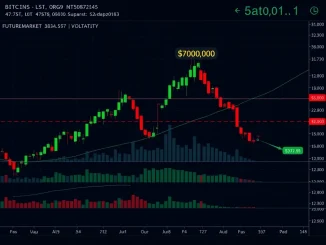
New York, January 28, 2025: The nascent market for U.S. spot Bitcoin exchange-traded funds (ETFs) experienced a significant reversal on Friday, January 27, recording a collective net outflow of $146.05 million. This sharp pivot followed a single day of net inflows, underscoring the volatile and sentiment-driven nature of early-stage cryptocurrency investment vehicles. Data from analytics firm TraderT reveals that industry giants BlackRock and Fidelity led the retreat, highlighting how institutional flows can rapidly change direction.
Spot Bitcoin ETF Outflow Details and Immediate Context
The $146.05 million net outflow represents a clear shift in short-term capital allocation. A net outflow occurs when the dollar value of shares redeemed from the ETFs exceeds the value of new shares created. This action directly pressures the funds’ custodians to sell Bitcoin from their underlying holdings to meet redemption requests. The reversal is particularly notable as it occurred just one day after the funds collectively saw net positive inflows, breaking a prolonged period of outflows that had characterized much of the previous week. This one-day-on, one-day-off pattern provides a real-time case study in the sensitivity of these products to broader market cues, regulatory whispers, and macroeconomic indicators.
Breaking down the figures, BlackRock’s iShares Bitcoin Trust (IBIT) accounted for the majority of the movement with an outflow of $101.49 million. Fidelity’s Wise Origin Bitcoin Fund (FBTC) followed with an outflow of $44.56 million. The outflows from these two behemoths, which have consistently been among the largest funds by assets under management since their launch, were enough to tilt the entire cohort into negative territory. Other funds, including those from Ark Invest, Bitwise, and Grayscale (which converted its GBTC trust), saw relatively minor flows that did little to offset the dominant trend set by IBIT and FBTC.
Analyzing the Drivers Behind the Sudden Reversal
Market analysts point to several concurrent factors that likely contributed to the sudden spot Bitcoin ETF outflow. Understanding these drivers requires looking beyond the crypto market alone.
- Broader Market Risk-Off Sentiment: January 27 coincided with a downturn in traditional equity markets, driven by stronger-than-expected economic data that renewed investor concerns about prolonged higher interest rates. When investors seek to de-risk portfolios, speculative assets like Bitcoin and its associated ETFs are often among the first to see selling pressure.
- Profit-Taking and Rebalancing: After a significant rally in Bitcoin’s price throughout late 2024 and early January 2025, some institutional investors embedded in these ETFs may have executed planned profit-taking. The brief inflow day prior could have been viewed as an opportune window to exit positions at a favorable price point.
- Technical and Flow Dynamics: The ETF market structure itself can create momentum. Large redemptions can trigger downward pressure on Bitcoin’s spot price, which in turn may spook other ETF investors, creating a self-reinforcing cycle of outflows over a short period. This is a common phenomenon observed in other commodity-based ETFs.
- Regulatory and Macroeconomic Headwinds: While no major new regulation was announced, the persistent backdrop of ongoing Securities and Exchange Commission (SEC) scrutiny and congressional hearings on digital asset oversight creates an environment of caution. Institutional allocators are highly sensitive to regulatory uncertainty.
Historical Precedent and Market Maturation
The volatility in daily flows is not unprecedented for a new asset class ETF. Financial historians often draw parallels to the early days of gold ETFs or even the first broad-market equity ETFs. Initial adoption is typically marked by periods of intense accumulation followed by sharp, liquidity-driven sell-offs as the market finds its equilibrium. The key metric for the long-term health of spot Bitcoin ETFs will not be single-day outflows but rather the trend in total assets under management (AUM) over quarters and years. As of January 27, despite the outflow, aggregate AUM for all U.S. spot Bitcoin ETFs remains in the tens of billions, indicating substantial foundational investment.
Implications for Investors and the Crypto Ecosystem
The return to net outflows carries concrete implications for different market participants.
For retail investors, it serves as a stark reminder that ETF shares, while traded on traditional exchanges, are still tied to a highly volatile underlying asset. The “easy access” provided by an ETF does not eliminate Bitcoin’s inherent price risk. For institutional portfolio managers, these flow data points are critical for assessing market sentiment and liquidity conditions. Large, rapid outflows can impact the premium or discount at which an ETF trades relative to its net asset value (NAV), creating arbitrage opportunities but also execution risk.
For the broader cryptocurrency ecosystem, sustained ETF outflows can translate into direct selling pressure on the Bitcoin network. Each dollar redeemed requires the ETF issuer’s authorized participant to sell a corresponding amount of Bitcoin. This creates a direct mechanical link between traditional finance flows and crypto market liquidity. However, analysts caution against over-interpreting a single day’s data. The long-term thesis for these products hinges on their ability to act as a regulated, secure bridge for mainstream capital, a process that will inevitably include periods of both inflow and outflow.
Conclusion
The $146.05 million spot Bitcoin ETF outflow on January 27 acts as a powerful reality check for the digital asset market. It demonstrates that while these financial instruments have successfully opened a new conduit for institutional investment, they remain subject to the powerful forces of global macro sentiment, profit-taking cycles, and internal market mechanics. The reversal after a mere day of inflows highlights that the path to maturation for cryptocurrency investment vehicles will be non-linear and volatile. Moving forward, investors should monitor weekly and monthly flow trends rather than daily gyrations, as these will provide a clearer signal of enduring institutional adoption or retreat. The performance of BlackRock’s IBIT and Fidelity’s FBTC will continue to be critical bellwethers for the entire sector’s health.
FAQs
Q1: What does a “net outflow” mean for a Bitcoin ETF?
A net outflow means more money was withdrawn from the ETF (through share redemptions) than was invested into it (through share creations) on that trading day. This forces the ETF’s manager to sell some of the fund’s underlying Bitcoin holdings to return cash to investors.
Q2: Why did BlackRock’s IBIT and Fidelity’s FBTC see the largest outflows?
IBIT and FBTC are the two largest spot Bitcoin ETFs by assets. Larger funds naturally see larger absolute dollar flows, both in and out. Their movements often dominate the aggregate data for the entire category of funds.
Q3: Is a single day of outflow a sign that Bitcoin ETF demand is falling?
Not necessarily. Daily flows for any ETF, especially a new one tied to a volatile asset, can be erratic. Analysts look at longer-term trends over weeks and months to gauge sustained demand. One day of outflow after a period of inflows is common market behavior.
Q4: How do ETF outflows directly affect the price of Bitcoin?
When an ETF experiences a net outflow, its authorized participants must sell Bitcoin on the open market to raise cash for redeeming shareholders. This increased selling supply can exert downward pressure on Bitcoin’s spot price, all else being equal.
Q5: What is the difference between an outflow and a decrease in an ETF’s share price?
An outflow refers to the movement of dollars into or out of the fund’s portfolio. A decrease in share price reflects a decline in the market value of the Bitcoin the fund holds. They can happen independently or simultaneously. A fund could have an inflow on a day when Bitcoin’s price falls, meaning new money is buying at lower prices.