Global Cryptocurrency Markets, April 2025: A discernible shift in investor strategy is unfolding across digital asset markets. Recent data tracking capital movements into and out of Bitcoin exchange-traded funds (ETFs) coincides with significant fundraising milestones for blockchain-based artificial intelligence projects. This trend highlights a growing market narrative that extends beyond pure speculative asset accumulation toward tangible technological utility, with DeepSnitch AI’s presale exceeding $1.6 million and locking over 36 million tokens serving as a prominent case study.
Bitcoin ETF Filings and Evolving Capital Dynamics
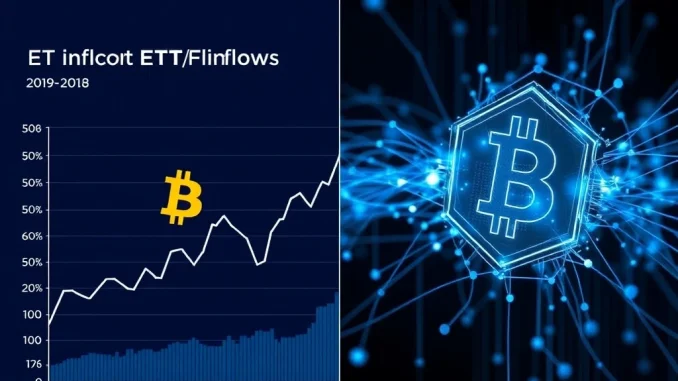
The approval and subsequent trading of spot Bitcoin ETFs in the United States in early 2024 marked a watershed moment for institutional cryptocurrency adoption. These financial instruments provide a regulated, familiar vehicle for traditional investors to gain exposure to Bitcoin’s price movements without the technical complexities of direct custody. Market analysts now closely monitor the daily net flows into these funds as a key indicator of institutional sentiment and capital allocation trends.
Recent weeks have shown a pattern of fluctuating inflows, suggesting a period of consolidation and evaluation by major asset managers. This activity occurs against a macroeconomic backdrop of interest rate deliberations and geopolitical uncertainty, factors that traditionally influence risk asset appetites. The flow data provides a transparent, real-time gauge of confidence in Bitcoin’s long-term store-of-value proposition, distinct from the more utility-driven investment thesis emerging elsewhere in the crypto ecosystem.
The Rise of AI-Integrated Cryptocurrency Projects
Parallel to the institutional movements in Bitcoin ETFs, a significant portion of venture capital and retail investor attention has pivoted toward projects merging blockchain technology with artificial intelligence. This sector aims to solve tangible problems, such as data verification, content authenticity, automated smart contract execution, and decentralized compute resource markets. The fundamental investment thesis here is not merely price appreciation but participation in a protocol’s utility and the value created by its underlying AI services.
Industry observers note that this represents a maturation phase for the cryptocurrency market. Following cycles dominated by decentralized finance (DeFi) and non-fungible tokens (NFTs), AI integration is viewed by many as the next frontier for substantive technological innovation on blockchain networks. Projects are increasingly judged on their technical whitepapers, the credibility of their development teams, and the clarity of their tokenomics, which detail how a token accrues value from network usage.
DeepSnitch AI: A Presale Case Study in Market Demand
The presale performance of DeepSnitch AI offers a concrete example of this investor focus. The project, which proposes AI-driven solutions for on-chain monitoring and smart contract security, reported raising over $1.6 million in its early funding phase. Furthermore, its presale structure involved the locking of more than 36 million tokens, a mechanism designed to align early investor incentives with long-term project development and mitigate immediate sell pressure upon exchange listing.
Presale events like this function as an early market validation test. They gauge whether a project’s proposed value proposition resonates with a knowledgeable investor cohort before it reaches public exchanges. The locked tokens indicate a commitment period, where investors cannot immediately liquidate their positions, which analysts often interpret as a sign of stronger, more patient capital seeking utility-based returns rather than short-term speculation.
Contrasting Investment Theses: Store of Value vs. Technological Utility
The simultaneous activity in Bitcoin ETFs and AI crypto presales underscores two dominant, yet complementary, investment philosophies within the digital asset space:
- Bitcoin (Digital Gold Thesis): Investment is primarily driven by its properties as a decentralized, scarce store of value and hedge against monetary inflation. ETFs facilitate this by offering traditional market exposure.
- AI Crypto (Utility Thesis): Investment is driven by belief in a project’s ability to provide useful services, generate demand for its token through operational use, and capture value within a specific technological niche.
Capital is not necessarily moving from one area to the other; rather, the market is expanding to accommodate both strategies. Institutional portfolios might allocate a core holding to Bitcoin via ETFs while venture arms separately seek high-growth potential in utility-driven AI protocols. This diversification reflects a broader understanding of the blockchain industry’s multifaceted potential.
Regulatory and Market Infrastructure Considerations
The regulatory environment for these two investment avenues differs substantially. Bitcoin ETFs operate within a strict, established securities framework in jurisdictions like the United States. In contrast, many utility token projects and their presales navigate a more complex, evolving regulatory landscape that varies significantly by country. This regulatory asymmetry affects investor access, reporting requirements, and risk profiles.
Market infrastructure has also adapted. While Bitcoin ETFs trade on traditional stock exchanges, AI and other utility tokens typically launch on dedicated cryptocurrency exchanges. The presale model itself is a product of this ecosystem, allowing projects to secure development funding and community support before pursuing a public listing. The success of a presale can significantly influence a project’s trajectory and its reception on secondary markets.
Conclusion
The current cryptocurrency landscape is characterized by a dual-track investment narrative. On one track, institutional capital flows through regulated Bitcoin ETFs, reinforcing the asset’s role as a macroeconomic hedge. On the other, a clear investor push for functional utility is fueling advanced presales for projects like DeepSnitch AI, which seek to leverage artificial intelligence on blockchain networks. This bifurcation signals a market that is maturing, developing deeper sophistication, and expanding its value propositions beyond a single use case. Monitoring both Bitcoin ETF filings and the milestones of utility-focused AI projects provides a comprehensive view of where institutional and entrepreneurial confidence is being placed in the digital asset economy of 2025.
FAQs
Q1: What are Bitcoin ETFs, and why are their capital flows important?
Bitcoin ETFs are exchange-traded funds that hold Bitcoin, allowing investors to buy shares that track its price. Their daily net inflows and outflows are a transparent metric for gauging institutional and large-scale investor sentiment toward Bitcoin as an asset class, separate from retail trading activity on crypto exchanges.
Q2: What does a “token presale” mean in cryptocurrency?
A token presale is an early-stage fundraising event where a blockchain project sells a portion of its native tokens to selected investors before a public launch. Funds raised typically finance development. Terms often include vesting periods or token locks to align early investors with the project’s long-term success.
Q3: How does AI utility create value for a cryptocurrency token?
Value is created through demand for the token’s use within its ecosystem. For an AI project, the token might be required to pay for AI services (like data analysis or smart contract audits), to govern the network, or to reward providers of data or computing power. As usage grows, demand for the token may increase.
Q4: What is the significance of locking tokens during a presale?
Token locking prevents investors from immediately selling their allocated tokens on the open market once trading begins. This mechanism helps stabilize the token’s price post-launch, reduces sell pressure, and demonstrates that early backers are committed to the project’s medium-to-long-term development, not just quick profits.
Q5: Are investments in Bitcoin ETFs and AI crypto projects mutually exclusive?
No, they represent different strategies and risk profiles. Bitcoin ETFs are often viewed as a core, lower-risk (relative to altcoins) allocation based on a store-of-value thesis. Investments in AI crypto projects are typically more speculative, targeting higher growth based on technological adoption and utility. Many portfolios contain both types of assets.