Global Cryptocurrency Markets, April 2025: A sudden and massive Bitcoin dump involving major entities like Wintermute, Binance, and Coinbase sent shockwaves through digital asset markets. Approximately $2.5 billion worth of BTC changed hands in a frantic 30-minute window, abruptly halting a sharp rally and triggering a cascade of liquidations. This event has reignited a critical debate about cryptocurrency market structure, liquidity, and the influence of large-scale traders.
Bitcoin Dump: A Minute-by-Minute Market Earthquake
The event unfolded with textbook volatility. Bitcoin had been enjoying a sustained rally, climbing to a local high that encouraged bullish sentiment across derivatives markets. Then, without a single dominant news catalyst, sell orders began flooding major spot exchanges. Blockchain analytics firms and on-chain data trackers recorded an unprecedented volume of Bitcoin moving from unknown wallets to known exchange deposit addresses, primarily at Binance and Coinbase.
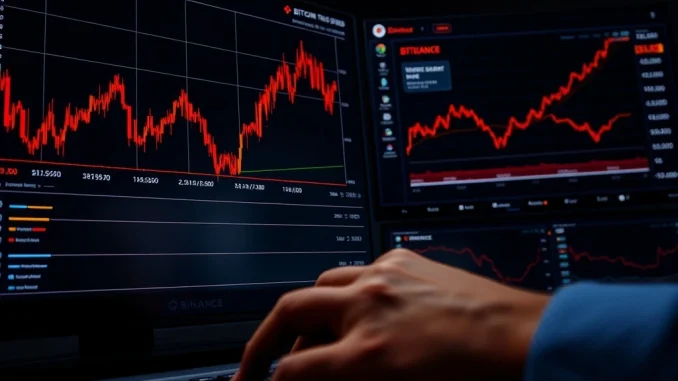
Subsequently, these coins hit the open order books. The sell pressure was immense and concentrated. Market depth on several platforms evaporated as the bids were consumed. The price dropped precipitously, falling thousands of dollars in minutes. This rapid decline triggered automatic liquidation engines on perpetual swap and futures markets, where over-leveraged long positions were forcibly closed. These liquidations, selling Bitcoin to cover margin calls, created a self-reinforcing downward spiral, amplifying the initial sell-off’s impact and contributing significantly to the erased billions in market capitalization.
Key Players: The Role of Wintermute, Binance, and Coinbase
While the sell-off was broad, attention quickly focused on several key players. Wintermute, a leading cryptocurrency market maker known for providing liquidity across dozens of platforms, was identified by analysts as a significant participant in the flow. Market makers often manage large inventories and execute sizable trades to balance their books or hedge risk. Their activity, while a normal function, can move markets during periods of thin liquidity.
The exchanges themselves, Binance and Coinbase, were the primary venues. Their order books absorbed the shock. The event tested their infrastructure and highlighted their role as the central liquidity hubs for the entire ecosystem. The concentration of trading on a few large platforms means that large movements on one can instantly affect the global price. This structure differs fundamentally from traditional finance, where trading is fragmented across many more venues and asset classes.
- Wintermute’s Function: As a market maker, its trades are typically for liquidity provision and risk management, not directional speculation.
- Exchange Impact: Binance and Coinbase’s deep liquidity was crucial but also concentrated the market impact.
- Data Transparency: On-chain tracking allowed near-real-time attribution of wallet movements to these entities.
Anatomy of the Cryptocurrency Liquidation Cascade
The $2.5 billion Bitcoin dump was not merely a large sale. Its true market impact was magnified by the highly leveraged nature of cryptocurrency trading. When the price began to fall, it crossed critical thresholds for thousands of leveraged long positions. These are bets that the price will go up, often funded with borrowed funds.
As the price dropped, traders faced margin calls—demands to add more collateral to maintain their positions. Many could not or did not do so quickly enough. Consequently, exchange algorithms automatically sold the underlying Bitcoin from these positions to repay the lenders. This created a wave of involuntary selling precisely when the market was already under pressure. Data from derivatives tracking sites showed total liquidations exceeding $1 billion within the hour, with long positions accounting for the overwhelming majority. This mechanism is a defining feature of crypto volatility and was a core component of the market structure debate sparked by the event.
Historical Context and Market Maturity
Similar events have punctuated Bitcoin’s history, from the 2017 bull run corrections to the March 2020 COVID-induced crash. Each episode prompts a reevaluation of market resilience. Compared to 2017, today’s market features more institutional participants, regulated products like Bitcoin ETFs, and more sophisticated risk management tools. However, the 2025 event demonstrates that underlying vulnerabilities remain. The 24/7, globally interconnected, and highly leveraged nature of crypto markets can still facilitate rapid, high-amplitude price discoveries that would be extraordinary in more established asset classes.
The debate now centers on whether this is an inherent, unchangeable feature of a nascent asset class or a structural flaw that improved regulation, product design, and institutional practices can mitigate. Proponents of the former view see it as the cost of admission for an uncorrelated, high-growth asset. Advocates for the latter argue that such volatility hinders mainstream adoption as a store of value or medium of exchange.
Implications for Traders and the Broader Ecosystem
The immediate consequence for traders was a brutal reminder of risk management. The event underscored the dangers of high leverage in a volatile asset. For long-term holders, the episode was a short-term paper loss, but the rapid recovery often seen after such events did not materialize immediately, suggesting a potential shift in market psychology.
For the ecosystem, the implications are broader. Regulators examining the cryptocurrency space will likely point to such volatility as evidence of market fragility. It may accelerate calls for clearer rules on leverage limits, exchange transparency, and the oversight of large market participants like principal trading firms. Furthermore, it highlights the critical need for robust, decentralized finance (DeFi) lending protocols to manage their own liquidation risks effectively to avoid systemic issues.
Conclusion
The $2.5 billion Bitcoin dump involving Wintermute, Binance, and Coinbase was a multifaceted market event. It was part large-scale portfolio rebalancing, part stress test for exchange liquidity, and part demonstration of the destructive power of leveraged liquidation cascades. This Bitcoin dump has forcefully reopened the debate on whether the current cryptocurrency market structure is fit for the growing institutional interest it seeks. While the market absorbed the shock without a technical failure, the event serves as a stark data point on the road to maturity, emphasizing that in crypto, extreme volatility remains a persistent, defining characteristic.
FAQs
Q1: What exactly caused the $2.5 billion Bitcoin sell-off?
There was no single public news event cited as the cause. Analysts attribute it to a combination of large sell orders from institutional-scale entities (like market makers adjusting inventory), which triggered a sharp price drop. This drop then activated automatic liquidations of over-leveraged long positions on derivatives platforms, amplifying the sell pressure.
Q2: Why are Wintermute, Binance, and Coinbase specifically mentioned?
Wintermute was identified by on-chain analysts as a significant source of the initial sell flow. Binance and Coinbase were the primary cryptocurrency exchanges where the Bitcoin was sold, making them the central venues where the price action and liquidations occurred.
Q3: How does a liquidation cascade work?
When traders use high leverage (borrowed funds) to open long positions, they must maintain a minimum collateral level. If the price falls enough, they get a margin call. If they don’t add funds, the exchange automatically sells their position to repay the loan. This forced selling pushes the price down further, triggering more liquidations in a vicious cycle.
Q4: Is this kind of volatility normal for Bitcoin?
While the scale was significant, sharp volatility has been a historical feature of Bitcoin and the broader cryptocurrency market. However, as the market matures and gains more institutional participation, the frequency and severity of such events are a key metric for observers.
Q5: What does this mean for the average cryptocurrency investor?
For the average investor, it reinforces fundamental principles: understand the extreme volatility of the asset class, avoid using high leverage unless you fully comprehend the risks, and consider a long-term, dollar-cost-averaging strategy to mitigate the timing risk of such short-term price shocks.
Updated insights and analysis added for better clarity.
This article was produced with AI assistance and reviewed by our editorial team for accuracy and quality.