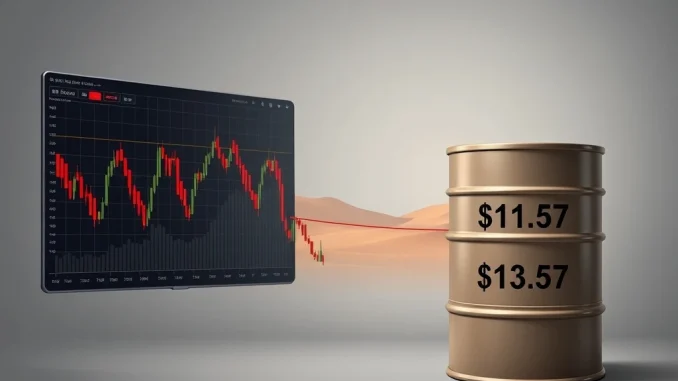
NEW YORK, April 14, 2026 — Global financial markets experienced a sharp, correlated shock Sunday night as Bitcoin (BTC) fell nearly 2% in minutes while oil prices surged almost 20%. The simultaneous moves, triggered by the opening of U.S. futures markets, stem directly from escalating geopolitical tensions in the Middle East. Specifically, fears of a major energy supply disruption followed Iraqi warnings that Iranian threats could halt 3 million barrels per day of oil traffic through the critical Strait of Hormuz. Consequently, Bitcoin’s price dropped from $66,960 to $65,725 before partially recovering to $66,272, while Brent crude oil futures briefly touched $113.7 per barrel—a high not seen since April 2022.
Bitcoin and Oil: A Sudden Geopolitical Correlation
Data from the decentralized derivatives platform Hyperliquid captures the precise moment of market panic. At approximately 10:15 PM UTC Sunday, as U.S. futures trading commenced, oil prices rocketed from $95 to over $113 per barrel. Simultaneously, Bitcoin’s value plummeted. This inverse correlation—where Bitcoin fell as a traditional inflation hedge like oil rose—challenges recent narratives of crypto as a digital safe haven. “We’re observing a classic ‘risk-off’ flight to tangible assets,” noted Maya Chen, a senior market strategist at FinTech Analytics Group. “In moments of genuine physical commodity shortage fears, especially in energy, capital can flow out of digital assets perceived as more speculative.” The event provides a stark, real-time case study in how cryptocurrency markets now react instantaneously to traditional macroeconomic and geopolitical triggers.
This price action marks a reversal from earlier in the week. Initially, Bitcoin climbed from below $64,000 to over $73,700 following the initial U.S.-Israeli strikes. However, the rally faded as the conflict’s potential to strangle global energy supplies became the dominant market narrative. Since Wednesday, Bitcoin has now declined for four consecutive days, shedding over 10% of its value from the weekly peak. This timeline underscores how quickly cryptocurrency sentiment can pivot from viewing geopolitical strife as a catalyst for adoption to seeing it as a source of macroeconomic instability.
Impact on Global Energy and Crypto Markets
The immediate impact centers on volatility and recalibrated risk assessments. The oil price spike represents the most significant weekly gain—over 30%—since the early weeks of the Russia-Ukraine war. For cryptocurrency markets, the drop exacerbates existing pressures, including outflows from exchange-traded funds and miner selling. The event’s consequences ripple across several key areas.
- Investor Portfolio Rebalancing: Institutional investors with allocations to both commodities and digital assets may be forced to rebalance, potentially leading to sustained selling pressure on Bitcoin to cover margins in other parts of their portfolio.
- Mining Economics: A sustained rise in global energy prices directly increases the operational cost for Bitcoin miners, potentially squeezing profit margins and increasing sell-side pressure from miners needing to cover fiat-denominated expenses.
- Regulatory Scrutiny: Such volatile, geopolitically-driven price action may bolster arguments from regulators advocating for stricter oversight of cryptocurrency markets due to their perceived instability and correlation with systemic risks.
Expert Analysis and Institutional Response
Market analysts are divided on the longevity of this correlation. Dr. Arjun Patel, lead economist at the Global Digital Asset Council, provided context: “This is a liquidity event. In thin Sunday evening trading, any major shock in the oil futures market can create disproportionate waves in all correlated and anti-correlated assets, including crypto. The key test will be sustained correlation throughout Monday’s full trading session.” Patel referenced a 2025 MIT study on cross-asset volatility transmission, which found that energy price shocks now propagate into digital asset markets within 15 minutes, a speed that has halved since 2022.
Meanwhile, former U.S. President Donald Trump addressed the oil price surge directly. “We figured oil prices would go up, which they will. They’ll also come down. They’ll come down very fast,” Trump told reporters on Saturday. He dismissed the need to tap the U.S. Strategic Petroleum Reserve, stating, “We’ve got a lot of oil. Our country has a tremendous amount. There’s a lot of oil out there. That’ll get healed very quickly.” This perspective suggests some policymakers view the spike as temporary, which could limit long-term inflationary expectations that often hurt risk assets like Bitcoin.
Historical Context and Market Comparison
To understand the significance of Sunday’s move, it’s instructive to compare it to previous geopolitical events that linked energy and cryptocurrency markets. The table below highlights key differences in market structure and reaction.
| Event & Date | Oil Price Change | Bitcoin Price Reaction | Primary Market Narrative |
|---|---|---|---|
| Russia Invades Ukraine (Feb 2022) | +40% (over 2 weeks) | Initial drop, then rise as inflation hedge | Global sanctions, commodity shortages |
| Iranian General Strike (Jan 2020) | +10% (intraday) | +5% (safe-haven flow) | Limited regional conflict, no supply disruption |
| Strait of Hormuz Tensions (April 2026 – This Event) | +20% (intraday) | -2% (intraday) | Direct threat to 20% of global oil supply |
The critical distinction in the current event is the direct threat to a specific, irreplaceable maritime chokepoint. The Strait of Hormuz handles about 20% of global oil consumption. Previous events either lacked this precise supply-chain target or occurred when Bitcoin’s market maturity and institutional ownership were significantly lower. Consequently, the 2026 reaction reflects a more integrated, yet complex, relationship between digital and traditional asset classes.
What Happens Next: Market Trajectories and Triggers
Forward-looking analysis hinges on two evolving situations: the geopolitical conflict and market technicals. First, any military action that physically obstructs the Strait of Hormuz would likely cause oil prices to sustain highs and could trigger a broader market sell-off, further pressuring Bitcoin. Conversely, a rapid de-escalation would see oil prices retrace, potentially freeing capital to flow back into risk assets. Second, Bitcoin’s price is testing a critical technical support level around $65,000. A sustained break below this level on high volume could trigger automated selling and lead to a test of the $60,000 support zone.
Industry and Trader Reactions
Within the cryptocurrency community, reactions were swift. Decentralized finance (DeFi) platforms saw a spike in volatility-based liquidations in leveraged positions. Meanwhile, reports from blockchain analytics firm Chainalysis indicated a 700% spike in crypto outflows from Iranian addresses following the initial airstrikes, highlighting digital assets’ role in cross-border value transfer during sanctions and conflict. This on-chain data provides a ground-level view of how individuals, not just institutions, are utilizing crypto in response to the same geopolitical pressures moving macro markets.
Conclusion
Sunday’s event demonstrates that Bitcoin and major cryptocurrency markets are no longer isolated from traditional finance. They react with hypersensitivity to geopolitical shocks that threaten global economic stability, particularly those involving energy. The immediate 2% Bitcoin drop alongside a 20% oil price surge serves as a powerful reminder that in times of acute physical commodity fear, digital assets can behave as risk assets, not hedges. Investors should monitor the situation in the Strait of Hormuz closely, as further supply disruption will keep energy volatility high and likely maintain downward pressure on crypto markets. The coming days will test whether this correlation holds or if Bitcoin decouples to resume its own market-driven trajectory.
Frequently Asked Questions
Q1: Why did Bitcoin drop when oil prices surged?
The drop suggests markets treated Bitcoin as a risk asset in this specific event. Fears of an oil supply shock can cause inflation fears and economic slowdown concerns, prompting investors to sell speculative assets and seek shelter in tangible commodities or cash in the short term.
Q2: How significant is the threat to oil in the Strait of Hormuz?
It is a critical threat. The Strait is a maritime chokepoint for roughly 20% of global oil consumption. Iraq’s warning of a potential 3-million-barrel-per-day disruption represents about 3% of global daily supply, enough to cause major price spikes.
Q3: Is this correlation between Bitcoin and oil prices likely to continue?
It depends on the conflict’s duration. If the threat to oil supplies persists, the correlation may hold. In a rapid de-escalation, oil prices would fall and Bitcoin might recover independently, breaking the short-term link.
Q4: What does this mean for the average cryptocurrency investor?
It highlights the importance of geopolitical awareness in crypto investing. Events far removed from blockchain technology can significantly impact prices. Diversification and risk management are crucial.
Q5: How does this compare to Bitcoin’s reaction during the Russia-Ukraine war?
Initially different. In 2022, Bitcoin fell then rose as an inflation hedge. Today, the direct threat to a specific oil chokepoint created an immediate negative correlation, showing evolved, if more complex, market integration.
Q6: Should Bitcoin miners be concerned about rising oil prices?
Yes, indirectly. While many miners use stranded or renewable energy, a broad rise in global energy prices increases economic pressure across the sector and can make mining less profitable overall, potentially leading to increased selling of mined coins.