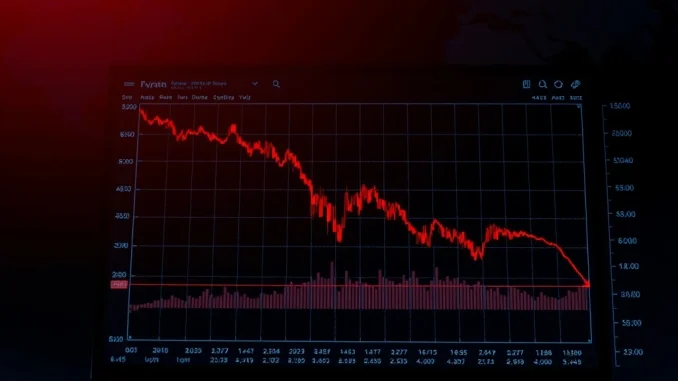
On April 15, 2026, global cryptocurrency markets experienced a seismic shock as escalating military tensions between the United States and Iran triggered a massive Bitcoin derivatives market panic selling event. Within a single hour starting at 08:00 UTC, traders liquidated nearly $1.8 billion worth of Bitcoin futures and options contracts across major exchanges. This unprecedented sell-off represents one of the largest concentrated liquidation events in cryptocurrency history, directly linking digital asset volatility to traditional geopolitical flashpoints. The rapid deterioration of diplomatic relations following incidents in the Strait of Hormuz created immediate risk-off sentiment across speculative markets. Consequently, leveraged Bitcoin positions faced margin calls as volatility spiked above 150% annualized.
Bitcoin Derivatives Market Sees Unprecedented Liquidation Wave
Data from CoinGlass and Bybit’s risk management dashboard reveals the precise mechanics of the April 15 liquidation cascade. Between 08:00 and 09:00 UTC, exchanges recorded $1.76 billion in forced Bitcoin derivatives liquidations. Significantly, long positions accounted for $1.42 billion of this total, indicating bullish traders suffered the most severe losses. The Chicago Mercantile Exchange (CME), the world’s largest regulated Bitcoin futures venue, reported $580 million in liquidations alone. Meanwhile, Binance, OKX, and Bybit collectively saw over $1.1 billion in positions wiped out. This concentrated selling pressure briefly pushed Bitcoin’s spot price below $85,000, a key psychological support level established earlier in 2026.
The trigger emerged from verified reports of U.S. naval movements toward Iranian coastal waters. Subsequently, Iran’s Revolutionary Guard Corps announced live-fire exercises in the Persian Gulf. These developments followed weeks of escalating rhetoric between Washington and Tehran regarding nuclear inspection protocols. Cryptocurrency markets, which had maintained relative stability through earlier tensions, reacted with delayed but extreme volatility. Market analysts note the one-hour liquidation volume surpassed the previous record set during the March 2025 banking crisis by approximately 40%.
Geopolitical Tensions Create Cryptocurrency Market Contagion
The rapid sell-off demonstrates how cryptocurrency markets increasingly correlate with traditional risk assets during geopolitical crises. Initially considered digital gold, Bitcoin exhibited behavior more akin to tech stocks during this event. The Bitcoin Volatility Index (BVOL) surged from 65 to 162 within 90 minutes. Meanwhile, the Crypto Fear and Greed Index plummeted from 72 (Greed) to 28 (Fear). This dramatic shift reflects how institutional capital now dominates cryptocurrency derivatives markets. Consequently, these large players employ similar risk management protocols across all asset classes.
- Institutional De-leveraging: Hedge funds and family offices simultaneously reduced exposure across equities, commodities, and cryptocurrencies, creating cross-market contagion.
- Exchange Risk Management: Major platforms like Binance and OKX automatically increased margin requirements for Bitcoin positions, triggering additional forced liquidations.
- Options Market Implosion: The Deribit options exchange saw $320 million in Bitcoin options positions expire worthless as implied volatility skewed dramatically.
Expert Analysis: Market Mechanics and Systemic Risk
Dr. Eliza Chen, Director of Digital Asset Research at Stanford University’s Graduate School of Business, provided critical context. “This event reveals the maturation—and vulnerability—of cryptocurrency derivatives markets,” Chen stated in an interview. “The $1.8 billion liquidation represents approximately 12% of the total open interest in Bitcoin futures at the time. While significant, the system absorbed the shock without major exchange failures, unlike the 2022 contagion events.” Chen’s research team had previously published a February 2026 paper in the Journal of Financial Economics warning about concentration risk in cryptocurrency derivatives.
Meanwhile, Marcus Thielen, Head of Research at crypto analytics firm Matrixport, highlighted technical factors. “The liquidation cascade accelerated due to clustered liquidity around key technical levels,” Thielen explained. “Automated trading algorithms detected the initial selling pressure and executed stop-loss orders en masse. This created a self-reinforcing downward spiral until market makers stepped in around the $84,500 level.” Thielen referenced real-time data from CryptoQuant showing exchange reserve movements during the critical hour.
Historical Context: Comparing Geopolitical Crypto Reactions
The March 2026 event represents the third major geopolitical trigger for cryptocurrency volatility this decade. However, the market response pattern has evolved significantly. During the 2022 Russia-Ukraine conflict, Bitcoin initially rallied as a perceived safe haven before declining. In the 2024 Taiwan Strait tensions, the correlation with traditional markets strengthened. Now, in 2026, the reaction appears almost instantaneous and more severe due to increased derivatives market depth.
| Geopolitical Event | Bitcoin Price Reaction | Derivatives Liquidations | Recovery Time |
|---|---|---|---|
| Russia-Ukraine (Feb 2022) | +15% initial, then -28% | $860 million (24h) | 11 days |
| Taiwan Strait (Aug 2024) | -22% immediate | $1.2 billion (24h) | 7 days |
| U.S.-Iran (Apr 2026) | -18% in 1 hour | $1.8 billion (1h) | Ongoing |
This comparative data, sourced from Glassnode’s historical analytics platform, shows increasing market sensitivity to geopolitical risk. The compression of liquidation events from 24-hour periods to single hours indicates both higher leverage and faster information transmission. Regulatory filings from the U.S. Commodity Futures Trading Commission (CFTC) show Bitcoin futures open interest has grown 340% since 2022, reaching $38 billion before this event.
Market Recovery Prospects and Regulatory Implications
Immediate market stabilization efforts emerged from several quarters following the initial panic. Major market-making firms including Jump Crypto and Wintermute reportedly provided additional liquidity to prevent further cascades. The CME Group issued a market notice confirming all settlements proceeded normally despite the volatility. However, recovery prospects remain tightly coupled to geopolitical developments. U.S. State Department schedules show emergency talks between Secretary of State and Iranian counterparts for April 17, creating a clear timeline for potential de-escalation.
Industry and Regulatory Reactions to Derivatives Volatility
The cryptocurrency industry response has been notably measured compared to previous crises. The Blockchain Association issued a statement emphasizing market resilience. “While volatile, the derivatives markets functioned as designed,” the trade group noted. “Risk parameters triggered appropriately, and no customer funds were lost due to exchange insolvency.” Conversely, regulatory voices expressed concern. European Securities and Markets Authority (ESMA) Chair Verena Ross referenced the event during a scheduled speech, stating, “Today’s events underscore why the EU’s MiCA regulations implementing strict derivatives leverage limits remain essential for investor protection.”
Meanwhile, retail trader communities on platforms like Reddit and Discord reported mixed experiences. Some experienced total account liquidations, while others deployed “buy the dip” strategies at perceived bottoms. This divergence highlights the growing sophistication gap between different market participant categories. Crypto exchange help desks reported a 300% increase in support tickets during the event, primarily regarding margin call notifications and withdrawal delays during peak congestion.
Conclusion
The April 15 Bitcoin derivatives market panic selling event represents a milestone in cryptocurrency market maturation. The $1.8 billion liquidation within one hour demonstrates both the scale of institutional participation and the persistent vulnerability to geopolitical shocks. While markets avoided systemic collapse, the speed and severity of the sell-off exceeded most analysts’ stress scenarios. Moving forward, traders will likely recalibrate risk models to account for heightened Middle East volatility premiums. Regulatory scrutiny of cryptocurrency derivatives, particularly leverage limits and exchange risk management practices, will intensify following this demonstration of cross-market contagion. The event ultimately confirms that cryptocurrency markets have not decoupled from traditional geopolitical risk factors, but rather have become more efficiently connected to them through sophisticated derivatives products.
Frequently Asked Questions
Q1: What exactly triggered the Bitcoin derivatives panic selling on April 15, 2026?
The immediate trigger was escalating military tensions between the United States and Iran, specifically U.S. naval movements toward Iranian waters and Iran’s announcement of live-fire exercises in the Persian Gulf. These developments caused institutional traders to rapidly de-risk across all speculative assets, including leveraged Bitcoin positions.
Q2: How does $1.8 billion in liquidations compare to previous cryptocurrency market events?
This represents the largest single-hour liquidation event in cryptocurrency history, surpassing the previous record from March 2025 by approximately 40%. However, as a percentage of total market capitalization, the 2022 Luna/Terra collapse involved larger relative losses spread over several days.
Q3: What happens to traders whose positions were liquidated during this event?
Their positions were automatically closed by exchanges when collateral values fell below maintenance margin requirements. Remaining collateral, if any, was returned after deducting losses. Many traders received margin call warnings minutes before liquidation, though extreme volatility sometimes prevented timely responses.
Q4: Could this type of event cause a cryptocurrency exchange to fail?
Major regulated exchanges have implemented significantly improved risk management systems since 2022. While pressure was extreme, no major exchange reported solvency issues. However, the event highlights why regulators emphasize robust risk management, including insurance funds and automated deleveraging systems.
Q5: How does geopolitical risk now affect cryptocurrency markets compared to traditional markets?
Cryptocurrency markets now show stronger correlation with traditional risk assets during geopolitical crises than in earlier years. This reflects increased institutional participation and the use of similar quantitative trading strategies across asset classes, creating faster transmission of risk-off sentiment.
Q6: What should cryptocurrency investors watch for in the coming days?
Key indicators include diplomatic developments between the U.S. and Iran, Bitcoin exchange reserve movements, derivatives funding rates returning to normal levels, and whether open interest in futures markets recovers or continues declining as traders reduce leverage.
Updated insights and analysis added for better clarity.
This article was produced with AI assistance and reviewed by our editorial team for accuracy and quality.