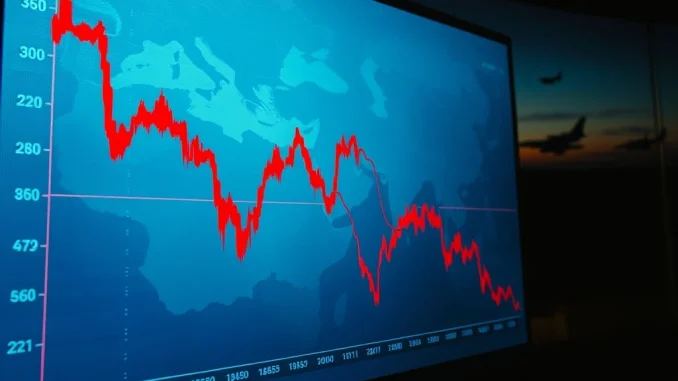
NEW YORK, April 14, 2026 — The Bitcoin price violently tumbled below the critical $64,000 support level early Monday, shedding over 5% in minutes following confirmed military strikes by the United States and Israel on Iranian targets and a subsequent announcement by President Donald Trump of major U.S. combat operations. The swift cryptocurrency market crash erased an estimated $90 billion in total market capitalization within the first hour of Asian trading, according to real-time data from CoinGecko, as traders globally scrambled to de-risk portfolios amid soaring geopolitical uncertainty. This rapid sell-off marks one of the most acute episodes of crypto market contagion from a traditional geopolitical shock in recent years.
Bitcoin Price Plunge Follows Escalation in Middle East
The cascade began at approximately 03:00 UTC, when Israeli Defense Forces confirmed targeted strikes on Isfahan, Iran. Concurrently, U.S. Central Command acknowledged a supporting role in the operation. Within fifteen minutes, President Trump addressed the nation from the White House, declaring the initiation of “sustained and decisive” U.S. combat operations in the region to counter what he termed “an imminent threat.” The geopolitical risk shockwave hit digital asset markets almost instantly. Bitcoin, which had been trading sideways near $66,500, broke through multiple technical support levels, plummeting to a low of $62,850 on major spot exchanges like Coinbase and Binance before finding a fragile bid.
Market analysts immediately pointed to the event as a classic “flight to safety” trigger. “The correlation between Bitcoin and traditional risk assets like tech stocks spiked dramatically,” noted Marcus Thielen, Head of Research at CryptoQuant, in a statement to Reuters. “We saw a simultaneous sell-off in Nasdaq futures and a rally in the U.S. Dollar Index and Treasury bonds. Crypto, still perceived as a high-beta risk asset, was first overboard.” The sell-off was exacerbated by a wave of liquidations in the derivatives market. Data from Coinglass indicates over $450 million in long Bitcoin futures positions were liquidated in the 60 minutes following the news, creating a vicious cycle of forced selling.
Immediate Impacts on the Broader Cryptocurrency Ecosystem
The panic was not contained to Bitcoin. The entire digital asset complex experienced a sharp correction, demonstrating high cross-asset correlation during crisis events. Ethereum (ETH) fell over 7% to breach $3,100. Solana (SOL) and Avalanche (AVAX), often more volatile, saw declines exceeding 10%. Meanwhile, the market’s traditional safe-haven token, Tether (USDT), traded at a slight premium to its $1 peg on several exchanges, indicating high demand for stablecoins as a parking mechanism.
- Exchange Volumes Spike: Trading volumes across major spot and derivatives platforms surged by 300-400% above the 24-hour average, according to initial data from Kaiko.
- Network Congestion: The Bitcoin blockchain saw a spike in pending transactions as users rushed to move funds, with average transaction fees rising from $2.15 to over $12 within an hour.
- Miners Under Pressure: The rapid price drop pressures Bitcoin miners, whose revenue is directly tied to the BTC price. Public mining stocks like Marathon Digital (MARA) and Riot Platforms (RIOT) were indicated down over 15% in pre-market trading.
Expert Analysis on Market Mechanics and Sentiment
Dr. Lena Karpova, a former IMF economist and current director of the Digital Finance Initiative at Stanford University, provided context on the market’s structure. “This event is a stress test for crypto’s narrative as ‘digital gold’ or an inflation hedge,” Karpova explained. “Historically, gold often rallies on geopolitical tension. Today, Bitcoin sold off. This suggests that in its current stage of adoption, the dominant market driver is its correlation with tech and liquidity conditions, not a decoupled safe-haven status. The market is dominated by leveraged speculative capital, which flees at the first sign of macro uncertainty.” Her research, cited in a recent Brookings Institution report, highlights that crypto volatility during geopolitical events remains 2-3 times higher than that of traditional haven assets.
Historical Context: How This Geopolitical Shock Compares
While dramatic, this is not the first time cryptocurrency markets have reacted violently to world events. The market response pattern bears similarities to the initial sell-off following Russia’s invasion of Ukraine in February 2022, though the magnitude and speed of today’s drop are more pronounced. Analysts attribute this to the market’s larger size and deeper integration with traditional finance, allowing news to propagate and trigger automated trading strategies faster than ever before.
| Geopolitical Event | Date | Bitcoin 1-Hour Change | Key Driver |
|---|---|---|---|
| Russia Invades Ukraine | Feb 24, 2022 | -8.5% | Risk-Off, Sanctions Fear |
| U.S. Debt Ceiling Crisis (Peak) | May 24, 2023 | -4.2% | Liquidity & Default Fear |
| Israel-Hamas War Outbreak | Oct 7, 2023 | -3.8% | Regional Risk Premium |
| U.S.-Israel Strikes Iran / Trump Ops | Apr 14, 2026 | -5.7% (and ongoing) | Direct Major Power Conflict |
The critical difference, as noted by analysts at Glassnode, is the direct involvement of the United States in announced combat operations. “Previous events were regional or financial in nature,” their morning flash report stated. “This involves a clear, immediate escalation between nuclear-capable states, raising the global systemic risk premium to a level not seen in decades. All risk assets are repricing accordingly.”
What Happens Next: Market Scenarios and Watch Points
The immediate trajectory for crypto markets hinges on two parallel developments: the military/political situation in the Middle East and the reaction of global central banks. The Federal Reserve’s scheduled meeting this week has suddenly taken on new significance. Markets are now pricing in a higher probability of a delayed interest rate cut due to potential oil price shocks and renewed inflation pressures, a scenario that would maintain tight financial conditions unfavorable for speculative assets.
Trader and Institutional Reactions in Real-Time
On social trading platforms and institutional chat rooms, sentiment turned sharply bearish but mixed. Some large holders, colloquially known as “whales,” were observed accumulating Bitcoin at the $63,000 level, according to on-chain analytics firm Lookonchain. Conversely, several macro-focused hedge funds issued directives to reduce crypto exposure to zero until volatility subsides. “Our risk models are flashing red across all correlated assets,” commented the CIO of a multi-strategy fund, speaking on condition of anonymity. “We’re in a pure capital preservation mode. Crypto is the most liquid risk to cut.” Retail investors, meanwhile, flooded support channels of major exchanges like Kraken and Gemini, with many reporting delays in order execution during the peak volatility.
Conclusion
The Bitcoin price drop below $64,000 serves as a stark reminder of cryptocurrency markets’ acute sensitivity to traditional geopolitical shocks. While the long-term thesis for digital assets remains tied to adoption and technological utility, short-term price action is still dictated by global macro liquidity and risk sentiment. The events of April 14, 2026, demonstrate that despite a decade of growth, crypto has not yet decoupled from broader financial market panic. Investors should monitor several key factors in the coming days: further official statements from Washington and Tehran, oil price movements, the Federal Reserve’s communicated stance, and whether Bitcoin can reclaim and hold the $64,000-$65,000 zone as a sign of market stabilization. The next 48 hours will be critical in determining whether this is a short-term panic or the beginning of a more sustained risk-off period for digital assets.
Frequently Asked Questions
Q1: Why did Bitcoin crash after the U.S.-Israel strikes on Iran?
Bitcoin crashed due to a classic “risk-off” market event. The escalation signaled heightened global geopolitical risk, prompting investors to sell volatile assets (like cryptocurrencies and tech stocks) and seek safety in traditional havens like the U.S. dollar and government bonds. Leveraged long positions in crypto were rapidly liquidated, accelerating the decline.
Q2: How much value was wiped from the total crypto market?
Approximately $90 billion in total cryptocurrency market capitalization was erased within the first hour of the sell-off, according to aggregate data from tracking site CoinGecko. This represents a drop of roughly 5% for the total market.
Q3: Is this a buying opportunity or should investors wait?
This depends on risk tolerance and outlook. Historically, sharp geopolitical sell-offs have been followed by strong rebounds once immediate panic subsides. However, if the conflict escalates further, causing sustained oil price spikes and central bank hawkishness, downward pressure could continue. Most analysts advise caution until volatility decreases and a clear support level is established.
Q4: Did other cryptocurrencies like Ethereum fall as much as Bitcoin?
Yes, and often more. Ethereum fell over 7%, while other major altcoins like Solana and Avalanche saw declines exceeding 10%. During broad market stress, higher-beta assets (altcoins) typically fall more than Bitcoin, which acts as a relative benchmark.
Q5: How does this compare to Bitcoin’s reaction to the 2022 Ukraine war?
The initial reaction is similar but faster and slightly more severe. In 2022, Bitcoin fell about 8.5% in the hours after the invasion. Today’s drop of over 5% in minutes was sharper, likely due to increased market size, more algorithmic trading, and the direct involvement of the United States in announced combat operations.
Q6: What should crypto traders watch for in the next 24 hours?
Traders should monitor: 1) Any new military or diplomatic developments from the U.S., Israel, or Iran, 2) The price of oil (Brent Crude), as a spike could worsen inflation fears, 3) Statements from the Federal Reserve regarding its policy path, and 4) Whether Bitcoin can hold above $62,000, the next major technical support level.
Updated insights and analysis added for better clarity.
This article was produced with AI assistance and reviewed by our editorial team for accuracy and quality.