
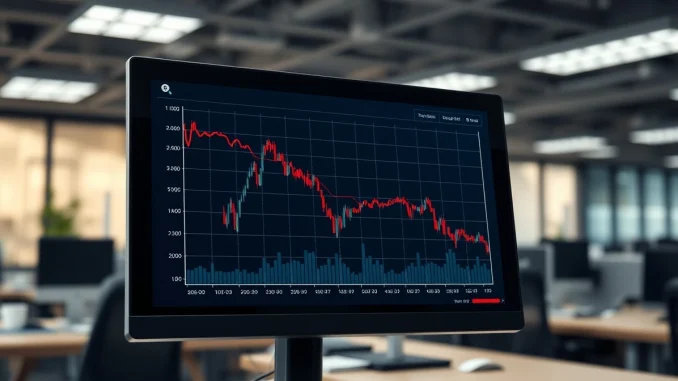
Six months have passed since the cryptocurrency market convulsed. On October 10, 2025, a flash crash wiped out $19 billion in leveraged positions and sent some altcoins tumbling over 80%. Today, in April 2026, the question remains: has the market healed, or are underlying weaknesses still in control? Data reveals a sobering reality. Bitcoin’s market liquidity has been cut in half, pointing to a system that is less resilient than it was before the crash.
Bitcoin Orderbook Depth: A 50% Collapse in Liquidity
The most telling metric is orderbook depth. This measures the volume of buy and sell orders within a narrow price band, indicating how much capital is ready to trade without moving the price significantly. In September 2025, Bitcoin’s aggregate orderbook depth for the +/-1% range typically sat between $180 million and $260 million. According to data from CoinAnk, that depth now seldom exceeds $130 million. This represents a drop of roughly 50% in available spot market liquidity in just seven months.
Also read: Polymarket's Google News Appearance Sparks Debate Over Prediction Market Legitimacy
Market analysts note this isn’t solely a hangover from October. The flash crash itself was a liquidity event. A combination of reported technical issues at Binance and auto-deleveraging on decentralized exchanges created a temporary vacuum. Orderbook depth stabilized near $150 million by mid-November 2025. The real deterioration came later. In February 2026, depth plunged below $60 million for nearly ten days as Bitcoin’s price tested the $65,000 support level. This suggests the current market fragility stems more from 2026 trends than the 2025 crash itself.
Derivatives and ETF Volumes Tell a Mixed Story
Trading activity across the board has cooled. Data from TokenInsight shows cryptocurrency derivatives volumes have oscillated between $40 billion and $130 billion over the past month. These figures fall short of the $200 billion marks common in September 2025. However, the reduced volume isn’t inherently bearish. The balance between long and short positions in perpetual futures markets has remained relatively even. The funding rate, which indicates whether bulls or bears are paying to hold their positions, has been stable. This points to a cautious, wait-and-see sentiment rather than rampant pessimism.
Also read: Ether Machine SPAC Merger Collapses: $1.5 Billion Ethereum Fund Plan Scrapped Amid Market Turmoil
The story for institutional products is nuanced. US-listed spot Bitcoin ETFs saw no immediate negative impact from the October crash. In fact, by late November 2025, their daily trading volume surged to a 20-month high of $11.5 billion. This surge didn’t last. Data from Coinglass indicates that by the first week of April 2026, daily volumes had fallen below $3.3 billion, down from averages above $4 billion in early 2026. Similarly, US-listed Ether ETF volumes have halved, dropping to around $1 billion daily from $2 billion in September 2025.
The Institutional Perspective Shift
What does this mean for investors? The sharp decline in ETF volumes after a post-crash spike is significant. It implies that while institutional pathways held firm during the volatility, sustained interest has waned. Some traders interpreted the initial crash as a potential market maker failure. The subsequent data indicates a broader withdrawal of liquidity. Market makers, essential for smooth trading, may be operating with more caution or reduced capital. This creates a thinner market where large orders can cause more pronounced price swings.
Connecting the Dots: A Less Healthy Market Structure
When you combine the metrics—orderbook depth, derivatives volume, and ETF activity—a clear picture forms. The cryptocurrency market in April 2026 is structurally less reliable than it was in September 2025. Liquidity is thinner. Trading activity is lower. The implication is higher volatility risk. A market with shallow order books can experience sharper price drops if a major sell order hits. This is a key concern for both retail and institutional participants.
Yet, there’s a vital nuance. The market structure did not break in October 2025. It weathered the initial storm and remained functional through February 2026. The recent decline appears to be a separate, gradual trend of capital exiting or becoming inactive. This could signal a consolidation phase. Investors are likely seeking clearer regulatory signals or stronger macroeconomic catalysts before committing fresh capital.
Conclusion
The October 2025 Bitcoin crash was a dramatic event, but its long-term impact on market health may have been overstated. The more pressing issue is the steady erosion of liquidity throughout early 2026. With Bitcoin orderbook depth down 50% and ETF volumes retreating, the market is operating in a more fragile state. Bears may not be fully in charge, but the environment is undoubtedly more challenging. Recovery will likely depend on a return of consistent trading volume and depth, not just price appreciation. For now, the data shows a market that is thinner, quieter, and more vulnerable than it was before the crash.
FAQs
Q1: What exactly happened in the October 2025 crypto crash?
The crash on October 10, 2025, was a flash crash where Bitcoin and altcoin prices plummeted rapidly. It triggered a record $19 billion in liquidations of leveraged trades. The event was linked to a mix of technical issues at a major exchange and forced selling on decentralized platforms.
Q2: Why is orderbook depth important?
Orderbook depth measures market liquidity. It shows how much buying and selling interest exists near the current price. High depth means large trades can happen without drastically moving the price. Low depth, like the 50% drop seen since September 2025, means the market is thinner and more prone to volatility.
Q3: Did the crash destroy the Bitcoin ETF market?
No. Surprisingly, US spot Bitcoin ETF volumes initially surged after the crash, hitting a 20-month high in November 2025. However, volumes have since declined significantly by April 2026, suggesting a drop-off in sustained institutional trading activity.
Q4: Are derivatives markets signaling a bearish turn?
Not directly. While derivatives trading volumes are lower, the balance between long and short positions has remained steady. The funding rate data does not show excessive bearish utilize. This points more to reduced overall activity and risk appetite than a one-sided bet on lower prices.
Q5: What is the main takeaway for crypto investors in April 2026?
The key takeaway is about market quality, not just price. The trading environment has become less liquid. This means investors should be aware that price movements could be more abrupt. The market’s foundation is weaker than it was before the October 2025 crash, requiring greater caution.

This article was produced with AI assistance and reviewed by our editorial team for accuracy and quality.




Be the first to comment