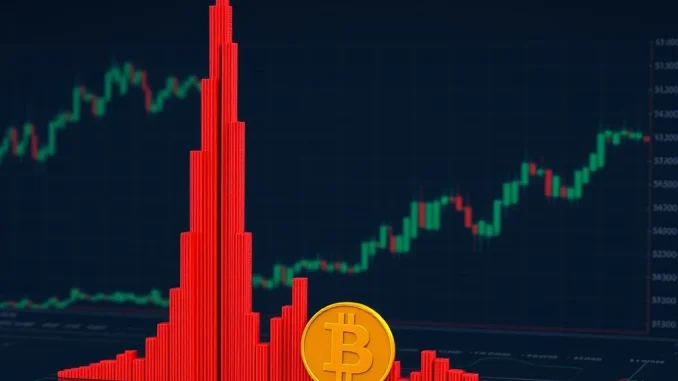
Bitcoin Liquidations Reveal Stunning ‘Burj Khalifa’ Towers on Market Liquidity Map
Global, May 2025: A recent analysis of Bitcoin’s market microstructure has revealed a startling visual pattern on its liquidity map, drawing immediate comparisons to the world’s tallest building. Data from leading crypto analytics platforms shows concentrated towers of high-leverage liquidations, a phenomenon traders are informally calling the “Burj Khalifa” formations. This development provides a stark, visual representation of the extreme risk concentration and volatility present in the current cryptocurrency derivatives market.
Bitcoin Liquidations Form Unprecedented Towers
Liquidity maps are advanced analytical tools used by traders to visualize where buy and sell orders cluster on an exchange’s order book. They essentially create a topographical chart of market sentiment and potential price support and resistance. The recent data for Bitcoin $BTC shows not the usual rolling hills of orders, but two sharp, vertical spikes representing massive clusters of pending liquidations. These spikes occur at specific price points where a high volume of leveraged long and short positions would be automatically closed by exchanges if the price reaches them. The sheer density and height of these clusters, visible on platforms like CoinGlass and Hyblock Capital, are what inspired the “Burj Khalifa” analogy, referencing the 828-meter skyscraper in Dubai. One tower typically represents a cluster of long positions at risk, while the other represents shorts, creating a dramatic visual of opposing forces.
Decoding the High-Leverage Phenomenon
The formation of these towers is a direct consequence of the widespread use of high leverage in cryptocurrency trading. Unlike traditional markets, crypto exchanges often allow leverage ratios of 10x, 50x, or even 100x. When traders open highly leveraged positions, they post only a small fraction of the position’s total value as collateral. This creates a precarious situation.
- Liquidation Price: Each leveraged position has a specific price point—the liquidation price—where the exchange will automatically sell (for a long) or buy back (for a short) the asset to prevent losses from exceeding the collateral.
- Clustering Effect: Many traders, often using similar trading strategies or following popular analysts, place their stop-losses and leverage settings near the same price levels.
- Map Visualization: On a liquidity map, each of these liquidation points is a data point. When thousands of them aggregate at a narrow price band, it creates a towering spike, indicating a zone of extreme market fragility.
The presence of such distinct “towers” signals that the market is primed for a potential cascade. If Bitcoin’s price moves swiftly toward one of these towers, it can trigger a chain reaction of liquidations, fueling further price movement in the same direction—a event known as a liquidation cascade or squeeze.
Historical Context and Market Implications
While liquidation clusters are common, the scale and definition of the current “Burj Khalifa” patterns are noteworthy. Analysts compare this to previous volatility events, such as the market shakeouts in mid-2021 and the aftermath of the LUNA collapse in 2022, where similar but less pronounced clustering occurred. The current map suggests an unusually high consensus among leveraged traders about key technical levels, which can be both a predictor of volatility and a target for large-scale market participants. Institutional traders and liquidity providers often monitor these maps closely. The towers can act as magnets for price action, as some entities may try to “snipe” the liquidity by pushing the price toward these levels to trigger the liquidations and profit from the resulting momentum. Conversely, it presents a clear warning to risk managers about zones of extreme danger.
Mechanics of a Liquidation Cascade
Understanding the potential consequence of these towers requires breaking down the cascade mechanism. Imagine the tower representing long liquidations sits at a price of $61,000, while Bitcoin trades at $63,000. If the price begins to fall and approaches $61,000, the first wave of highly leveraged long positions gets liquidated. This forced selling creates additional downward pressure on the price. This pressure can push the price lower, triggering the next layer of liquidations in the tower, leading to more selling. This self-reinforcing loop can cause a rapid, exaggerated price drop far steeper than underlying fundamentals might suggest, potentially wiping out the tower entirely and creating a new, volatile price discovery zone below it. The same process in reverse applies to a tower of short liquidations during a rapid price rise.
Expert Insight on Risk and Market Health
Market structure analysts emphasize that while dramatic, these patterns are a symptom, not a cause. “The ‘Burj Khalifa’ towers are a perfect visualization of the high-risk, high-reward ethos that still permeates much of crypto trading,” notes a veteran derivatives analyst from a major trading firm, speaking on the common condition of anonymity. “They highlight a massive concentration of speculative positions at precise levels. For the ecosystem, it’s a double-edged sword. It provides deep liquidity at those points, but it also creates systemic fragility. A healthy market typically shows a more distributed, ‘mountain range’ liquidity profile, not isolated skyscrapers of risk.” This analysis underscores a ongoing tension in crypto markets between the demand for leveraged products and the overall stability of the asset’s price discovery process.
Conclusion
The appearance of “Burj Khalifa” like towers on Bitcoin’s liquidity map is a significant technical development, offering a clear, visual gauge of market sentiment and latent volatility. These formations of high-leverage liquidations serve as a stark reminder of the risks inherent in leveraged cryptocurrency trading. They identify precise price levels where the potential for accelerated, volatile price movements is exceptionally high. For traders, this map is a crucial risk management tool, highlighting zones to approach with caution. For observers, it provides a transparent look into the often-opaque mechanics of market structure and the powerful forces that can drive short-term Bitcoin price action beyond fundamental news.
FAQs
Q1: What is a liquidity map in cryptocurrency trading?
A liquidity map is a data visualization tool that plots the density of buy and sell orders, including potential liquidation points, across different price levels on an exchange. It helps traders identify key support, resistance, and high-risk zones.
Q2: What causes “Burj Khalifa” towers to form on a liquidity map?
They form when a very large number of traders using high leverage place their liquidation orders within a very narrow price band. This mass clustering of risk creates a tall, thin spike on the map, resembling a skyscraper.
Q3: Are these liquidation towers a bearish or bullish signal?
They are not inherently directional. A tower can form for both long (bearish risk below price) and short (bullish risk above price) positions. Their primary signal is of high potential volatility and risk concentration at those specific price levels.
Q4: What usually happens when the price reaches a liquidation tower?
When the price touches a tower, it can trigger a liquidation cascade. This is a chain reaction of forced buy or sell orders that can amplify price movement, often leading to a rapid and exaggerated swing—a “squeeze” or “flush.”
Q5: How can traders use this information?
Prudent traders use these maps to adjust their risk parameters, such as widening stop-losses to avoid being caught in a cascade or identifying areas where rapid price breaks are more likely. They highlight prices to be extra cautious around.
Related News
- O.XYZ Launches OSOL100 AI Index – The S&P 100 of Solana’s AI Ecosystem
- Bitcoin Hashrate Surges to New High as Miners Realize Losses: CryptoQuant
- MMON Staking Unleashes Incredible 200% APR Opportunity on MEXC
Related: Xaman Wallet's 0.8% Fee: The Critical Debate Over Who Funds XRPL Infrastructure
Related: Claude Code Security Triggers Devastating $15B Cybersecurity Stock Plunge