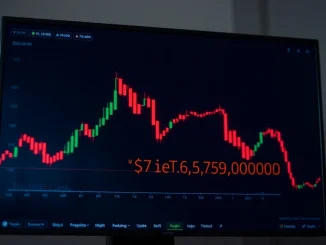
NEW YORK, March 15, 2026 — Bitcoin’s sharp rebound to $74,000 this week has ignited a fierce debate among cryptocurrency traders, with technical charts showing alarming similarities to the brutal 2022 bear market. The flagship digital asset traded 4.5% below that local high on Friday, March 14, leaving the market divided on a critical question: was the recent surge a genuine recovery or a classic bull trap setting the stage for another leg down? This divergence centers on whether the 2022 Bitcoin price cycle, which saw a 68% collapse, is repeating itself in 2026.
Technical Fractals Echo 2022 Bear Market Structure
Several prominent analysts point to uncanny technical parallels between the current price action and the middle of past bear cycles. Bitcoin Hyper, a noted market analyst, highlighted a specific pattern in an X post on Thursday. “$BTC made a local high around 140–150 days after its all-time high in the previous two cycles before pushing lower,” Hyper stated. Bitcoin’s latest rise to $74,000 occurred precisely 149 days after its bull market peak of $126,000 in October 2025, fitting this historical template perfectly.
Meanwhile, pseudonymous trader Bitcoin Isaiah labeled the rally a “perfect local top indicator,” citing premature bullish euphoria as a signal for further decline. Isaiah referenced the 2022 cycle, where similar optimism preceded a catastrophic drop from $48,200 to $15,500. This analysis suggests history could repeat with a revisit to sub-$60,000 levels. Another voice, Master of Crypto</strong, argued the brief pump above $70,000 acted as a liquidity trap, clearing out leveraged positions before targeting lower support zones between $62,000 and $65,000. "The price usually goes where the bigger money sits," the analyst added, indicating where sell-side pressure may be concentrated.
Bullish Counterargument: A Structural Shift is Underway
Despite the bearish technical warnings, a contingent of analysts insists the market dynamic has fundamentally changed. They argue that the $60,000 support level, tested and held last week, likely marked the cycle’s bottom. Bitcoin Munger, a crypto analyst, contends the 2022 bear fractal is not a valid reason for pessimism because this cycle is structurally different. Munger’s chart analysis shows that while the 2022 drawdown “cut through” the critical 200-week exponential moving average (EMA), the current price only retested this trend line and bounced—a sign of stronger underlying support.
- Institutional Inflows: The launch and sustained capital inflow into U.S. spot Bitcoin ETFs provide a bedrock of institutional demand absent in 2022.
- Supply Constriction: Accelerated coin accumulation by long-term holders and ETFs is tightening available supply, creating upward price pressure.
- Technical Breakout: Analyst Mister Crypto notes BTC/USD is breaking out of an ascending triangle, expecting a “strong move to the upside” if the $70,000 level holds as support.
Expert Analysis on Diverging Trader Sentiment
The clash in perspectives reflects a deeper uncertainty in post-halving market psychology. According to data from CryptoQuant, exchange outflows hit an anomalous high this week, with 32,000 BTC leaving trading platforms in a single day—an event typically associated with accumulation rather than distribution. However, derivatives data tells a conflicting story. Funding rates on major exchanges, while positive, have not reached the extremes seen at previous market tops, suggesting leveraged speculation is more measured. This mixed on-chain and derivatives picture feeds directly into the trader divide, with neither side possessing a definitive data edge.
Comparative Analysis: 2022 vs. 2026 Market Environments
To understand the debate, one must examine the starkly different macroeconomic and regulatory landscapes. The 2022 crash unfolded amid aggressive Federal Reserve rate hikes, the collapse of major entities like Terra/Luna and FTX, and a pervasive risk-off sentiment across all asset classes. Conversely, the 2026 environment, while not without challenges, features a more mature regulatory framework for spot ETFs and a Fed policy that has potentially shifted toward a neutral stance. The table below highlights key differences.
| Market Factor | 2022 Environment | 2026 Environment |
|---|---|---|
| Monetary Policy | Aggressive Quantitative Tightening | Potential Policy Pivot/Neutral |
| Institutional Access | Limited; No Spot ETFs | Robust; Multiple Spot ETFs Live |
| Major Catalysts | Contagion from Terra & FTX Collapses | Post-Halving Supply Shock; ETF Flows |
| On-chain Holder Behavior | Panicked Selling (Capituation) | Strong HODLing & Accumulation |
The Path Forward: Key Levels to Watch
The immediate future hinges on several concrete price levels and on-chain signals. For the bullish thesis to hold, Bitcoin must defend the $69,000 to $70,000 zone as new support. A sustained break above $74,000 with high volume could then trigger the rally to $75,000–$80,000 that optimists forecast. Conversely, bears will gain control if the price decisively breaks below the $65,000 support cluster, opening the door for a test of $60,000 and potentially lower. Traders are also closely monitoring the Pi Cycle Top indicator and the 200-day moving average, which provided critical support during the recent dip.
Market Participant Reactions and Positioning
The divergence is not just theoretical; it is reflected in real-time market positioning. Options markets show a bifurcation, with significant open interest at both $80,000 call options and $60,000 put options for the coming quarter. Retail sentiment gauges like the Crypto Fear & Greed Index have cooled from “Extreme Greed” to “Greed,” indicating a pullback in euphoria. Meanwhile, institutional flow data from Farside Investors shows spot Bitcoin ETFs have recorded net inflows for 14 of the last 15 trading days, providing a tangible counterweight to technical bearishness.
Conclusion
The Bitcoin market stands at a critical inflection point, torn between bearish technical patterns from the past and bullish structural shifts in the present. The fear of a bull trap replaying the 2022 crash is valid based on fractal analysis, but it is challenged by unprecedented institutional demand and supply-side constraints. Ultimately, the resolution will depend on whether ETF inflows and holder conviction can overpower the cyclical forces that have historically governed crypto winters. Traders should watch the $70,000 support level and ETF flow data this week for the next decisive clue. The only consensus is that volatility will remain high as this fundamental clash of narratives plays out on the charts.
Frequently Asked Questions
Q1: What is a ‘bull trap’ in cryptocurrency trading?
A bull trap is a false signal that suggests a declining asset has reversed into a bull market, enticing buyers, before the price resumes its downtrend, trapping those buyers in losing positions.
Q2: How similar is the current Bitcoin chart to the 2022 cycle?
Analysts note similarities in the timing of local highs after all-time highs and the formation of bearish chart patterns. However, key differences include stronger institutional support and a held 200-week EMA in the current cycle.
Q3: What are the main arguments against a 2022-style crash repeating?
The primary arguments are sustained inflows into spot Bitcoin ETFs, which create constant buy-side pressure, and a significantly reduced liquid supply due to long-term holder accumulation, both of which were absent in 2022.
Q4: What price level is most critical for Bitcoin to hold right now?
The $69,000 to $70,000 zone is critical short-term support. A break below could accelerate selling toward $65,000, while holding it opens the path for a retest of $74,000 and higher.
Q5: How are institutional investors reacting to this price uncertainty?
Institutional flows, as seen through spot ETF data, have remained net positive throughout the recent volatility, suggesting large players are using dips as accumulation opportunities rather than fleeing the market.
Q6: What should a retail investor monitor in the coming days?
Key metrics include daily spot ETF net flows, Bitcoin’s ability to hold above $70,000, and funding rates on derivatives exchanges to gauge leverage risk.