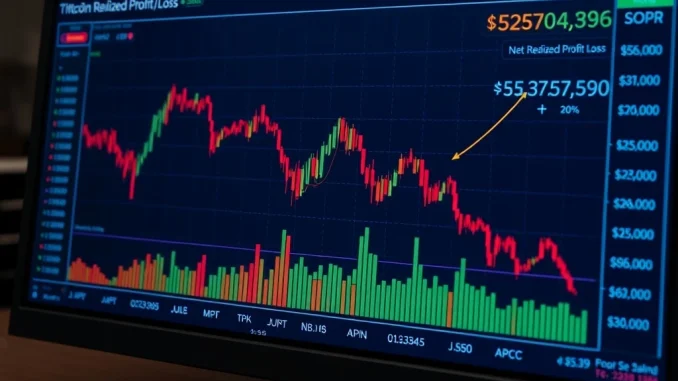
Global, March 2025: The cryptocurrency market faces renewed scrutiny as leading on-chain analytics firm CryptoQuant publishes a sobering assessment, suggesting Bitcoin may not have reached its definitive cycle bottom. The firm’s latest data flags the $55,000 price level as a potential bear market floor, contingent on the formation of a “full capitulation” event that current metrics indicate has not yet materialized. This analysis follows a turbulent period for the flagship cryptocurrency, including a notable $5.4 billion sell-off on February 5th that intensified pressure on prices and investor sentiment.
Bitcoin Bottom Analysis: Deciphering the Capitulation Signal
Capitulation in financial markets describes a period of intense, panicked selling where investors surrender hope of recovering losses and exit positions en masse. This event often creates a sentiment extreme that marks a major market low. CryptoQuant’s core thesis rests on the absence of several key on-chain and market indicators that have historically coincided with these definitive bottoms. The firm analyzes metrics derived directly from blockchain data, which provides a transparent, real-time ledger of investor behavior beyond mere price action. Their current assessment suggests that while significant selling pressure exists, the market-wide despair and exhaustion typical of a final washout may still be ahead. This creates a critical distinction between a short-term bounce and a sustainable cycle low, a nuance vital for both traders and long-term holders to understand.
Understanding the $55,000 Risk Level in Context
The $55,000 figure cited by CryptoQuant is not a random prediction but a level derived from on-chain cost basis models and historical support zones. It represents a plausible area where the aggregate cost basis of a large cohort of investors converges, potentially acting as a strong support. To contextualize this risk, analysts often examine previous cycles. For instance, the bear market bottom following the 2017 peak saw Bitcoin fall approximately 84% from its all-time high. Similar drawdowns from the 2021 peak would project to levels in this general vicinity, though exact parallels are rare. The recent $5.4 billion in realized losses on February 5th, while substantial, may represent profit-taking and leveraged unwinding rather than the full-scale capitulation of long-term holders. The table below outlines key metrics analysts monitor to gauge capitulation intensity.
| Metric | Description | What It Signals at a Bottom |
|---|---|---|
| Net Realized Profit/Loss | Total profit/loss realized by all coins moved on-chain. | Sustained, deep negative values indicating widespread loss-taking. |
| Spent Output Profit Ratio (SOPR) | Ratio of realized value to created value for spent outputs. | Values consistently below 1.0, showing coins are being sold at a loss. |
| MVRV Z-Score | Measures how far Bitcoin’s market value deviates from its realized value. | Extreme negative readings, historically below -0.5. |
| Exchange Net Flow | Net amount of Bitcoin moving into/out of exchange wallets. | Large, sustained inflows suggesting holders are preparing to sell. |
The Mechanics of a Full Capitulation Event
A full capitulation event is a multi-faceted process observable through on-chain forensics. It typically begins with a breakdown of major psychological support levels, triggering stop-losses and margin calls. This forces a cascade of liquidations, sending a wave of coins to exchanges. As price declines accelerate, long-term holders who have remained resilient through previous dips finally break, moving their older, cheaper coins to sell at a loss. This is visible in metrics like Coin Days Destroyed, which spikes as dormant coins suddenly move. The capitulation phase concludes when the selling pressure from this final cohort exhausts itself, leaving mostly steadfast holders and creating a solid foundation for the next cycle. CryptoQuant’s data suggests we may be in the later stages of the initial sell-off but have not yet witnessed this final, painful flush of long-term supply.
Historical Precedents and Market Psychology
Examining past cycles provides a framework, though not a blueprint, for current conditions. The bear market of 2018-2019 saw Bitcoin decline for over a year, with multiple false rallies, before finally reaching a capitulation low. The 2022 cycle featured a rapid, sharp decline linked to macroeconomic forces and industry contagion. Each bottom shared common traits: negative funding rates on derivatives markets, extreme fear on sentiment indices, and a significant contraction in market activity and media attention. The current environment shows some, but not all, of these characteristics. Market psychology plays an undeniable role; bottoms are formed not when the news is bad, but when it stops mattering to the remaining holders. The transition from “When will it stop falling?” to “I don’t care anymore” is often the silent signal of a true low.
Broader Market Implications and Trader Sentiment
The potential for a move toward $55,000 carries significant implications for the broader digital asset ecosystem. Altcoins, which often exhibit higher beta (volatility) relative to Bitcoin, could face amplified downward pressure in such a scenario. Furthermore, the health of companies and funds within the cryptocurrency industry, many of which hold Bitcoin as a treasury asset, would come under increased scrutiny. Derivatives markets would see massive volatility, with put options at lower strikes gaining immense value and the potential for further liquidations if leverage remains high. For traders, this analysis underscores the importance of risk management, position sizing, and avoiding over-leverage in an uncertain environment. For long-term investors, it reinforces the value of dollar-cost averaging and a multi-cycle perspective, separating emotional reactions from strategic allocation decisions.
Conclusion
CryptoQuant’s Bitcoin bottom analysis presents a data-driven, cautious outlook for the market, highlighting the $55,000 level as a zone where a bear market bottom could form if a full capitulation event occurs. This assessment is not a certainty but a probabilistic scenario based on the absence of key on-chain signals that have marked historical lows. It serves as a critical reminder that blockchain data provides a powerful, unbiased lens on market structure and investor behavior. Whether the market descends to test these levels or finds support higher, understanding the mechanics of capitulation is essential for navigating the volatile landscape of cryptocurrency investing. The path forward will likely be determined by a combination of on-chain flows, macroeconomic conditions, and the evolving narrative surrounding digital asset adoption.
FAQs
Q1: What does “capitulation” mean in cryptocurrency markets?
Capitulation refers to a period of intense, panicked selling where investors give up hope of near-term recovery and sell their holdings at a loss. It is characterized by high volume, sharp price declines, and extreme negative sentiment, and often marks a major market bottom.
Q2: How does CryptoQuant determine that full capitulation hasn’t happened yet?
CryptoQuant analyzes on-chain metrics like Net Realized Profit/Loss, Spent Output Profit Ratio (SOPR), and exchange flows. The firm’s data suggests that while selling is occurring, the scale and nature of the selling—particularly from long-term holders moving very old coins at a loss—has not reached the extremes seen at prior cycle lows.
Q3: Is the $55,000 level a guaranteed price target for Bitcoin?
No, it is not a guarantee. The $55,000 figure is presented as a potential risk level and a plausible area for a bottom based on on-chain cost basis models and historical support analysis. It is a scenario, not a prediction, and depends on broader market conditions.
Q4: What is the difference between a normal sell-off and a capitulation event?
A normal sell-off involves profit-taking, rebalancing, or reaction to news. A capitulation event is more severe and emotional, involving the surrender of investors who held through earlier declines. It is typically the final, exhaustive wave of selling that clears out weak hands before a sustainable recovery.
Q5: What should investors do in light of this analysis?
Investors should prioritize risk management. This includes avoiding excessive leverage, ensuring portfolio allocations align with personal risk tolerance, and considering strategies like dollar-cost averaging to mitigate timing risk. It is also crucial to use such analysis for context rather as a sole trading signal, combining it with other fundamental and technical research.