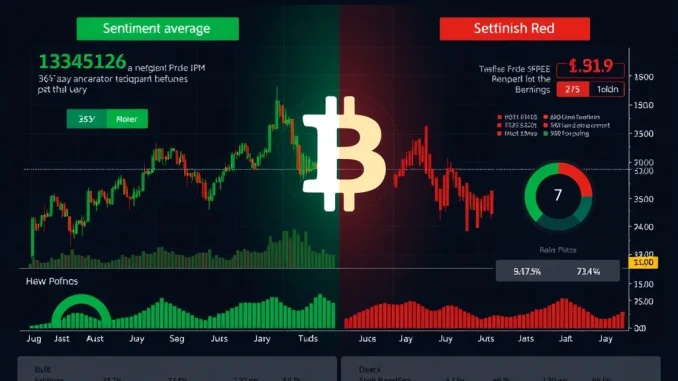
March 2025 – The cryptocurrency market faces a pivotal moment as renewed Bitcoin enthusiasm clashes with persistent bearish technical indicators. According to a detailed analysis from on-chain data platform CryptoQuant, BTC’s recent price rally masks concerning underlying metrics that suggest the broader bear market remains intact. This divergence between market sentiment and on-chain reality creates a complex landscape for investors navigating the volatile digital asset space.
Bitcoin’s Sentiment Revival Meets Technical Reality
CryptoQuant’s latest market assessment reveals a fascinating contradiction in current Bitcoin dynamics. While investor enthusiasm has noticeably increased throughout early 2025, multiple technical indicators continue flashing warning signs. The platform’s analysts emphasize that BTC has approached its critical 365-day moving average on daily charts, a level that historically served as significant resistance during previous market cycles. This technical barrier previously halted rallies during the extended 2022 bear market, creating a crucial test for current price action.
Furthermore, the current chart pattern shows striking similarities to the 2022 cycle structure. During that period, Bitcoin broke decisively below this moving average following its peak, marking the definitive beginning of a prolonged bear market. Market analysts note that historical patterns don’t guarantee future outcomes, but they provide essential context for understanding potential market trajectories. The resemblance between current price action and previous bear market transitions warrants careful consideration from both institutional and retail investors.
On-Chain Data Reveals Underlying Weakness
CryptoQuant’s analysis extends beyond price charts to examine fundamental blockchain metrics. The platform identifies decreasing on-chain spot demand as a particularly concerning signal. This metric measures genuine user adoption and transaction activity, serving as a health indicator for the Bitcoin network’s organic growth. When spot demand weakens during price rallies, it often suggests speculative trading rather than fundamental adoption drives market movements.
The report also highlights exchange inflow patterns that indicate rising selling pressure. Increased BTC transfers to major exchanges typically precede selling activity, as investors move assets from cold storage to trading platforms. This metric has shown consistent elevation throughout 2025, contrasting with the optimistic price action. Additionally, ETF-driven fund inflows remain largely unchanged compared to the same period last year, suggesting institutional participation hasn’t accelerated despite the price recovery.
Historical Context and Market Psychology
Market cycles in cryptocurrency follow recognizable psychological patterns that experienced analysts monitor closely. The current environment exhibits classic characteristics of a bear market rally, where temporary optimism creates buying opportunities that eventually succumb to broader downward trends. Seasoned investors recognize these patterns through multiple metrics beyond simple price appreciation.
CryptoQuant’s methodology combines quantitative on-chain data with qualitative market structure analysis. This approach provides a multidimensional view of market health that superficial price observations often miss. The firm’s track record of accurate market calls during previous cycles lends credibility to their current assessment, though all market predictions inherently carry uncertainty in such a volatile asset class.
Comparative Analysis: 2022 vs. 2025 Market Dynamics
The following table illustrates key differences and similarities between current market conditions and the 2022 bear market transition:
| Metric | 2022 Bear Market Transition | Current 2025 Environment |
|---|---|---|
| 365-Day MA Position | Price broke below after peak | Price approaching from below |
| Exchange Inflows | Consistently elevated | Showing similar elevation |
| Spot Demand | Declined throughout rally | Currently decreasing |
| ETF Participation | Not applicable (pre-ETF) | Stable but not accelerating |
| Market Sentiment | Initially optimistic then reversed | Currently optimistic |
This comparative analysis reveals structural similarities that concern technical analysts. While each market cycle contains unique elements, the recurrence of specific patterns provides valuable insight for risk assessment. The 365-day moving average’s historical significance as resistance during bear markets makes its current test particularly noteworthy for determining medium-term direction.
Institutional Perspectives and Market Implications
Professional cryptocurrency analysts emphasize the importance of distinguishing between sentiment-driven rallies and fundamentally-supported bull markets. The current environment presents several characteristics of the former, including:
- Diverging indicators: Price action contradicts on-chain fundamentals
- Selective metrics improvement: Only certain indicators show strength
- Historical resistance tests: Key technical levels remain unconquered
- Unchanged institutional flows: Major capital sources show caution
These factors collectively suggest that the year-to-date rally represents a rebound within a broader bear market rather than a genuine trend reversal. Market participants should consider this context when making allocation decisions, as bear market rallies often retrace significantly before establishing new upward trends. The psychological aspect of investing becomes particularly relevant in such environments, where optimism can override technical evidence.
Risk Management Considerations
Experienced traders approach conflicting market signals with specific risk management protocols. Position sizing becomes crucial when technical and fundamental analyses diverge, as current conditions demonstrate. Many professional investors maintain reduced exposure during such periods, waiting for clearer confirmation of trend direction before committing significant capital.
The cryptocurrency market’s inherent volatility amplifies both opportunities and risks during transitional phases. CryptoQuant’s analysis provides data-driven perspective that helps investors navigate these uncertain conditions with greater information symmetry. While not predictive, such analysis informs probability assessments that sophisticated market participants incorporate into their decision frameworks.
Conclusion
CryptoQuant’s comprehensive analysis presents a nuanced view of Bitcoin’s current market position. Despite renewed investor enthusiasm and price recovery, multiple indicators suggest the broader bear market persists. The approaching test of the 365-day moving average, decreasing spot demand, elevated exchange inflows, and stable ETF participation collectively paint a cautious picture. Historical patterns resembling the 2022 bear market transition add context to these observations. While market conditions remain fluid and subject to change, the weight of evidence currently favors interpreting recent gains as a bear market rally rather than a definitive trend reversal. Investors should monitor these developments closely, recognizing that cryptocurrency markets often present conflicting signals during transitional periods.
FAQs
Q1: What is the 365-day moving average and why is it significant for Bitcoin?
The 365-day moving average represents Bitcoin’s average price over the past year. It serves as a crucial long-term trend indicator. Historically, this level has acted as strong resistance during bear markets and support during bull markets, making its current test particularly important for determining market direction.
Q2: How does CryptoQuant gather and analyze its on-chain data?
CryptoQuant collects raw blockchain data directly from Bitcoin nodes, then processes this information through proprietary analytical models. The platform examines transaction patterns, wallet movements, exchange flows, and network activity to derive insights about market sentiment and potential price direction.
Q3: What distinguishes a bear market rally from a genuine bull market?
Bear market rallies occur within broader downward trends and typically show weak fundamentals despite price appreciation. Genuine bull markets feature strong on-chain metrics, accelerating adoption, and breaking through key resistance levels with conviction across multiple timeframes.
Q4: How reliable are historical patterns in predicting cryptocurrency markets?
Historical patterns provide context rather than certainty. While cryptocurrency markets exhibit cyclical behavior, each cycle contains unique elements. Analysts use historical comparisons as one component of comprehensive market assessment, combining them with current fundamentals and technical indicators.
Q5: What should investors monitor to confirm a genuine Bitcoin trend reversal?
Investors should watch for sustained break above the 365-day moving average with strong volume, improving on-chain spot demand, decreasing exchange inflows, and accelerating institutional participation through ETFs or other vehicles. Multiple confirming indicators across different timeframes provide greater conviction than any single signal.
Updated insights and analysis added for better clarity.
This article was produced with AI assistance and reviewed by our editorial team for accuracy and quality.