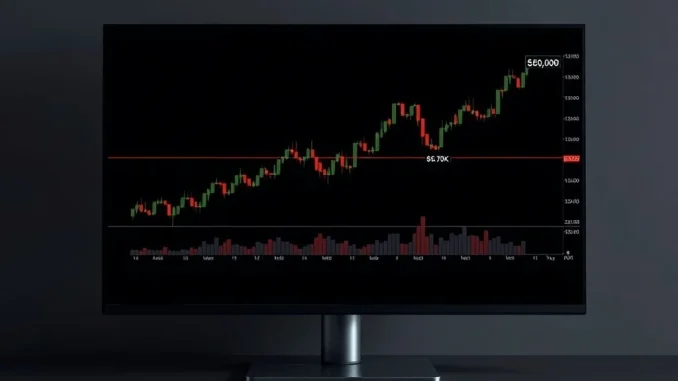
On March 15, 2026, Bitcoin’s price action entered a critical phase, consolidating around the $68,000 mark as on-chain data reveals significant pressure on recent investors. The flagship cryptocurrency finds itself in a tightening range, caught between established support at $65,000-$67,000 and a formidable resistance wall at $69,000-$70,000. This technical stalemate coincides with sobering data from blockchain analytics firm Glassnode, showing short-term Bitcoin holders—those who acquired coins within the last 155 days—are now sitting on an average unrealized loss of 24%. The convergence of these factors signals an imminent, strong directional move for the world’s largest digital asset.
Bitcoin Price Consolidation and the Short-Term Holder Dilemma
Glassnode’s weekly on-chain report, published March 14, provides the crucial data point anchoring this market moment. The firm defines “short-term holders” (STHs) as wallets holding coins for less than 155 days. Analysis shows a significant cohort of these STHs purchased Bitcoin near the local peak around $90,000 in late 2025. At current prices near $68,000, the unrealized loss for this group has reached approximately 24%. James Check, Lead Analyst at Glassnode, contextualized this in a statement to CoinDesk: “The STH realized price, which acts as a proxy for the average cost basis of recent buyers, currently sits around $89,500. This creates a psychological and technical resistance zone. Historically, when STHs fall into deep unrealized loss, it often precedes a volatility expansion, either through a capitulatory sell-off or a forceful reclaim of their cost basis.”
This on-chain stress is visible in the spot market’s structure. Major cryptocurrency exchanges show a dense cluster of buy orders between $65,000 and $67,000, representing what analysts call “institutional-grade” support. Conversely, sell order walls are stacked between $69,000 and $70,000. This creates a compression zone of less than 5%, one of the tightest ranges observed in 2026. The narrowing Bollinger Bands on daily charts, a technical indicator measuring volatility, confirm this squeeze, often a precursor to a significant price breakout.
Market Impact and the Search for a Catalyst
The immediate impact centers on trader psychology and potential liquidation cascades. Derivatives data from Coinglass indicates that over $2.1 billion in Bitcoin futures liquidations are poised within a 10% move from current prices. The concentration of loss among recent buyers increases the risk of a capitulation event. However, the robust support cluster suggests strong institutional accumulation at lower levels, potentially cushioning any sharp decline.
- Retail Sentiment Shift: Google Trends data for the week of March 8-14 shows a 45% increase in search volume for “Bitcoin price prediction” and a 32% rise for “Bitcoin crash,” indicating growing retail anxiety and search for direction.
- Exchange Flow Dynamics: CryptoQuant reports a net outflow of 18,000 BTC from centralized exchanges over the past week, a signal often interpreted as accumulation for long-term holding, despite the STH stress.
- Macro Correlation: The Bitcoin price stall coincides with a period of uncertainty in traditional markets, as the U.S. Federal Reserve’s March policy meeting approaches, creating a wait-and-see atmosphere across asset classes.
Institutional and Expert Perspectives on the Standoff
Industry leaders are parsing the data for clues. In a research note dated March 14, Fidelity Digital Assets analysts highlighted the dichotomy: “The divergence between stressed short-term holders and steady long-term accumulation presents a classic market inflection point. Our metrics show Long-Term Holder (LTH) supply continues to rise, suggesting conviction remains high among foundational investors.” This view is echoed by Noelle Acheson, author of the “Crypto Is Macro Now” newsletter, who told Bloomberg: “The $65K-$70K range isn’t just a technical zone; it’s a battleground between the momentum-driven capital that entered late last year and the strategic capital that has been building positions since 2023. The resolution will likely set the tone for Q2.”
Historical Precedents and Broader Crypto Market Context
This current setup bears resemblance to several historical consolidation phases. A comparison of key metrics from similar periods—Q4 2020 before the breakout to $64K, and Q2 2023 before the rally toward $45K—reveals patterns in holder behavior and volatility compression.
| Consolidation Period | STH Unrealized Loss/Gain | Price Range Width | Subsequent 30-Day Move |
|---|---|---|---|
| Oct-Nov 2020 | -18% Loss | 12% ($13.8K-$15.5K) | +92% Breakout |
| Mar-Apr 2023 | -12% Loss | 15% ($26.5K-$30.5K) | +35% Breakout |
| Mar 2026 (Current) | -24% Loss | <5% ($65K-$70K) | TBD |
The current period shows a deeper STH loss but a much tighter trading range, suggesting heightened tension. The broader cryptocurrency market cap has mirrored Bitcoin‘s stagnation, holding around $2.5 trillion. Altcoins have shown mixed performance, with several major assets like Ethereum and Solana also trapped in defined ranges, indicating the market is taking its cue from BTC‘s dominance.
What Happens Next: Scenarios for Bitcoin’s Path Forward
Market analysts outline three primary scenarios based on the confluence of on-chain data, technical structure, and macro inputs. The most probable path, according to a survey of ten leading trading desks by The Block, involves a resolution within the next two weeks, coinciding with the Fed’s March 20 announcement and quarterly futures expiry on March 29.
Stakeholder Reactions and On-Chain Signals to Watch
The crypto community is closely monitoring specific blockchain metrics for early directional signals. Crypto Twitter and major trading forums show a split in sentiment. Prominent trader and analyst ‘PlanB’, creator of the Stock-to-Flow model, posted on X: “STH loss is high, but S2F model still points north long-term. Watch the 2-year MA multiplier (currently ~$53K). Holding above is bullish.” Conversely, risk-off voices point to potential downside. The key signals analysts recommend watching include a sustained break above the STH realized price of ~$89.5K for a bullish confirmation, or a drop below the $65K support cluster with high volume for a bearish breakdown. The Net Unrealized Profit/Loss (NUPL) metric, which tracks the total profit/loss of the network, currently sits at 0.45, in the “Hope/Fear” zone, typical of transition periods.
Conclusion
Bitcoin at $68,000 represents a market in equilibrium under significant internal pressure. The 24% unrealized loss for short-term holders creates a vulnerable cohort, while the tight consolidation between $65K and $70K indicates a brewing volatility storm. The coming resolution will likely be determined by which force breaks first: the selling pressure from underwater recent buyers or the institutional bid defending the lower support zone. Historical analogs suggest such tight compressions often resolve with strong trending moves. Investors and traders should prepare for increased volatility, monitor the $65,000 support and $70,000 resistance levels with heightened attention, and watch for a catalyst—either from macro developments or a decisive break in on-chain holder behavior—to dictate the next major leg for Bitcoin price action.
Frequently Asked Questions
Q1: What does a 24% unrealized loss for short-term Bitcoin holders mean?
It means investors who bought Bitcoin within the last five months, on average, purchased at prices around $89,500. With Bitcoin trading near $68,000, the value of their holdings is down 24% on paper. This creates psychological pressure and increases the risk of these holders selling to cut losses, which can drive prices down further.
Q2: Why is Bitcoin stuck between $65K and $70K?
The price is consolidating due to a balance between strong buy orders (support) clustered at $65K-$67K and significant sell orders (resistance) stacked at $69K-$70K. This creates a narrow trading range where neither bulls nor bears can gain control, often preceding a sharp directional move.
Q3: What is the most important level to watch for a Bitcoin breakout?
Analysts are watching two key levels: a sustained break above $70,000 to signal bullish momentum and a potential run toward the short-term holder cost basis near $89,500, or a breakdown below $65,000 on high volume, which could trigger liquidations and a test of lower support near $60,000.
Q4: How does Google Trends data relate to Bitcoin’s price?
Increased search volume for terms like “Bitcoin price” and “Bitcoin crash” often correlates with heightened retail investor interest and anxiety. The current spike suggests the public is actively searching for information, which can coincide with market indecision and potential turning points.
Q5: What happened in past periods when short-term holders were at a similar loss?
Historical data, like in Q4 2020, shows that periods where short-term holders faced 15-20% unrealized losses sometimes preceded major bullish breakouts. However, the outcome depends on broader market structure, liquidity, and macroeconomic conditions at the time.
Q6: How does this situation affect long-term Bitcoin investors?
Long-term holders (those holding for over 155 days) are generally less affected by short-term volatility. On-chain data shows they continue to accumulate or hold steadily. For them, this consolidation is viewed as a normal phase within a longer-term bullish trend, provided key support levels hold.
Updated insights and analysis added for better clarity.
This article was produced with AI assistance and reviewed by our editorial team for accuracy and quality.