Global, May 2025: Bitcoin is currently testing a critical technical juncture, holding above a vital support zone while market participants closely monitor its interaction with the 21-day moving average. This specific technical indicator has historically served as a key signal for intermediate-term momentum shifts, making its current position a focal point for analysts and traders worldwide. The outcome of this test could provide significant clues about the next directional move for BTC and the broader cryptocurrency market.
Bitcoin’s Current Technical Standoff
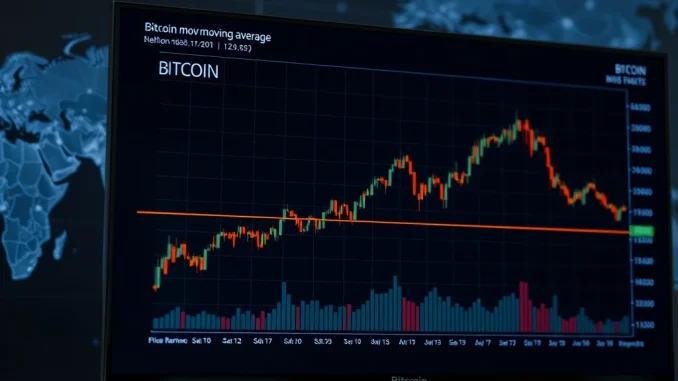
As of this week, Bitcoin’s price action shows it consolidating within a defined range, with a clearly identifiable support level preventing further declines. This support zone, established through repeated tests over recent trading sessions, represents a concentration of buying interest where market participants have consistently stepped in to acquire assets. Simultaneously, the 21-day moving average (21-DMA) acts as a dynamic resistance level overhead. The moving average calculates the average closing price over the past 21 days, smoothing out short-term volatility to reveal the underlying trend. A sustained price move above this line is widely interpreted by technical analysts as a potential shift from a neutral or bearish bias to a bullish one for the intermediate term. The convergence of these two factors—strong support below and key resistance above—creates a textbook technical setup that often precedes periods of increased volatility and decisive price movement.
The Significance of the 21-Day Moving Average in Crypto Markets
The 21-day moving average is not an arbitrary choice for market observers. Its use stems from its position as a medium-term trend filter, more responsive than longer-term averages like the 50-day or 200-day, yet smoother than very short-term ones. In the fast-paced cryptocurrency markets, where trends can develop and reverse quickly, the 21-DMA offers a balanced view. Historically, Bitcoin has shown a strong tendency to respect this level. For instance, during the bull market of 2021, the 21-DMA frequently acted as dynamic support during uptrends, with pullbacks to this line offering buying opportunities before the trend resumed. Conversely, in bearish phases, rallies often faltered precisely at this average, confirming its role as resistance. This historical precedent gives the current price interaction added weight. A decisive breakout, characterized by a strong daily or weekly close above the average accompanied by rising volume, would suggest that buying pressure is overcoming the selling pressure that has defined the recent range.
Understanding Support Zones and Market Psychology
The concept of a “support zone” is fundamental to technical analysis. It represents a price area where demand is sufficiently strong to overcome selling pressure, halting a decline. This demand can come from various sources: long-term investors viewing the price as a value opportunity, traders covering short positions, or algorithmic buying programs triggered at specific levels. The strength of a support zone is validated by the number of times price touches it without breaking down and the volume of trading activity that occurs there. A robust support zone, like the one Bitcoin currently occupies, acts as a foundation. If this foundation holds while price pushes against the overhead 21-DMA resistance, it increases the probability of a successful breakout. Market psychology plays a key role here; the longer price consolidates near resistance with strong support underneath, the more pent-up energy builds, often resulting in a more powerful move when a direction is finally chosen.
Broader Market Context and Implications
Bitcoin’s technical posture does not exist in a vacuum. Its performance often sets the tone for the wider digital asset ecosystem. A confirmed breakout above the 21-DMA for Bitcoin would likely be interpreted as a bullish signal for altcoins and other crypto assets, potentially catalyzing increased capital flow into the sector. Several contextual factors are relevant. First, on-chain data, which analyzes blockchain activity, can provide corroborating evidence. Metrics like exchange net flows (whether coins are moving to or from trading platforms), the activity of long-term holder wallets, and network utilization rates offer a fundamental backdrop to the price chart. Second, macro-economic conditions, including interest rate expectations and traditional market volatility, continue to influence investor sentiment toward risk assets like cryptocurrencies. Finally, the regulatory landscape for digital assets, which has seen significant evolution, contributes to the overall environment. A technical breakout gains more credibility if it aligns with neutral or positive developments in these fundamental areas.
Historical Precedents and Analyst Methodology
Professional analysts avoid relying on a single indicator. The 21-DMA breakout thesis is typically part of a confluence model. They will examine other timeframes, such as the weekly chart, to assess the longer-term trend. They will also look for confirmation from other technical tools. Key among these is momentum oscillators like the Relative Strength Index (RSI) or the Moving Average Convergence Divergence (MACD), which can indicate whether buying or selling momentum is strengthening beneath the price surface. Furthermore, analysts monitor trading volume meticulously. A breakout on low volume is often considered suspect and prone to failure, whereas a high-volume breakout suggests strong institutional or widespread retail participation, lending it validity. This multi-faceted approach helps distinguish between a mere technical wiggle and a meaningful shift in market structure.
Risk Considerations and Market Structure
While the potential for an upward breakout is the subject of discussion, a balanced analysis must account for the alternative scenario. A failure to overcome the 21-DMA, followed by a breakdown below the established support zone, would signal a rejection of higher prices and could open the door for a test of lower support levels. This is why the current zone is described as “critical.” It represents an inflection point. Healthy markets experience both breakouts and breakdowns; the key for participants is to identify the confirming signals that follow the initial move. A common framework is to wait for a “retest.” After a breakout, price will often dip back to the former resistance level (now turned support) to test its integrity. A successful retest that holds adds significant confidence to the new trend’s sustainability. Current market structure, including the placement of large buy and sell orders (visible on exchange order books), will play a crucial role in determining the path of least resistance in the coming sessions.
Conclusion
Bitcoin’s price action is at a notable technical crossroads, defined by a firm support zone and the looming test of the 21-day moving average. This setup provides a clear framework for market participants to gauge intermediate-term momentum. A successful bitcoin breakout above this key average would require confirmation through volume and follow-through strength, potentially energizing the broader crypto market. Conversely, a rejection at resistance would reinforce the current consolidation phase. The situation underscores the importance of technical levels in market psychology and highlights the disciplined, multi-indicator approach required for nuanced market analysis. The coming days will be instrumental in revealing whether the market has gathered enough strength to stage a decisive technical breakout.
FAQs
Q1: What is the 21-day moving average and why is it important for Bitcoin?
The 21-day moving average (21-DMA) is a technical indicator that calculates the average closing price of Bitcoin over the past 21 days. It is important because it smooths out short-term price noise and is widely watched by traders as a dynamic level of support or resistance. It often signals the health of the intermediate-term trend.
Q2: What does a “breakout” above the 21-DMA technically mean?
A breakout occurs when Bitcoin’s price closes decisively above the 21-DMA on significant trading volume, especially after a period of trading below it. This is interpreted by analysts as a shift in momentum, suggesting that buying pressure is overcoming selling pressure and that the intermediate-term trend may be turning positive.
Q3: How is a “support zone” different from a single support price?
A support zone is a price range or area where buying interest has historically been strong enough to halt declines, rather than a single, precise price point. It is considered more robust than a single price level because it accounts for market volatility and shows where clusters of buy orders are likely placed.
Q4: Does Bitcoin’s price action impact other cryptocurrencies?
Yes, historically, Bitcoin’s price trends have a significant correlation with the broader cryptocurrency market. As the largest and most established digital asset, Bitcoin often leads market sentiment. A strong, confirmed breakout in BTC frequently results in increased capital flowing into altcoins and other crypto assets.
Q5: What other factors should I watch alongside the 21-DMA?
For a more complete picture, analysts recommend watching trading volume (higher is better for breakouts), momentum indicators like the RSI, on-chain data (e.g., exchange flows), and broader market conditions. No single indicator should be used in isolation for making trading decisions.
Updated insights and analysis added for better clarity.
This article was produced with AI assistance and reviewed by our editorial team for accuracy and quality.