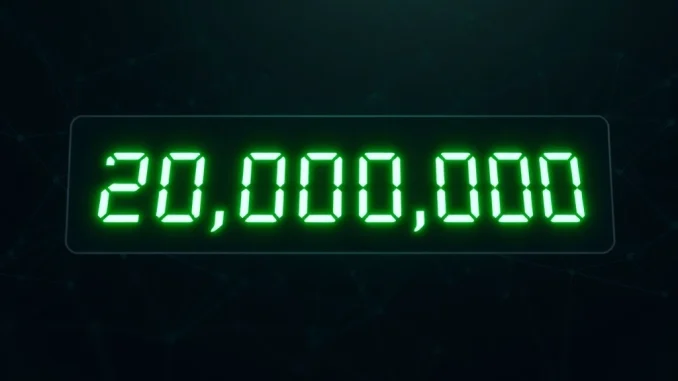
On March 15, 2026, the Bitcoin network achieved a historic milestone that cryptocurrency enthusiasts have anticipated since the digital currency’s creation in 2009. The network produced its 20 millionth Bitcoin, leaving exactly one million coins remaining to be mined over the next 114 years. This unprecedented event marks the first time a globally recognized asset has reached such a definitive supply threshold with complete transparency about its remaining issuance schedule. The milestone occurred at block height 840,000, with the 20 millionth coin mined by an anonymous miner using F2Pool’s mining pool. Bitcoin’s predictable scarcity mechanism, hard-coded into its protocol by pseudonymous creator Satoshi Nakamoto, now enters its final phase as the digital gold narrative faces its ultimate test.
Bitcoin’s 20 Million Milestone: A Transparent Supply Achievement
The Bitcoin network’s production of its 20 millionth coin represents more than just a numerical milestone. According to blockchain analytics firm Glassnode, the network reached this threshold at precisely 14:23 UTC, with the milestone block containing 1.72 BTC in transaction fees alongside the 3.125 BTC block reward. “The issuance schedule is transparent decades into the future,” said Raphael Zagury, CEO of Bitcoin mining company Elektron Energy, in exclusive comments to our publication. “Humans value predictable rules, especially when it comes to money. This milestone reinforces that Bitcoin’s monetary policy operates with mathematical certainty rather than human discretion.” The network’s current daily production stands at approximately 450 new Bitcoins, a rate that will halve again during the next scheduled halving event in 2028.
Historical context reveals the accelerating pace of this achievement. The first 10 million Bitcoins took approximately 8.5 years to mine, reaching that threshold in mid-2017. The second 10 million required just under 9 years, demonstrating how the network’s difficulty adjustment mechanism has maintained consistent issuance despite exponential increases in mining power. This predictable deceleration stands in stark contrast to traditional fiat currencies, where central banks can expand money supply through quantitative easing or other policy tools. The Federal Reserve’s balance sheet, for comparison, expanded from approximately $900 billion in 2008 to nearly $9 trillion by 2022 before recent reductions.
Scarcity Impact: What One Million Remaining Coins Means for Markets
The remaining one million Bitcoin supply represents just 4.76% of the total 21 million hard cap, creating unprecedented scarcity dynamics for a global asset. “The market is about to experience something new: A global asset with almost no new supply left,” said David Eng, managing partner at Energy Co, in a social media post following the milestone. Current mining rates suggest the final Bitcoin will emerge around the year 2140, though precise timing depends on network difficulty adjustments and hash rate fluctuations. This scarcity timeline creates several immediate and long-term impacts that market participants must consider as the countdown progresses.
- Supply Shock Acceleration: With daily new supply reduced to approximately 0.0021% of total circulating supply, even modest increases in institutional or retail demand could create significant price pressure. The stock-to-flow ratio, a popular scarcity metric among Bitcoin analysts, will increase from approximately 56 currently to over 100 by 2028’s halving.
- Miner Economics Transformation: Mining operations must increasingly rely on transaction fees rather than block rewards for profitability. Current fee revenue represents approximately 3-5% of total miner income but must grow substantially over coming decades to maintain network security.
- Psychological Market Effects: The visible countdown creates scarcity awareness that may influence investor behavior differently than abstract supply limits. Behavioral economists note that countdown mechanisms often trigger urgency responses in consumer and investment decisions.
Expert Perspectives: Scarcity Versus Price Reality
Financial analysts offer nuanced perspectives on how this milestone affects Bitcoin’s valuation. “Already priced in, markets know the supply growth rate of BTC with certainty, and it’s already lower than gold,” said Charles Edwards, founder of Capriole Investments, referencing Bitcoin’s current annual inflation rate of approximately 1.7% compared to gold’s 1.5-2.5% annual supply growth from mining. Zagury shares similar analytical caution: “I don’t think the milestone alone moves price in the short term. Liquidity and macro still dominate. But long term, scarcity plus predictable policy is a powerful combination. Over time, markets tend to reward systems people can trust.”
Institutional analysis from Grayscale Investments provides broader context: “A digital money system with transparent, predictable, and ultimately scarce supply is a simple idea, but it has rising appeal in today’s economy due to fiat currency tail risks.” This perspective references increasing concerns about fiscal sustainability in major economies, where U.S. national debt has surpassed $34 trillion and several European nations maintain debt-to-GDP ratios exceeding 100%. The European Central Bank’s balance sheet expanded from approximately €1 trillion in 2015 to nearly €9 trillion at its 2022 peak before recent reductions.
Comparative Analysis: Bitcoin Scarcity Versus Traditional Assets
Bitcoin’s transparent scarcity mechanism represents a fundamental innovation in monetary design. Unlike traditional stores of value, whose supplies can change based on discovery, technological advancement, or policy decisions, Bitcoin’s supply schedule remains immutable without overwhelming network consensus. This creates unique investment characteristics that financial institutions increasingly recognize in portfolio allocation models. The following comparison illustrates how Bitcoin’s scarcity profile differs from traditional stores of value:
| Asset | Total Supply | Annual Supply Growth | Supply Control Mechanism |
|---|---|---|---|
| Bitcoin | 21,000,000 (fixed) | ~1.7% (decreasing) | Algorithmic, decentralized consensus |
| Gold | ~201,296 tonnes (estimated) | 1.5-2.5% | Mining economics, discovery |
| U.S. Dollar (M2) | ~$20.8 trillion | Variable (0-15% historically) | Federal Reserve policy decisions |
| Fine Art (global market) | Effectively unlimited | Variable | Artist production, preservation |
Network Security Evolution: The 2140 Transition Challenge
One of the most significant technical questions surrounding Bitcoin’s final supply countdown involves network security sustainability. Currently, miners receive approximately 97% of their revenue from block rewards, with only 3% coming from transaction fees. By 2140, when the final Bitcoin is mined, this ratio must invert completely. “The one million countdown reinforces everything that’s unique about Bitcoin,” said Tommy Rogulj, portfolio manager at crypto exchange Swyftx. “It is a hard-capped, permissionless, and neutral bearer asset operating on a transparent supply curve that cannot be expanded like fiat currencies.”
Network security models suggest transaction fees must increase substantially to maintain current hash rate levels. Assuming constant hash rate, transaction fees would need to reach approximately $150-200 per transaction by 2140 to provide equivalent security incentives. However, technological improvements like the Lightning Network and other layer-2 solutions may enable high-value settlement with fewer on-chain transactions, potentially concentrating fee revenue among larger transactions. Historical precedent exists in Bitcoin’s fee market evolution during the 2017 and 2021 bull markets, where fees temporarily reached $50-60 per transaction during network congestion periods.
Industry Reactions and Community Response
The Bitcoin community’s response to the 20 million milestone has been celebratory yet reflective. Social media platforms show increased discussion about Bitcoin’s long-term value proposition, with particular emphasis on its predictable monetary policy compared to central bank actions during recent economic challenges. Mining operations have begun publicly discussing their transition strategies toward fee-dependent revenue models, with several major miners announcing research initiatives into transaction processing optimization and energy efficiency improvements. Institutional investors have shown increased interest in Bitcoin’s scarcity narrative, with several pension fund managers noting the milestone in recent investment committee discussions.
Conclusion
The Bitcoin network’s production of its 20 millionth coin represents a watershed moment in digital asset history, marking the beginning of the final countdown toward complete scarcity. While short-term price impacts may be limited as markets have long anticipated this milestone, the psychological and structural implications will unfold over decades. The transparent, predictable reduction in new supply contrasts sharply with traditional monetary systems and positions Bitcoin uniquely among global stores of value. As the network progresses toward its 21 million hard cap, attention will increasingly focus on transaction fee economics and network security sustainability. This milestone ultimately validates Bitcoin’s core innovation: a monetary system governed by mathematical certainty rather than human discretion, achieving a level of supply predictability unprecedented in financial history. Market participants should monitor hash rate trends, fee market evolution, and institutional adoption patterns as the final million coins gradually enter circulation over the next century.
Frequently Asked Questions
Q1: What exactly does the 20 million Bitcoin milestone mean for the network?
The milestone means 95.24% of all Bitcoin that will ever exist has now been mined, leaving exactly 1 million coins (4.76% of total supply) remaining for issuance over approximately 114 years. This represents the final phase of Bitcoin’s predictable supply schedule.
Q2: How will this milestone affect Bitcoin’s price in the short term?
Most analysts believe the milestone itself won’t significantly impact short-term prices since the supply schedule has always been transparent. However, the psychological effect of visible scarcity and increased media attention could influence investor behavior over coming months.
Q3: When will the final Bitcoin be mined, and what happens then?
The final Bitcoin is projected for mining around 2140 based on current network parameters. Afterward, miners will rely entirely on transaction fees rather than block rewards, requiring the fee market to grow substantially to maintain network security.
Q4: How does Bitcoin’s scarcity compare to gold’s scarcity?
Bitcoin has absolute scarcity with a fixed maximum supply of 21 million coins, while gold has relative scarcity with unknown remaining reserves. Bitcoin’s annual supply growth is currently about 1.7% and decreasing, while gold’s is 1.5-2.5% and could increase with new discoveries or extraction technologies.
Q5: What should Bitcoin investors watch following this milestone?
Investors should monitor hash rate trends, transaction fee evolution, institutional adoption patterns, and macroeconomic conditions that affect Bitcoin’s store-of-value narrative. The next significant event will be the 2028 halving, which will reduce block rewards to 1.5625 BTC.
Q6: How does this milestone affect Bitcoin mining profitability?
Mining profitability becomes increasingly dependent on transaction fees rather than block rewards. Miners must optimize operations for efficiency and may prioritize transactions with higher fees. The transition toward fee-dependent revenue will accelerate with each future halving event.