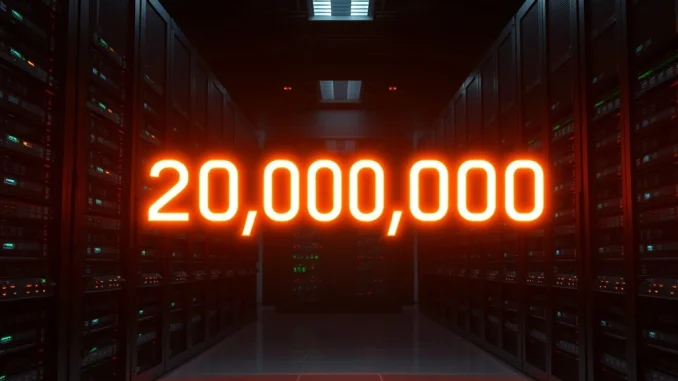
LONDON, March 15, 2026 — The Bitcoin network achieved a historic milestone today as miners produced the 20 millionth Bitcoin, marking the cryptocurrency’s entry into its final scarcity phase. This unprecedented event leaves exactly 1 million Bitcoin remaining to be mined over the next 114 years, fundamentally altering the digital asset’s supply dynamics. The milestone occurred at block height 1,050,000, with network participants worldwide celebrating the achievement while analysts debate its long-term implications for the world’s largest cryptocurrency by market capitalization.
Bitcoin’s 20 Millionth Coin Marks Scarcity Countdown Beginning
The Bitcoin network reached its 20 millionth mined coin at approximately 14:23 UTC, according to blockchain data from multiple monitoring services. This development means 95.2% of Bitcoin’s total 21 million coin supply has now entered circulation. Consequently, the remaining 4.8% represents the final tranche of new Bitcoin that will ever be created. “The market is about to experience something new: A global asset with almost no new supply left,” said David Eng, managing partner at Energy Co, in a social media post shortly after the milestone.
Currently, miners produce approximately 450 new Bitcoin daily at current difficulty levels. However, this issuance rate will continue decreasing through scheduled halving events every four years. The next halving, expected in April 2028, will reduce daily production to about 225 Bitcoin. This predictable reduction schedule, encoded in Bitcoin’s protocol since its 2009 launch, creates what experts describe as the most transparent monetary policy in financial history.
Scarcity Mechanics and Economic Implications
Bitcoin’s finite supply offers “predictable rules” that contrast sharply with traditional fiat currencies, according to industry experts. Raphael Zagury, CEO of Bitcoin mining company Elektron Energy, told Cointelegraph that the clarity around Bitcoin’s supply is “unprecedented” in monetary systems. “The issuance schedule is transparent decades into the future. Humans value predictable rules, especially when it comes to money,” Zagury explained. This transparency becomes increasingly significant as the remaining supply dwindles.
- Daily Production Decline: From current 450 BTC/day to approximately 225 BTC/day after 2028 halving
- Annual Inflation Rate: Currently around 1.7%, dropping below 1% after 2028 halving
- Gold Comparison: Bitcoin’s inflation rate already lower than gold’s approximate 2% annual supply increase
- Final Coin Timeline: Last Bitcoin expected around 2140 based on current protocol parameters
Expert Perspectives on Scarcity Impact
Financial institutions and cryptocurrency analysts offer mixed perspectives on the milestone’s immediate and long-term effects. Grayscale Investments noted in a December research report that “a digital money system with transparent, predictable, and ultimately scarce supply is a simple idea, but it has rising appeal in today’s economy due to fiat currency tail risks.” Meanwhile, Tommy Rogulj, portfolio manager at crypto exchange Swyftx, emphasized that “the one million countdown reinforces everything that’s unique about Bitcoin.”
However, some analysts remain skeptical about short-term price impacts. Charles Edwards, founder of Capriole Investments, told Cointelegraph that the milestone is “already priced in” by markets. “Markets know the supply growth rate of BTC with certainty, and it’s already lower than gold. I think it’s a non-event, no impact,” Edwards stated. Zagury shares this cautious view regarding immediate effects, noting that “liquidity and macro still dominate” short-term price movements.
Bitcoin Mining Economics Enter New Phase
The 20 millionth coin milestone signals a fundamental shift in Bitcoin mining economics. As new coin issuance decreases through halving events, transaction fees must increasingly compensate miners for securing the network. This transition represents one of Bitcoin’s most significant economic experiments. Currently, transaction fees constitute approximately 2-5% of miner revenue, but this percentage must grow substantially over coming decades to maintain network security.
| Year | Daily Bitcoin Issuance | Approximate Annual Inflation | Transaction Fee Percentage of Miner Revenue |
|---|---|---|---|
| 2026 | 450 BTC | 1.7% | 2-5% |
| 2030 | 225 BTC | 0.8% | 10-15% (projected) |
| 2040 | 112.5 BTC | 0.4% | 25-40% (projected) |
| 2140 | 0 BTC | 0% | 100% |
Network Security and Post-2140 Considerations
One of the most significant questions among Bitcoin developers and economists concerns network security after the final Bitcoin mines around 2140. Without block rewards, miners must rely entirely on transaction fees for revenue. Some experts worry this could lead to higher transaction costs or reduced security if fee revenue proves insufficient. However, Bitcoin’s design anticipates this transition, with the protocol allowing fee market dynamics to determine appropriate compensation levels.
Community Reactions and Global Response
Bitcoin community members worldwide celebrated the milestone across social media platforms and at physical gatherings. In Miami, Austin, and Berlin, groups of Bitcoin enthusiasts marked the occasion with meetups and discussions about the cryptocurrency’s future. Meanwhile, traditional financial institutions showed increased interest, with several major banks reportedly accelerating their Bitcoin research initiatives following the milestone announcement. Regulatory bodies in multiple jurisdictions have begun examining how Bitcoin’s fixed supply affects monetary policy considerations.
Conclusion
The mining of Bitcoin’s 20 millionth coin represents more than a numerical milestone—it marks the cryptocurrency’s entry into its final scarcity phase. While immediate price impacts remain debated, the long-term implications are profound. Bitcoin’s predictable, diminishing supply contrasts sharply with expanding fiat currency supplies worldwide. As the remaining 1 million Bitcoin enter circulation over the next century, the network faces its ultimate economic test: transitioning from block reward to fee-based security. This milestone reinforces Bitcoin’s unique value proposition as a hard-capped, transparent monetary asset in an era of increasing financial uncertainty. Market participants should monitor how mining economics evolve as scarcity intensifies, particularly around halving events and transaction fee market development.
Frequently Asked Questions
Q1: What does Bitcoin’s 20 millionth coin milestone actually mean?
This milestone means 95.2% of all Bitcoin that will ever exist has now been mined, leaving just 1 million Bitcoin (4.8% of total supply) remaining to be produced over approximately 114 years. It represents Bitcoin’s entry into its final scarcity phase.
Q2: Will this milestone immediately affect Bitcoin’s price?
Most analysts believe the milestone itself won’t cause immediate price movements since Bitcoin’s predictable issuance schedule has been known since 2009. However, it reinforces long-term scarcity narratives that could influence investor behavior over extended periods.
Q3: When will the last Bitcoin be mined?
Based on current protocol parameters and assuming no fundamental changes, the last Bitcoin should mine around the year 2140. This occurs because block rewards halve approximately every four years until they become negligible.
Q4: How does Bitcoin’s scarcity compare to gold?
Bitcoin’s annual inflation rate is currently around 1.7%, already lower than gold’s approximate 2% annual supply increase. After the 2028 halving, Bitcoin’s inflation will drop below 1%, making it significantly scarcer than the precious metal.
Q5: What happens to Bitcoin miners after the last coin is mined?
Miners will transition to earning revenue entirely from transaction fees rather than block rewards. This economic shift represents one of Bitcoin’s most significant long-term experiments in maintaining network security without new coin issuance.
Q6: How does this milestone affect everyday Bitcoin users?
For regular users, the main practical effect may be gradually increasing transaction fees over decades as block rewards diminish. However, layer-2 solutions like the Lightning Network aim to keep small transactions affordable regardless of base layer fee markets.