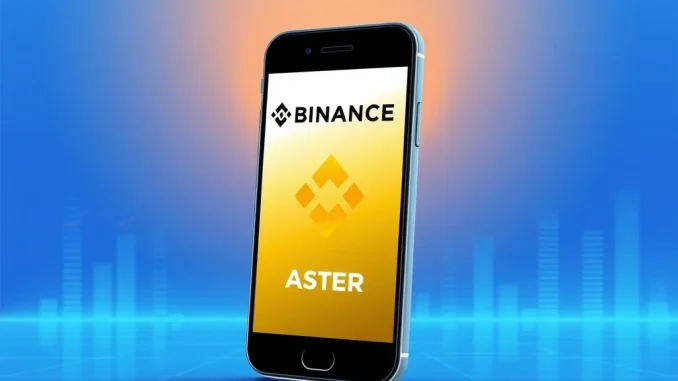
In a significant move for decentralized finance, Binance Wallet has announced a groundbreaking integration with the perpetual futures exchange ASTER. This development, confirmed on March 21, 2025, fundamentally changes how users access leveraged derivatives markets. Consequently, traders can now engage with perpetual futures contracts for both cryptocurrencies and U.S. equities directly from their self-custody wallet, bypassing the need for centralized exchange deposits entirely.
Binance Wallet Perpetual Futures: The ASTER Integration Explained
The integration connects Binance’s popular non-custodial wallet to ASTER’s decentralized exchange (PerpDEX) infrastructure. Therefore, users maintain full control of their private keys while accessing sophisticated trading products. This model starkly contrasts with traditional centralized exchanges (CEXs), where users must deposit funds into an exchange-controlled wallet. The process leverages smart contracts on a compatible blockchain, which ASTER operates on, to facilitate trustless trading. For instance, positions are managed on-chain, and collateral is held in smart contracts rather than by a central entity.
This development arrives amid a broader industry trend toward decentralized derivatives. Major analytics firm Messari reported a 300% year-over-year increase in PerpDEX trading volume in Q4 2024. Furthermore, regulatory scrutiny on centralized crypto entities has accelerated user demand for self-custody solutions. Binance Wallet’s support for ASTER directly addresses this demand by merging user experience with DeFi’s core principles.
The Mechanics of Decentralized Futures Trading
Understanding this integration requires a grasp of how perpetual futures and PerpDEXs function. Perpetual futures, or “perps,” are derivative contracts without an expiry date. Traders can speculate on an asset’s future price using leverage. Traditionally, platforms like Binance.com and Bybit dominated this market. However, ASTER and similar protocols like dYdX and GMX have built decentralized alternatives.
The key operational differences are substantial:
- Custody: On a CEX, the exchange holds user funds. On ASTER via Binance Wallet, the user’s assets remain in their self-custody wallet until a trade executes via smart contract.
- Settlement: Centralized exchanges manage profit/loss internally. ASTER uses an on-chain oracle system and smart contracts for transparent, automatic settlement.
- Access: The integration allows trading of both crypto perps (like BTC/USD) and synthetic U.S. stock perps (like Tesla or Apple) from a single interface.
This structure mitigates counterparty risk associated with centralized platforms. Notably, funds are not susceptible to exchange insolvency during the trading process. The table below summarizes the core shift:
| Aspect | Traditional CEX (Binance.com) | Binance Wallet + ASTER |
|---|---|---|
| Asset Custody | Exchange-controlled | User-controlled (self-custody) |
| Platform Type | Centralized Order Book | Decentralized, Smart Contract-based |
| Counterparty Risk | Higher (vs. Exchange) | Lower (vs. Smart Contract) |
| Product Range | Primarily Crypto | Crypto + Synthetic Stocks |
Expert Analysis on Market Impact and User Experience
Industry analysts view this as a strategic bridge between CeFi and DeFi. “Binance Wallet’s integration with ASTER isn’t just a feature addition; it’s a philosophical pivot,” noted Clara Vance, a lead researcher at CryptoFinance Labs. “It acknowledges that the future of trading is non-custodial by default. By offering a familiar wallet as the gateway, they significantly lower the technical barrier to entry for PerpDEXs.”
From a user perspective, the workflow is streamlined. A trader connects their Binance Wallet to the ASTER application. They then select a market and leverage level. The smart contract locks the required collateral from the wallet and opens the position. Funding rates, which keep perpetual contract prices aligned with spot markets, are applied automatically on-chain. Importantly, all transactions are visible on the blockchain, providing unparalleled transparency compared to opaque centralized systems.
Regulatory and Security Implications for 2025
This move carries significant implications in the current regulatory climate. Global regulators, particularly the SEC in the U.S. and MiCA authorities in the EU, are intensifying oversight of centralized crypto intermediaries. Decentralized protocols like ASTER present a more complex regulatory challenge because no single entity controls user funds or order matching.
However, security considerations evolve. While eliminating exchange risk, users now bear full responsibility for managing their private keys and understanding smart contract interactions. The risk shifts from platform insolvency to individual error or potential, though audited, smart contract vulnerabilities. ASTER’s code has undergone multiple audits by firms like CertiK and OpenZeppelin, a standard practice for establishing trust in DeFi.
Data from DeFiLlama indicates that total value locked (TVL) in perpetual futures DEXs surpassed $8 billion in early 2025. Binance Wallet’s vast user base could catalyze further growth. This integration may pressure other wallet providers and centralized exchanges to develop or partner with similar non-custodial trading solutions.
Conclusion
The integration of Binance Wallet with the ASTER perpetual futures exchange marks a pivotal moment in digital asset trading. It successfully merges the security and autonomy of self-custody with the sophisticated functionality of leveraged derivatives markets. This development directly responds to growing user demand for control and transparency while navigating an increasingly complex regulatory landscape. As the lines between centralized and decentralized finance continue to blur, the Binance Wallet perpetual futures offering via ASTER sets a new benchmark for accessible, non-custodial trading. It empowers users to trade a diverse range of assets without ever ceding control of their funds, potentially charting the course for the next generation of financial platforms.
FAQs
Q1: Do I need a Binance.com account to use perpetual futures on Binance Wallet with ASTER?
A1: No. Binance Wallet is a separate, non-custodial application. You only need to set up the wallet and fund it with crypto assets to connect to and trade on the ASTER PerpDEX. Your Binance.com exchange account is not required or linked.
Q2: What are the main risks of trading perpetual futures on ASTER versus Binance.com?
A2: The risk profile differs significantly. On Binance.com, you face counterparty risk with the exchange. On ASTER via Binance Wallet, you eliminate that risk but assume smart contract risk (despite audits) and full responsibility for your private key security. Market and leverage risks remain present on both platforms.
Q3: Can I really trade U.S. stock perpetual futures through this integration?
A3: Yes, but they are synthetic stock products. ASTER offers perpetual futures contracts that track the price of U.S. stocks like Tesla or Apple. These are not direct equities but derivative contracts whose value is pegged to the real-world stock price via oracles. You are trading a crypto derivative, not the actual stock.
Q4: How does funding work for perpetual futures on a decentralized exchange like ASTER?
A4: Funding rates are calculated periodically (e.g., every 8 hours) based on the difference between the perpetual contract price and the underlying spot index price. These payments are automatically transferred between long and short traders directly through the on-chain smart contracts. The process is transparent and verifiable on the blockchain.
Q5: Is this integration available to users in all countries?
A5: Access depends on local regulations governing cryptocurrency and derivatives trading. While decentralized protocols are permissionless, Binance Wallet as a software provider may impose geo-restrictions based on its own compliance policies. Users must ensure their activity complies with the laws and regulations of their jurisdiction.
This article was produced with AI assistance and reviewed by our editorial team for accuracy and quality.