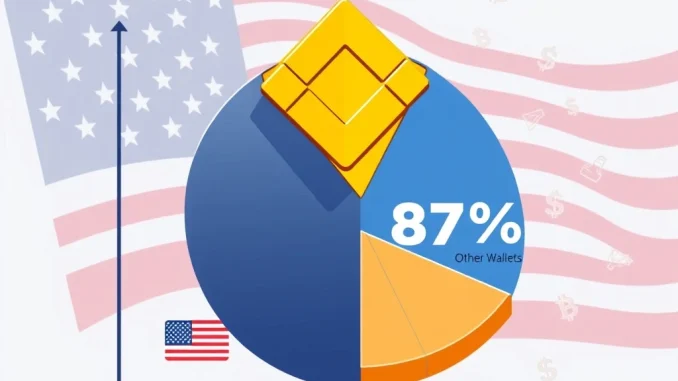
Global, May 2025: New on-chain data analysis reveals a striking concentration in the market for a new political stablecoin. Binance, the world’s largest cryptocurrency exchange, reportedly holds 87% of the circulating supply of the Trump-linked USD1 stablecoin. This dominant position, contrasted with Binance US holding almost none of the tokens, emerges as the USD1 token experiences rapid expansion amidst intensifying political and regulatory scrutiny of the stablecoin sector.
Binance’s Dominant Position in USD1 Stablecoin Holdings
The distribution of the USD1 stablecoin presents a highly centralized picture. According to blockchain analytics, a single entity—the global Binance exchange—custodies the overwhelming majority of tokens in circulation. This concentration means that most of the liquidity and trading activity for USD1 likely flows through Binance’s order books. The near-absence of the token on Binance US, the exchange’s American affiliate operating under separate regulatory constraints, highlights a significant geographical divide in the asset’s adoption and availability. Analysts point to wallet addresses publicly associated with Binance’s hot wallets to substantiate these figures, noting the transparency of blockchain data in revealing such holdings.
Understanding the USD1 Stablecoin and Its Political Link
The USD1 stablecoin entered the digital asset market as a dollar-pegged cryptocurrency explicitly associated with former President Donald Trump’s political brand and related fundraising efforts. Like major stablecoins such as Tether (USDT) and USD Coin (USDC), USD1 aims to maintain a 1:1 value with the U.S. dollar, typically through reserves of cash and cash equivalents. Its “political-linked” status distinguishes it, as its promotion and use are often framed within the context of supporting a specific political movement or ideology. The rapid expansion of its supply indicates successful initial capital formation and growing interest from a specific investor demographic, though it remains a fractional player compared to the hundreds of billions in market capitalization commanded by the sector’s giants.
The Mechanics of Stablecoin Supply and Exchange Custody
When users purchase stablecoins on an exchange like Binance, they often do not withdraw the tokens to a private wallet. Instead, the tokens remain in the exchange’s centralized custody within pooled “hot wallets” to facilitate fast trading. Therefore, a large percentage of a token’s supply appearing in an exchange’s wallet is not uncommon, especially for newer assets. However, an 87% concentration is exceptionally high and suggests that Binance is the primary, if not sole, major liquidity pool and on-ramp for this asset. This creates a single point of potential failure or market influence that contrasts with the decentralized ethos of cryptocurrency.
Regulatory Scrutiny and the Stablecoin Landscape
This concentration of supply arrives during a period of heightened global regulatory focus on stablecoins. Legislators and financial watchdogs are actively debating and drafting frameworks to govern these digital assets, which sit at the intersection of payments, securities, and banking. Key concerns for regulators include:
- Reserve Transparency and Audits: Ensuring the stablecoin issuer holds sufficient, high-quality assets to back every token in circulation.
- Market Manipulation: Preventing large holders from exerting undue influence on the token’s price or liquidity.
- Systemic Risk: Understanding how the failure of a major stablecoin or a key exchange like Binance could impact the broader financial system.
- Political Finance Rules: Applying existing campaign finance and securities laws to politically-branded digital assets.
The USD1 token, by virtue of its political connections and concentrated exchange holdings, touches on several of these sensitive regulatory nerves.
Implications of Supply Concentration for Investors and the Market
Such a lopsided distribution carries several immediate implications. For traders, liquidity is heavily dependent on one platform, which could lead to wider spreads or price instability if Binance’s trading engine experiences issues or decides to delist the token. For the project itself, this dependence on a single exchange represents a significant business risk. Furthermore, it raises questions about the token’s decentralization and resilience. Market analysts often view high exchange concentration as a sign that an asset is primarily held for speculative trading rather than for use in decentralized finance (DeFi) applications or as a medium of exchange, which could limit its long-term utility and adoption curve.
Historical Context: Exchange Dominance in Crypto Markets
The phenomenon of exchange concentration is not new. In the early days of many altcoins, a majority of trading occurred on a single platform. However, as assets mature and gain adoption, their supply typically disperses across multiple exchanges, into DeFi protocols, and private wallets. The persistent concentration of USD1 may reflect its niche audience, the regulatory barriers preventing its listing on other major U.S.-facing exchanges, or a strategic decision by its backers. Comparing this to the distribution of major stablecoins, which are widely held across countless exchanges and wallets globally, underscores USD1’s current market position.
Conclusion
The data showing Binance controlling 87% of the Trump-linked USD1 stablecoin supply illuminates a critical aspect of the evolving cryptocurrency landscape: the tension between centralized exchange power and asset distribution. This concentration presents clear challenges for market stability, regulatory oversight, and the token’s own decentralized credentials. As the USD1 stablecoin continues its expansion, its ability to diversify its holder base and liquidity sources will be a key factor watched by regulators, competitors, and investors alike. The situation underscores the broader regulatory imperative to develop clear rules for stablecoins, particularly those intersecting with political campaigns and concentrated market power.
FAQs
Q1: What does it mean that Binance holds 87% of USD1’s supply?
It means that the vast majority of this specific stablecoin currently in existence is held in the custody of the Binance cryptocurrency exchange, likely in wallets used to facilitate customer trading on its platform. This indicates Binance is the primary marketplace for this asset.
Q2: Why does Binance US hold almost no USD1 tokens?
Binance US operates as a separate entity to comply with United States regulations. The USD1 stablecoin’s political linkages and regulatory uncertainty likely make it a complex asset to list for a U.S.-regulated exchange, leading to its absence on that platform.
Q3: Is it risky for one exchange to hold so much of a stablecoin?
Yes, it introduces concentration risk. If Binance experienced technical issues, regulatory action, or decided to delist USD1, it could severely impact the token’s liquidity and price stability, as most buying and selling activity occurs there.
Q4: How is the USD1 stablecoin linked to Donald Trump?
The USD1 stablecoin has been promoted and associated with fundraising efforts for Donald Trump’s political brand and related causes. It is marketed as a way for supporters to engage with the movement digitally, though it is not officially issued by Trump’s campaign.
Q5: Are other major stablecoins like USDT or USDC this concentrated on one exchange?
No. Established stablecoins like Tether (USDT) and USD Coin (USDC) have supplies measured in the tens or hundreds of billions and are distributed across hundreds of exchanges, thousands of DeFi protocols, and millions of private wallets globally, making them far less dependent on any single platform.
Updated insights and analysis added for better clarity.
This article was produced with AI assistance and reviewed by our editorial team for accuracy and quality.