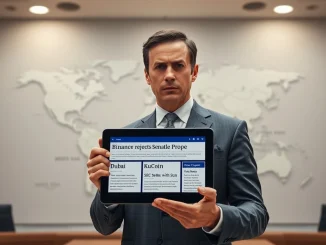
WASHINGTON, D.C., March 15, 2026 — Global cryptocurrency exchange Binance has issued a forceful response to a U.S. Senate investigation into its sanctions compliance, labeling media reports about Iranian transactions as “demonstrably false” and “defamatory.” In a formal letter obtained exclusively by our newsroom, Binance executives told Senators Richard Blumenthal and Ron Johnson that their February inquiry relied on inaccurate journalism. The exchange specifically denied facilitating direct transactions with Iran-based entities, marking a significant escalation in the ongoing regulatory scrutiny facing the cryptocurrency industry. This development comes just three years after Binance’s landmark $4.3 billion settlement with U.S. authorities over sanctions violations.
Binance Denies Direct Iran Transactions in Senate Response
Binance’s legal team delivered a detailed rebuttal to the Senate Permanent Subcommittee on Investigations on Friday, March 13, 2026. The 14-page letter systematically addresses each allegation raised by the bipartisan group of 11 senators. According to the document, “no Binance account transacted directly with an Iran-based entity” during the period under investigation. The exchange acknowledged removing certain entities from its platform following law enforcement inquiries but maintained these actions represented proactive compliance rather than evidence of violations.
Furthermore, Binance challenged the narrative surrounding employee terminations that first appeared in major financial publications. The company stated that some individuals referenced in media reports actually resigned voluntarily, while another was terminated for violating internal privacy policies by sharing user information externally. “Binance takes seriously the privacy of its users and has no tolerance for employees violating that trust,” the letter emphasized. This response directly counters reporting from the Wall Street Journal, New York Times, and Fortune that suggested whistleblower retaliation.
Regulatory Impact and Industry Consequences
The Senate probe and Binance’s aggressive response carry significant implications for cryptocurrency regulation and international sanctions enforcement. As digital assets continue to challenge traditional financial oversight mechanisms, this confrontation tests the boundaries of regulatory authority in decentralized finance. The outcome could establish precedents affecting how all cryptocurrency exchanges interact with U.S. sanctions programs.
- Compliance Standards: The investigation may force clearer compliance standards for cryptocurrency transactions involving sanctioned jurisdictions
- Industry Scrutiny: Other major exchanges face increased regulatory attention as lawmakers seek consistent enforcement
- International Coordination: The case highlights challenges in coordinating sanctions enforcement across global cryptocurrency markets
Expert Analysis: Regulatory Perspectives
Dr. Eleanor Vance, former Treasury Department sanctions official and current director of the Georgetown Center for Financial Security, provided context about the investigation’s significance. “This represents the next phase of cryptocurrency regulation,” Vance explained. “After the 2023 settlements established baseline accountability, we’re now seeing how exchanges implement compliance in practice. The Senate’s questions about transaction monitoring and employee protections go to the heart of whether cryptocurrency can operate within traditional regulatory frameworks.” Vance’s analysis underscores the broader regulatory evolution occurring alongside this specific investigation.
Historical Context: From Settlement to Senate Probe
The current Senate investigation follows Binance’s November 2023 settlement with the Department of Justice, Department of the Treasury, and Commodity Futures Trading Commission. That agreement included $4.3 billion in penalties and required the resignation of then-CEO Changpeng “CZ” Zhao, who later served a four-month prison term. The settlement specifically addressed violations of the Bank Secrecy Act and sanctions programs, including those involving Iran. Since that resolution, Binance has operated under monitorship while implementing enhanced compliance measures.
| Date | Event | Key Development |
|---|---|---|
| November 2023 | DOJ Settlement | $4.3 billion penalty, CZ resignation, compliance monitorship |
| February 2026 | Senate Inquiry | 11 senators request investigation into Iran transactions |
| March 2026 | Binance Response | Formal denial of allegations, criticism of media reports |
| October 2025 | Presidential Pardon | President Trump pardons CZ, enabling potential return |
Next Steps: Congressional and Executive Responses
The Senate subcommittee now faces critical decisions about how to proceed with its investigation. Senators Blumenthal and Johnson requested responses from Treasury Secretary Scott Bessent and Attorney General Pamela Bondi by March 13 regarding potential government investigations into Binance. As of publication, neither official has publicly commented on the matter. Congressional staffers indicate the subcommittee may schedule hearings or request additional documentation from Binance, depending on the adequacy of the exchange’s response. Meanwhile, the Department of Justice’s monitorship continues through 2026, providing ongoing oversight of Binance’s compliance enhancements.
Industry and Political Reactions
Cryptocurrency industry associations have expressed concern about the investigation’s potential chilling effect on innovation. “While compliance is essential, we must ensure regulatory approaches don’t inadvertently push legitimate activity offshore,” stated Marcus Chen, executive director of the Blockchain Association. Conversely, advocacy groups focused on sanctions enforcement have welcomed the Senate’s scrutiny. “The opacity of cryptocurrency transactions creates unique challenges for sanctions compliance,” noted Sarah Johnson of the Financial Accountability Institute. “This investigation helps clarify whether current systems adequately prevent illicit finance.” The political dimension gained additional complexity following President Trump’s October 2025 pardon of former CEO CZ, which some lawmakers have questioned amid broader concerns about administration ties to cryptocurrency interests.
Conclusion
Binance’s forceful rejection of the Senate investigation marks a pivotal moment in cryptocurrency regulation. The exchange’s detailed denial of direct Iran transactions and criticism of media reporting establishes its defensive position clearly. However, the broader questions about sanctions compliance in decentralized finance remain unresolved. As regulatory scrutiny intensifies globally, this confrontation between a leading cryptocurrency exchange and U.S. lawmakers will test the adaptability of both traditional oversight mechanisms and innovative financial technologies. The coming weeks will reveal whether the Senate subcommittee accepts Binance’s explanations or pursues additional investigative steps that could reshape cryptocurrency compliance standards for years to come.
Frequently Asked Questions
Q1: What specific allegations is Binance denying in its Senate response?
Binance denies facilitating direct cryptocurrency transactions with Iran-based entities, contradicting media reports suggesting over $1 billion in such transactions. The exchange also challenges narratives about employee terminations, stating some individuals resigned voluntarily while another was fired for privacy violations.
Q2: How does this investigation relate to Binance’s 2023 settlement with U.S. authorities?
The current Senate probe examines whether Binance has complied with the terms of its 2023 settlement, which included $4.3 billion in penalties and required enhanced sanctions compliance measures. The investigation specifically focuses on transactions potentially violating Iran sanctions.
Q3: What are the potential consequences if the Senate investigation continues?
Possible outcomes include additional hearings, requests for further documentation, potential referrals to regulatory agencies, or legislative proposals for cryptocurrency sanctions compliance. The investigation could also influence ongoing monitorship requirements under the 2023 settlement.
Q4: How does President Trump’s pardon of former CEO CZ affect this situation?
The October 2025 pardon legally enables CZ to return to Binance in a leadership role, though he has publicly stated he won’t resume as CEO. Some lawmakers have questioned the pardon’s timing and potential connections to administration cryptocurrency policies.
Q5: What broader implications does this case have for cryptocurrency regulation?
This confrontation tests how traditional sanctions enforcement applies to decentralized finance. The outcome could establish precedents affecting transaction monitoring, compliance standards, and regulatory jurisdiction across the cryptocurrency industry.
Q6: How should cryptocurrency users and investors interpret these developments?
Users should monitor how exchanges implement compliance measures while continuing normal operations. The investigation highlights ongoing regulatory evolution rather than immediate operational changes, but underscores the importance of compliance in cryptocurrency’s maturation.