Binance’s Bold Move: Repaying Gopax GoFi Users This Year to Capture South Korea’s Crypto Crown
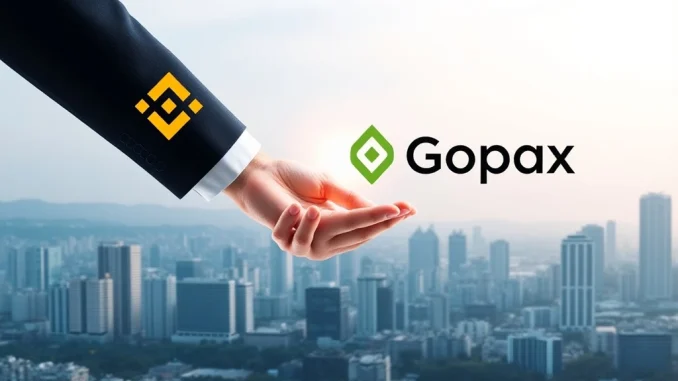
Seoul, South Korea – May 2025: In a decisive move to solidify its presence in a critical Asian market, global cryptocurrency exchange Binance has announced plans to complete repayments to users of the South Korean exchange Gopax’s troubled GoFi service within this year. This action forms the cornerstone of a broader, ambitious strategy where Binance aims to become the top cryptocurrency exchange by market share in South Korea, directly challenging the current duopoly. The announcement, based on an exclusive report by The Block, signals a pivotal moment for crypto investors in the region and highlights the evolving dynamics of international exchange expansion into tightly regulated markets.
Binance’s Strategic Roadmap for Gopax and South Korea
The path forward, as outlined by SB Seker, Binance’s Head of Asia Pacific, follows a clear, two-phase sequence. The immediate and non-negotiable priority is the full repayment of users affected by the GoFi service freeze. Seker emphasized that once this creditor obligation is honorably discharged, Binance will deploy its “global standard technology and security systems” to Gopax’s infrastructure. This technological uplift is not merely an upgrade; it represents the integration of Binance’s battle-tested security protocols and trading engine into the local platform, a move designed to rebuild user trust from the ground up. The subsequent phase will see a strategic pivot toward growth and innovation, focusing on introducing new business verticals like stablecoins, real-world asset (RWA) tokenization, and tailored services to attract institutional capital to the South Korean platform.
Understanding the GoFi Crisis and Binance’s Rescue Plan
To appreciate the significance of this repayment pledge, one must understand the origins of the GoFi crisis. GoFi was a yield-generating service offered by Gopax. In late 2022, its lending partner, Genesis Global Capital—a subsidiary of the Digital Currency Group—abruptly halted withdrawals amidst the contagion from the FTX collapse. This action effectively froze the digital assets of thousands of South Korean GoFi users. The situation left Gopax, a significant but not market-leading exchange, in a precarious position, unable to fulfill user withdrawals from the service.
Binance entered the picture in early 2023 through its Industry Recovery Initiative, acquiring a controlling stake in Gopax. This acquisition was fundamentally a rescue operation, with the primary condition being a plan to make GoFi users whole. However, the process encountered significant delays. South Korea’s stringent financial regulators meticulously reviewed the change in major shareholder, concerned about Binance’s global regulatory history and the stability of the local market. This regulatory scrutiny, while rigorous, is a hallmark of South Korea’s approach to crypto, designed to protect consumers. The repayment wallet, which is transparently verifiable on-chain, currently holds the original assets, including substantial amounts of Bitcoin (BTC), Ethereum (ETH), and USD Coin (USDC). Critically, Binance has committed to repaying users in the original cryptocurrency, not the Korean won equivalent, protecting users from potential price appreciation they would have otherwise missed.
The South Korean Crypto Exchange Landscape: A Market Dominated by Duopoly
Binance’s confidence in capturing top market share directly targets the established hierarchy. The South Korean crypto market is famously vibrant and retail-driven, but its exchange sector is dominated by two domestic giants: Upbit and Bithumb. Upbit, in particular, commands a overwhelming majority of the trading volume. These incumbents benefit from deep local integration, first-mover advantage, and strong brand recognition. For Binance to challenge them, it must offer more than just brand name; it must provide superior technology, compelling new products like RWA tokenization that are still nascent locally, and navigate a complex regulatory environment that includes rules like the controversial “Travel Rule” and restrictions on the listing of certain tokens. Seker’s expressed confidence in managing regulatory risks, including potential restrictions on major shareholder stakes, suggests Binance has engaged in extensive dialogue with Korean authorities to align its operations with local expectations.
Implications of Binance’s Expansion for the Global Crypto Industry
This move is a case study in how global crypto giants are adapting to a post-2023 regulatory landscape. The strategy is no longer purely aggressive expansion but responsible, compliance-first market entry. By prioritizing the repayment of GoFi users—a legacy issue it did not create—Binance is demonstrating a commitment to consumer protection and ethical responsibility, which are key currencies for gaining regulatory and public trust. Furthermore, the focus on stablecoins and RWAs indicates Binance is betting on the next wave of crypto adoption: the seamless integration of blockchain technology with traditional finance (TradFi) and real-world economies. Success in South Korea, a technologically advanced and financially sophisticated market, would serve as a powerful blueprint for Binance’s operations in other regulated jurisdictions worldwide.
The table below outlines the key components of Binance’s announced strategy for Gopax and the South Korean market:
| Phase | Primary Action | Key Objective | Timeline |
|---|---|---|---|
| Phase 1: Resolution & Foundation | Complete repayment of GoFi users in-kind (original crypto assets). | Fulfill ethical obligation, restore user trust, and clear regulatory hurdle. | Target completion within 2025. |
| Phase 2: Technological Integration | Deploy Binance’s global security, matching engine, and risk control systems to Gopax. | Elevate platform reliability, security, and performance to international standards. | To commence after Phase 1. |
| Phase 3: Growth & Innovation | Launch new services: stablecoins, RWA tokenization, institutional products. | Differentiate from Upbit/Bithumb, attract new user segments, and drive market share. | Next 12-24 months. |
Conclusion
Binance’s plan to repay Gopax GoFi users this year is far more than a simple debt settlement; it is the essential first step in a meticulously calculated campaign to win the South Korean cryptocurrency market. By addressing past grievances transparently, injecting world-class technology, and introducing forward-looking financial products, Binance is constructing a multifaceted value proposition for Korean traders and investors. The coming 12 months will be a critical test of whether this strategy can disrupt the stronghold of Upbit and Bithumb. The outcome will not only redefine South Korea’s crypto exchange rankings but also signal how effectively global crypto leaders can operate within the world’s most rigorous regulatory frameworks. The success of this Binance Gopax repayment and integration plan will be closely watched by the entire industry as a benchmark for responsible, sustainable expansion.
FAQs
Q1: What is the GoFi service and what happened to it?
A1: GoFi was a yield-earning service offered by the South Korean exchange Gopax. In late 2022, its partner Genesis Global Capital froze withdrawals following the FTX collapse, locking up users’ crypto assets. Binance’s acquisition of a stake in Gopax included a plan to rescue and repay these users.
Q2: How will Binance repay Gopax GoFi users?
A2: Binance has committed to repaying users with the original type and quantity of cryptocurrency they deposited into GoFi (e.g., BTC, ETH), not the Korean won equivalent. The assets are held in a dedicated wallet, and the process is slated for completion within 2025.
Q3: Why is South Korea an important market for Binance?
A3: South Korea has one of the world’s most active and technologically savvy retail crypto investor bases. Capturing significant market share there is a major strategic goal, but it requires overcoming the dominance of local exchanges Upbit and Bithumb and navigating strict local regulations.
Q4: What are the main regulatory challenges Binance faces in South Korea?
A4: Key challenges include securing full regulatory approval for its stake in Gopax, complying with strict anti-money laundering rules like the “Travel Rule,” adhering to listing standards, and potentially navigating laws that could limit a major shareholder’s influence—all under the watch of South Korea’s vigilant Financial Services Commission (FSC).
Q5: What does Binance plan to do after repaying GoFi users?
A5: After the repayment, Binance will focus on upgrading Gopax’s technology with its own security and trading systems. Subsequently, it plans to introduce new services like stablecoins and real-world asset (RWA) tokenization to attract both retail and institutional investors in South Korea.
Related News
- Finnovex West Africa 2025: Driving Financial Inclusion and Economic Growth
- Binance Unveils New Limited-Time Earn Offers on Wednesdays
- Mesh Series C Funding: Crypto Payments Network Secures $75M in Pivotal Round
Related: Aptos Deflation Plan: Unveiling a Radical Shift with Gas Burns and 210M APT Lock
Related: AEON and Ultima Forge Landmark Partnership to Power $ULTIMA Crypto Payments for Millions
Related: Inframarkets Reveals Groundbreaking Solution for Prediction Market Liquidity and Resolution