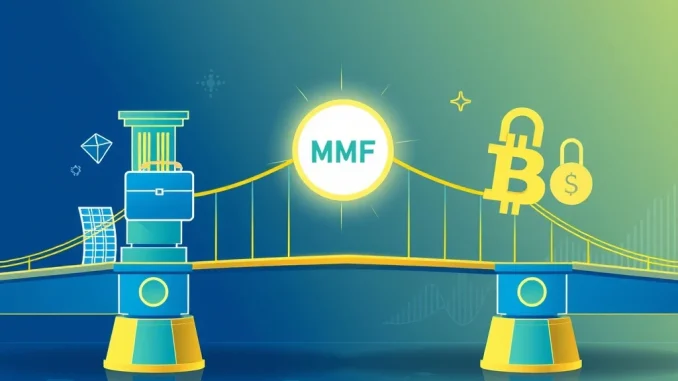
Global, May 2025: In a significant move bridging traditional finance and digital assets, Binance and Franklin Templeton have officially launched a pioneering tokenized money market fund (MMF) collateral program. This initiative allows eligible institutional clients to use tokenized versions of Franklin Templeton’s money market funds as collateral for trading on Binance, while the underlying assets remain securely held with independent, third-party custodians. The program directly addresses the growing institutional demand for yield-bearing collateral within the cryptocurrency ecosystem, marking a pivotal step in the maturation of crypto capital markets.
Tokenized MMF Collateral Program: A New Era for Institutional Crypto
The core of this collaboration is a structured off-exchange collateral program. Traditionally, traders on exchanges must post collateral—often in the form of stablecoins or major cryptocurrencies like Bitcoin and Ethereum—directly with the exchange. This new model introduces a novel alternative. Institutions can now pledge tokenized shares of a Franklin Templeton money market fund as collateral. Crucially, these tokenized assets are not held on Binance’s balance sheet. Instead, they remain under the custody of a qualified third party, separating asset custody from trading execution. This structure mitigates counterparty risk, a paramount concern for institutional participants. The tokenization process, facilitated by blockchain technology, creates a digital representation of the fund shares, enabling them to be programmatically managed, transferred, and used as collateral in real-time within the Binance trading environment.
The Rising Demand for Yield-Bearing Collateral in Crypto Trading
The launch responds to a clear and growing market need. As institutional participation in cryptocurrency markets has expanded, so too has the sophistication of their requirements. A primary pain point has been the opportunity cost of idle capital. Posting static USDC or USDT as collateral generates no yield, effectively putting that capital to work only for its function as a risk buffer. In contrast, money market funds are designed to provide stability, liquidity, and a yield—typically derived from short-term government securities and high-quality corporate debt. By using tokenized MMFs as collateral, institutions can potentially earn a return on assets that would otherwise sit idle, optimizing their capital efficiency. This demand reflects a broader trend in decentralized finance (DeFi), where yield-bearing “liquid staking tokens” have become fundamental building blocks, now influencing centralized institutional practices.
Architecture and Operational Mechanics
Operationally, the program functions through a secure, permissioned framework. An institution first acquires shares in a designated Franklin Templeton money market fund. These shares are then tokenized on a compatible blockchain network, with the digital tokens representing a legal claim on the underlying fund assets. The tokens are transferred to a pre-approved, independent custodian. When the institution wishes to trade on Binance, it does not transfer the tokens to the exchange. Instead, it provides proof of the pledged collateral to Binance through a secure attestation or messaging system. Binance’s risk engine verifies the pledge and grants corresponding trading credit. The entire process relies on robust legal agreements, real-time auditing, and blockchain-based transparency to ensure the collateral’s value is accurately reflected and maintained throughout the trading period.
Historical Context and Industry Implications
This development is not an isolated event but part of a multi-year convergence. Franklin Templeton has been a leader in exploring tokenized assets, having launched one of the first U.S.-registered money market funds using a public blockchain for share transactions in 2021. Binance, meanwhile, has steadily built its institutional offerings through Binance Institutional. Their collaboration signals a validation of tokenization’s utility beyond mere novelty. The implications are profound. Firstly, it lowers the barrier to entry for traditional finance (TradFi) funds wary of direct crypto asset custody. Secondly, it creates a potential on-ramp for hundreds of billions of dollars in money market fund assets to interact with the digital economy. Finally, it sets a precedent for other asset managers and exchanges, potentially leading to a standardized ecosystem for tokenized real-world asset (RWA) collateral. Analysts view this as a critical step toward solving the “trillion-dollar problem” of bringing off-chain liquidity on-chain in a compliant, institutional-grade manner.
Risk Management and Regulatory Considerations
A program of this scale inherently involves complex risk and regulatory landscapes. The use of third-party custody directly addresses the principal risk of exchange failure, a lesson underscored by events in 2022. From a market risk perspective, the volatility of the collateral must be managed. Money market funds are designed to maintain a stable net asset value (NAV) of $1.00 per share, but they are not FDIC-insured and can, in extreme circumstances, “break the buck.” The program likely incorporates strict haircuts (value discounts) and daily mark-to-market valuations to protect Binance from collateral depreciation. Regulatorily, both entities operate under intense scrutiny. The program’s design likely engages with existing securities laws (governing the MMFs) and evolving digital asset frameworks. Its off-exchange, custodial model may provide clearer regulatory demarcations than an on-exchange solution, demonstrating a deliberate approach to compliance in a nascent area.
Conclusion: A Paradigm Shift in Institutional Finance
The Binance and Franklin Templeton tokenized MMF collateral program represents a tangible fusion of traditional finance infrastructure with blockchain innovation. By enabling institutions to use yield-bearing, tokenized money market funds as off-exchange collateral, it solves a key inefficiency, enhances capital utility, and reduces counterparty risk. This initiative is more than a new product; it is a foundational development that could accelerate the integration of multi-trillion-dollar TradFi markets into the digital asset ecosystem. Its success will depend on robust technology, clear regulation, and market adoption, but its launch unequivocally marks a new chapter in the evolution of crypto trading collateral and institutional blockchain adoption.
FAQs
Q1: What is a tokenized money market fund (MMF)?
A tokenized MMF is a traditional money market fund whose shares are represented as digital tokens on a blockchain. These tokens are programmable, easily transferable, and maintain a legal claim to the underlying fund assets, which are invested in short-term, high-quality debt instruments.
Q2: How does the off-exchange collateral model work?
In this model, the collateral (tokenized MMF shares) is held by a third-party custodian, not by Binance. The institution pledges these assets to Binance to secure trading lines. Binance verifies the pledge externally, granting credit for trading without taking physical custody of the tokens, thereby separating custody and execution.
Q3: What are the main benefits for institutions using this program?
The primary benefits are capital efficiency (earning yield on collateral), enhanced risk management (assets stay with a trusted custodian), and access to crypto markets without needing to hold volatile crypto assets as the sole form of collateral. It also simplifies operations for firms already invested in money market funds.
Q4: What risks are associated with using tokenized MMFs as collateral?
Key risks include the remote possibility of the money market fund’s value fluctuating (“breaking the buck”), technological risks associated with the blockchain and smart contracts, and regulatory uncertainty. The program uses haircuts and daily valuations to mitigate market risk.
Q5: Could this model be applied to other types of assets?
Absolutely. The architecture is a blueprint for tokenizing other real-world assets (RWAs) like treasury bonds, corporate debt, or even equities for use as collateral. This program is likely a pilot for a broader ecosystem of tokenized RWA collateral in both centralized and decentralized finance.
Updated insights and analysis added for better clarity.
This article was produced with AI assistance and reviewed by our editorial team for accuracy and quality.