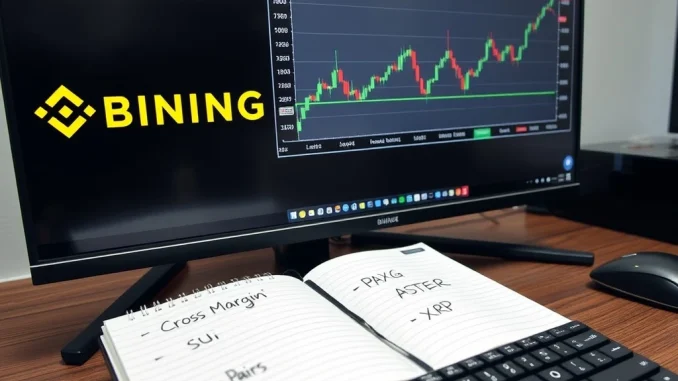
Global, May 2025: In a significant move for cryptocurrency traders, Binance, the world’s largest digital asset exchange by trading volume, has expanded its cross margin trading offerings. The platform has officially added new trading pairs, including PAXG, ASTER, SUI, and XRP, providing seasoned investors with enhanced leverage options on these substantial digital assets. This strategic expansion reflects the exchange’s ongoing commitment to diversifying its financial products and responding to evolving market demand for sophisticated trading tools.
Binance Cross Margin Trading Welcomes Major New Assets
Binance’s latest update integrates four distinct digital assets into its cross margin ecosystem. Cross margin trading allows users to utilize their entire margin balance as collateral for all open positions, a feature that differs from isolated margin, where collateral is assigned to a single trade. The newly supported assets represent a diverse cross-section of the cryptocurrency market. PAXG (Pax Gold) is a digital token backed by physical gold, offering a bridge between traditional commodity markets and digital finance. ASTER is the native utility token of the Aster Protocol, a decentralized data network. SUI serves as the native asset of the Sui Layer 1 blockchain, designed for high-speed smart contracts. Finally, XRP, one of the longest-standing major cryptocurrencies, is the digital asset used within the RippleNet payment network. By adding these pairs, Binance provides traders with the ability to apply leverage to strategies involving gold-pegged stability, emerging Web3 infrastructure, and established payment-focused cryptocurrencies.
Analyzing the Strategic Implications of the New Pairs
The introduction of these specific pairs is not arbitrary; it follows a clear logic based on market capitalization, liquidity, and user demand. Binance typically adds margin trading for assets that demonstrate sufficient trading volume and market depth to ensure stable leveraged trading conditions. The inclusion of PAXG caters to traders seeking exposure to gold’s price movements without the complexities of physical ownership, effectively creating a leveraged commodity play within a crypto framework. Adding ASTER and SUI highlights the exchange’s focus on supporting newer, high-potential Layer 1 and infrastructure projects, giving their communities advanced trading tools. The integration of XRP into cross margin, a feature long requested by its substantial user base, completes the suite of leverage options for one of the market’s most liquid assets. This expansion allows for more complex trading strategies, such as hedging positions across different asset classes or increasing capital efficiency in volatile market conditions.
The Evolution of Margin Trading on Centralized Exchanges
Margin trading has become a cornerstone product for major cryptocurrency exchanges since its introduction in the late 2010s. It allows traders to borrow funds to amplify potential returns, though it equally magnifies potential losses. Binance launched its margin trading platform in 2019 and has methodically expanded its list of supported assets ever since. The process for adding a new pair involves rigorous risk assessment, including analysis of the asset’s historical volatility, liquidity across order books, and custodial security. This latest update continues a trend of product maturation within the crypto industry, moving beyond simple spot trading to offer a suite of financial instruments comparable to those in traditional markets. For professional traders, access to cross margin on these assets reduces operational friction and enables more dynamic portfolio management.
Practical Guide to the New Cross Margin Pairs
For users accessing Binance’s margin trading interface, the new pairs will appear alongside existing options. It is critical for traders to understand the specific parameters and risks associated with each new pair. Below is a summary of key details traders should note:
- Asset Types: The mix includes a commodity-backed token (PAXG), protocol utility tokens (ASTER, SUI), and a payment token (XRP).
- Risk Profiles: Each asset carries a unique volatility profile. PAXG generally correlates with gold prices, often showing lower volatility than pure crypto assets. ASTER and SUI, as newer projects, may exhibit higher volatility. XRP’s price action is influenced by its adoption in payment systems and ongoing regulatory developments.
- Leverage Limits: Binance assigns specific maximum leverage tiers to each pair based on its risk assessment. Traders must check the platform for the exact leverage multiples available for PAXG, ASTER, SUI, and XRP pairs, as they can differ.
- Interest Rates: The hourly interest rate for borrowing each asset will vary based on market supply and demand for the margin asset.
Successful margin trading requires a disciplined approach to risk management, including the use of stop-loss orders and careful monitoring of liquidation prices, which is the price at which a position is automatically closed if losses erode the collateral below a maintenance threshold.
Regulatory and Market Context for Expanded Services
Binance’s expansion of margin products occurs within a global regulatory landscape that is increasingly defining rules for crypto leverage and derivatives. Jurisdictions like the European Union, under its Markets in Crypto-Assets (MiCA) regulation, and the United Kingdom’s Financial Conduct Authority (FCA) have implemented strict guidelines on the marketing and availability of leveraged crypto products to retail consumers. Binance’s rollout of new margin pairs likely involves geofencing or other compliance measures to restrict access in regions where such trading is prohibited for non-professional investors. This careful navigation of regulatory requirements is essential for the long-term sustainability of such advanced trading features. Furthermore, by adding margin support for assets like PAXG, Binance may be appealing to institutional traders familiar with leveraged commodity trading, thereby bridging traditional and digital finance.
Conclusion
Binance’s addition of PAXG, ASTER, SUI, and XRP pairs to its cross margin trading platform marks a calculated enhancement of its service portfolio. This move provides the exchange’s global user base with more tools for sophisticated capital deployment across a spectrum of digital assets, from gold-backed tokens to foundational blockchain protocols. For the broader cryptocurrency market, it signals continued maturation, as leading exchanges develop and refine advanced financial products that meet the demands of a diverse and growing trader ecosystem. As always, participants must approach cross margin trading with a full understanding of its amplified risks and rewards, utilizing the new pairs as part of a well-considered and responsibly managed trading strategy.
FAQs
Q1: What is cross margin trading on Binance?
Cross margin trading on Binance is a method where a trader’s entire margin balance acts as collateral for all open leveraged positions. This differs from isolated margin, where collateral is locked to a single trade. It allows for more efficient use of capital but risks the entire balance if a single position moves significantly against the trader.
Q2: Why did Binance choose PAXG, ASTER, SUI, and XRP for this expansion?
Binance typically adds margin trading for assets with high liquidity, significant market capitalization, and strong user demand. PAXG offers a commodity link, ASTER and SUI represent growing Layer 1/infrastructure projects, and XRP is a highly liquid, established asset. Together, they diversify the types of assets available for leverage.
Q3: Are there new risks with trading these new margin pairs?
The fundamental risks of margin trading—amplified gains and losses, liquidation risk, and borrowing costs—apply to all pairs. The specific risk profile varies by asset; PAXG may be less volatile than ASTER or SUI, for example. Traders must research each asset’s volatility and the specific leverage tiers and interest rates set by Binance.
Q4: How can I access these new cross margin pairs on Binance?
Users must have a verified Binance account and access to the margin trading platform, which may be restricted in some jurisdictions. Within the ‘Margin’ section of the exchange interface, traders can select ‘Cross’ margin mode and search for the new PAXG, ASTER, SUI, and XRP trading pairs against quoted assets like USDT or BUSD.
Q5: Does this mean Binance is increasing leverage offerings overall?
Not necessarily. Adding new trading pairs expands the *selection* of assets available for leverage but does not automatically change the maximum leverage limits for existing pairs. Binance adjusts leverage tiers independently based on ongoing risk assessments of each asset and regulatory requirements.
Updated insights and analysis added for better clarity.
This article was produced with AI assistance and reviewed by our editorial team for accuracy and quality.