Global, May 2025: The cryptocurrency market continues to present a dynamic landscape for investors, with established layer-1 blockchains and emerging utility-focused projects vying for attention. Current analysis highlights Avalanche (AVAX) as it approaches a significant technical threshold, Polkadot (DOT) navigating a path toward market recovery, and a notable shift in trader sentiment toward projects like DeepSnitch AI, which emphasizes tangible utility. This examination provides context on the technological foundations, market mechanics, and investor calculus shaping discussions around the best altcoins to buy in the current cycle.
Best Altcoins to Buy: A Market in Transition
The search for the best altcoins to buy often reflects broader technological and economic trends. Following the 2024 Bitcoin halving and subsequent institutional adoption phases, the market has entered a period characterized by a focus on fundamental utility and scalability. Analysts observe a divergence from pure speculative narratives toward a more measured evaluation of a project’s underlying technology, developer activity, and real-world application. This shift influences capital allocation, with funds moving between large-cap foundational protocols and newer entrants solving specific industry problems. The performance of layer-1 platforms like Avalanche and Polkadot serves as a barometer for institutional and retail confidence in scalable blockchain infrastructure, while niche AI-crypto hybrids test the market’s appetite for specialized utility.
Avalanche (AVAX) and the Pursuit of the $10 Threshold
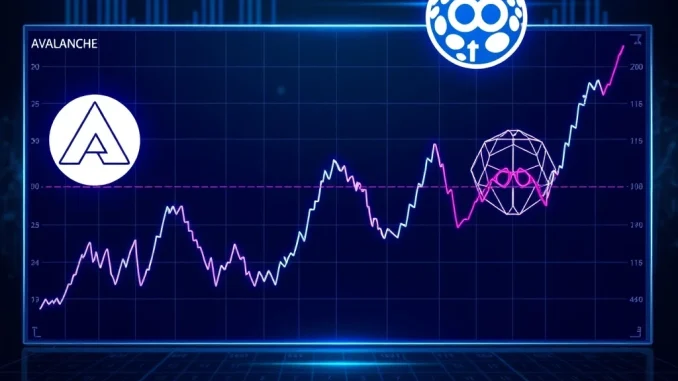
Avalanche, a platform renowned for its high throughput and sub-second transaction finality, has seen its native token, AVAX, consolidate within a key price range. The “$10 target” referenced in market discourse represents more than a round number; it is a psychologically significant resistance level that has acted as a pivot point in previous market cycles. Technically, a sustained break above this level on significant volume could signal a potential shift in market structure. Fundamentally, Avalanche’s position is bolstered by its consistent development of subnet architecture, which allows institutions and enterprises to deploy customizable blockchain solutions. Recent ecosystem growth, measured by total value locked (TVL) in decentralized finance (DeFi) and the expansion of its Evergreen subnets for institutional use, provides the foundational context for its price action. Market participants watching AVAX are therefore evaluating both its technical chart patterns and the adoption metrics of its core technology.
The Technical and Fundamental Landscape for AVAX
From a technical analysis perspective, the area around $10 has historically acted as a strong zone of confluence, where previous support has turned into resistance. A successful breach requires sustained buying pressure, often catalyzed by positive network developments or broader market rallies. Fundamentally, Avalanche’s value proposition hinges on scaling without sacrificing decentralization or security—the so-called “blockchain trilemma.” Its performance relative to competitors in processing speed and cost efficiency during periods of high network demand remains a critical benchmark. Analysts often cross-reference AVAX price trends with on-chain data points, such as active addresses, transaction counts, and developer contributions, to assess whether price movements are supported by network health.
Polkadot (DOT) Navigates a Complex Recovery Path
Polkadot’s market performance in early 2025 reflects the challenges and opportunities inherent in a complex, multi-chain ecosystem. Its architecture, centered on a relay chain coordinating numerous parallel chains (parachains), is fundamentally different from monolithic blockchains. DOT’s price recovery is thus tied not only to general market sentiment but also to the specific success and usage of the projects leasing parachain slots. The “attempts recovery” narrative follows a period of consolidation after the initial parachain auction frenzy subsided. The current phase focuses on the utility and user adoption being generated by the live parachains. Key metrics for Polkadot’s recovery include the number of active parachains, cross-chain message volume, and the growth of staking participation, which directly impacts network security and tokenomics.
Investor scrutiny has intensified regarding the tangible outputs of the parachain model. Successful deployments in areas like decentralized identity, real-world asset tokenization, and scalable smart contracts are considered essential for justifying the ecosystem’s early investment. Therefore, DOT’s price is increasingly viewed as a reflection of the aggregate success of its parachain ecosystem, making its recovery path inherently more multifaceted than that of a single-purpose blockchain.
The Rise of Utility: Why Traders Are Focusing on DeepSnitch AI
Amid the movements of large-cap altcoins, a significant portion of trader discussion and capital flow has shifted toward projects explicitly built around artificial intelligence utility. DeepSnitch AI represents this category, where the emphasis is on integrating AI models directly into blockchain operations. The cited “300x growth potential” is a speculative figure that originates from community projections based on total addressable market calculations for AI-on-blockchain services. However, the more substantive trader focus is on the project’s stated utility: providing on-chain AI auditing, smart contract vulnerability detection, and automated compliance checks.
This focus aligns with a clear market need. As blockchain applications grow more complex and handle greater value, security and code verification become paramount. A tool that can autonomously and continuously audit smart contract code for vulnerabilities or regulatory compliance gaps presents a practical use case. Traders evaluating such projects are less concerned with pure monetary policy and more with the product’s technical viability, the team’s expertise in both AI and cryptography, adoption roadmap, and potential customer base. The shift toward DeepSnitch AI and similar projects underscores a maturation in altcoin investing, where narratives are being stress-tested against real-world problem-solving capability.
Evaluating AI-Crypto Hybrids: Beyond the Hype
The integration of AI and blockchain is a nascent but rapidly evolving field. Projects like DeepSnitch AI operate at this intersection, promising enhanced security and automation. For a discerning investor, evaluation extends beyond the AI label. Critical due diligence involves examining the specifics of the AI model: Is it open-source? How is it trained and validated? What are its computational requirements, and how does the blockchain infrastructure support them? Furthermore, the tokenomics must clearly define how the utility token is used within the ecosystem—is it required to pay for audit services, stake for network security, or govern protocol upgrades? The concentration of trader interest suggests a market that is learning to differentiate between superficial AI branding and projects with a technically sound, utility-driven model that addresses a verifiable gap in the current blockchain landscape.
Comparative Analysis: Layer-1s vs. Niche Utility Protocols
The current market presents a strategic dichotomy for investors. On one side are established layer-1 platforms like Avalanche and Polkadot. These are foundational infrastructure plays; their long-term value is correlated with the broad adoption of blockchain technology itself. Investing in them is a bet on the ecosystem’s overall growth. Their risks include intense competition from other layer-1s and potential technological obsolescence.
On the other side are niche utility protocols like DeepSnitch AI. These are tactical investments in specific solutions. Their growth potential can be exponential if they capture a dominant share of a defined market, but they also carry higher risk, including execution risk, technological failure, or simply being outcompeted by a better solution. The following table outlines the core investment thesis for each type within the current “best altcoins to buy” discussion:
| Project Type | Primary Value Driver | Key Risk Factors | Investor Profile Fit |
|---|---|---|---|
| Layer-1 (Avalanche, Polkadot) | Ecosystem scale, network effects, foundational tech adoption. | Competition, scalability challenges, regulatory shifts. | Seeking broad market exposure, lower volatility relative to micro-caps. |
| Niche Utility (DeepSnitch AI) | Solution adoption, market capture, technological superiority in a niche. | Product-market fit, execution, technological feasibility. | Comfortable with higher risk for potentially asymmetric returns, believes in a specific trend. |
This framework helps explain why trader portfolios may contain a mix of both: layer-1s for stability and ecosystem growth, and high-utility micro-caps for targeted, high-growth potential.
Conclusion: A Maturing Market for the Best Altcoins to Buy
The landscape for identifying the best altcoins to buy is evolving from pure price speculation to a more nuanced analysis of technology, utility, and market fit. Avalanche’s approach toward the $10 level and Polkadot’s recovery efforts are grounded in their ongoing technological development and ecosystem expansion. Concurrently, the focused interest in projects like DeepSnitch AI highlights a market increasingly willing to reward tangible, problem-solving utility over vague promises. For investors, this environment demands rigorous due diligence, separating substantive technological progress from marketing narratives. The common thread is a demand for clarity: clear use cases, clear technological advantages, and clear paths to adoption. As the cryptocurrency sector matures, this focus on fundamental utility is likely to become the defining characteristic of sustainable value creation, making it the central criterion for any discussion about the best altcoins to buy.
FAQs
Q1: What does it mean when analysts say Avalanche is “targeting $10”?
This typically refers to technical analysis, where $10 is identified as a key price level of resistance. A break above it could indicate a potential bullish trend reversal, but it is not a guarantee. The term also incorporates market sentiment and the psychological importance of round-number thresholds.
Q2: What are the main factors influencing Polkadot’s recovery?
Polkadot’s recovery is primarily influenced by the adoption and usage of its parachains, the volume of cross-chain transactions, overall network security (staking participation), and broader cryptocurrency market sentiment. Success is measured by the utility being built on its ecosystem, not just DOT’s price.
Q3: What is the core utility proposed by DeepSnitch AI?
Based on available project documentation, DeepSnitch AI proposes to use artificial intelligence to provide automated security auditing for smart contracts, detect vulnerabilities in blockchain code, and assist with regulatory compliance checks—addressing critical needs for security and scalability in Web3.
Q4: Is a “300x growth potential” a reliable investment metric?
No, it is not a reliable metric. Such figures are highly speculative projections, often based on optimistic total market size assumptions. They should not be the basis for an investment decision. Serious evaluation focuses on the team, technology, product-market fit, and tokenomics.
Q5: How should an investor balance a portfolio between large-cap altcoins and newer utility projects?
A balanced approach often involves allocating a core portion to established projects with proven networks (like Avalanche or Polkadot) for stability and a smaller, risk-capital portion to high-potential utility projects (like AI-crypto hybrids). The exact allocation depends on individual risk tolerance, investment horizon, and belief in specific technological theses.
Q6: Why is utility becoming a more important factor in altcoin evaluation?
As the market matures and regulatory scrutiny increases, projects that solve real problems and generate actual usage are viewed as more sustainable. The era of “vaporware” and pure meme-driven coins has led to significant losses, prompting investors to prioritize fundamentals, including a clear and working utility, to assess long-term viability.