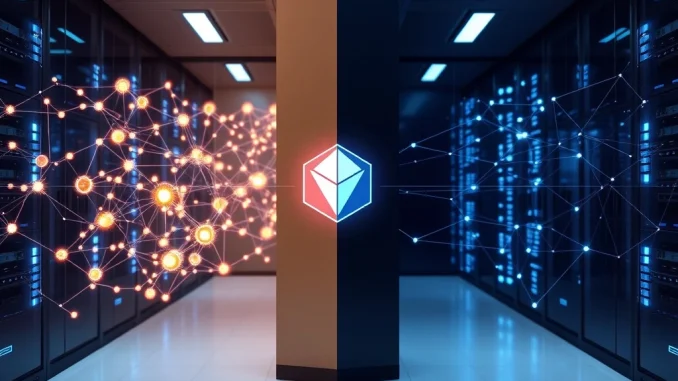
NEW YORK, March 15, 2026 — Major financial institutions are implementing a dual blockchain infrastructure strategy that splits real-world asset tokenization between public and permissioned networks, according to exclusive insights from RedStone co-founder Marcin Kaźmierczak. This architectural divide reveals how traditional finance is adapting blockchain technology to serve conflicting needs: the liquidity advantages of public chains versus the privacy demands of institutional workflows. The approach comes as tokenized assets processed through these systems reached $6 trillion in value during 2025, signaling a fundamental shift in how banks manage and distribute assets on-chain.
Dual Rails Strategy: Public Liquidity Meets Private Processes
Kaźmierczak explained to Cointelegraph that financial institutions are building parallel systems rather than converging on a single blockchain architecture. Product development and market-facing activities increasingly occur on public blockchains like Ethereum, which offer deep liquidity pools and access to decentralized finance protocols. Meanwhile, permissioned systems such as the Canton Network handle internal institutional processes requiring confidentiality. “There are operations between institutions that simply have to stay private,” Kaźmierczak stated, “and this is the value proposition that Canton offers very effectively.”
This division reflects practical considerations rather than technological limitations. Public chains provide composability and access to over $160 billion in stablecoin liquidity, while permissioned networks replicate existing traditional finance infrastructure for settlement and bilateral transactions. The Canton Network, developed by Digital Asset with consortium members including Goldman Sachs and Microsoft, processed $6 trillion in RWA value last year alone. Its cryptocurrency recently entered the top 20 by market capitalization following its November launch, demonstrating institutional adoption momentum.
Ethereum’s Institutional Confidence Surge Post-Merge
Kaźmierczak identified Ethereum’s 2022 transition to proof-of-stake as a critical turning point for institutional adoption. “When I was talking to institutions in 2022, the Merge was a big question mark,” he recalled. “They saw it worked without any hiccups, so it gave them this confidence.” This technical milestone preceded a wave of institutional RWA projects beginning in 2023-2024, though their public announcements clustered in late 2025 due to institutional budgeting cycles. Today, over $26.4 billion worth of RWA tokens use blockchains as distribution layers, with Ethereum hosting more than $15 billion of that total.
Regulatory developments have accelerated adoption. The 2025 GENIUS Act established a federal framework for stablecoins, creating a reliable settlement layer for tokenized assets. McKinsey’s June 2024 estimate projected $2 trillion in tokenized assets by 2030, while more optimistic forecasts from Standard Chartered and Synpulse target $30.1 trillion by 2034. These projections assume continued regulatory clarity and technological maturation across both public and private blockchain implementations.
Architectural Divide: ZK-Proofs Versus Permissioned Privacy
The privacy approaches between public and permissioned networks highlight fundamental philosophical differences. Public blockchain projects increasingly employ zero-knowledge proofs for confidentiality, while permissioned systems like Canton rely on restricted data sharing where transactions remain visible only to involved parties. This distinction sparked public debate between Matter Labs CEO Alex Gluchowski and Digital Asset’s Yuval Rooz regarding auditability versus security.
Gluchowski argued that ZK systems strengthen security by requiring cryptographic proofs for every state transition, preventing invalid transactions even if operators are compromised. Rooz countered that fully opaque ZK implementations could recreate “black box” conditions reminiscent of corporate scandals like Enron, making audit trails impossible. This disagreement reflects broader industry experimentation with balancing privacy, verifiability, and control as financial institutions test multiple architectural approaches.
Parallel Infrastructure: Market Impact and Implementation Timeline
The dual-rail strategy creates parallel infrastructure that serves different functions within tokenized finance. Public chains handle liquidity provision and DeFi integration, while permissioned systems support operational processes behind the scenes. According to RWA.xyz data, the Canton Network represents over $313 billion in RWA tokens used as recordkeeping layers, though these assets cannot move to external wallets outside issuing platforms.
- Liquidity Advantage: Ethereum holds over $160 billion in stablecoins and the deepest smart contract liquidity
- Privacy Requirement: Canton processes $6 trillion in RWA value with transaction visibility restricted to counterparties
- Regulatory Alignment: GENIUS Act provides stablecoin framework for tokenized asset settlement
- Implementation Pace: Institutional projects follow yearly budgets rather than crypto-native development cycles
Institutional Adoption Patterns and Future Projections
Kaźmierczak emphasized that institutional blockchain adoption follows different patterns than crypto-native development. “It’s not that they started in Q4 last year,” he noted regarding the cluster of December 2025 announcements. “No, they started a year before, and now we are seeing the fruits.” This delayed visibility creates challenges for tracking adoption momentum but suggests sustained institutional commitment beyond hype cycles.
The Depository Trust & Clearing Corporation completed a pilot of the US Treasury Collateral Network on Canton in September 2024, demonstrating real-world implementation at scale. Multiple major financial institutions participated in Canton’s development from inception, ensuring the network addresses actual institutional requirements rather than theoretical use cases. This ground-up design approach contrasts with public blockchain development driven primarily by developer communities and retail users.
Broader Industry Context: Tokenization Beyond Cryptocurrency
Tokenization represents one of the main narratives driving institutional blockchain adoption beyond spot crypto exposure and exchange-traded funds. The technology enables fractional ownership, automated compliance, and 24/7 settlement for traditionally illiquid assets including real estate, private equity, and commodities. As these markets digitize, the architectural choices between public and private implementations will shape global capital flows and financial infrastructure.
| Network Type | Primary Function | Key Advantage | Representative Value |
|---|---|---|---|
| Public Blockchains (Ethereum) | Market-facing distribution | Liquidity & composability | $15B+ RWA tokens |
| Permissioned Networks (Canton) | Internal workflows | Privacy & control | $6T processed (2025) |
| Hybrid Approaches | Cross-network settlement | Flexibility & interoperability | Emerging implementations |
Forward-Looking Analysis: Convergence or Continued Division?
The current dual-rail approach suggests continued division rather than convergence on a single network model. Financial firms appear committed to building specialized infrastructure for different functions rather than seeking universal solutions. However, interoperability between public and permissioned networks remains a critical challenge. Successful bridges could enable assets to move seamlessly between liquidity pools and private settlement systems, potentially creating hybrid architectures that leverage both approaches.
Kaźmierczak indicated RedStone’s intention to support both tracks: “That’s the reason we want to be on both of those legs.” This pragmatic approach reflects oracle providers’ need to serve diverse institutional requirements as tokenization expands across asset classes and jurisdictions. The coming years will test whether this division represents a temporary phase or a permanent feature of institutional blockchain infrastructure.
Stakeholder Reactions and Industry Positioning
Industry responses to the dual-rail strategy vary by sector. Traditional financial institutions generally favor permissioned approaches that mirror existing regulatory and operational frameworks. Crypto-native firms advocate for public chain solutions emphasizing transparency and decentralization. Technology providers like RedStone position themselves as neutral infrastructure serving both paradigms, while regulators monitor developments for systemic risk implications.
The debate extends beyond technical architecture to fundamental questions about financial system design. Public chains promote open access and innovation but face scalability and privacy challenges. Permissioned networks offer control and compliance but may limit interoperability and innovation. As tokenization scales, these trade-offs will shape not just technology choices but financial market structure itself.
Conclusion
Banks and asset managers are implementing a dual blockchain strategy that splits real-world asset tokenization between public chains for liquidity and permissioned networks for privacy. This architectural division reflects practical responses to conflicting institutional requirements rather than ideological preferences. Ethereum’s post-Merge stability and regulatory developments like the GENIUS Act have accelerated adoption, with $6 trillion in RWA value processed through these systems in 2025 alone.
The coming years will determine whether this division represents a transitional phase or permanent feature of tokenized finance. Interoperability solutions between public and private networks could enable hybrid architectures, while regulatory developments may favor one approach over the other. What remains clear is that institutional blockchain adoption has moved beyond experimentation into production implementation at scale, with real-world assets serving as the proving ground for next-generation financial infrastructure.
Frequently Asked Questions
Q1: What is the dual blockchain strategy banks are implementing for RWAs?
Banks are using public blockchains like Ethereum for market-facing token distribution and liquidity access, while employing permissioned networks like Canton for private internal workflows and settlement processes requiring confidentiality.
Q2: How much value do tokenized real-world assets currently represent?
Over $26.4 billion worth of RWA tokens use blockchains as distribution layers, with more than $15 billion of that on Ethereum. The Canton Network processed $6 trillion in RWA value during 2025 alone.
Q3: Why did Ethereum’s Merge increase institutional confidence?
The successful transition to proof-of-stake in 2022 demonstrated Ethereum’s technical stability without disruptions, addressing institutional concerns about network reliability for mission-critical financial applications.
Q4: What regulatory development supports tokenized asset growth?
The GENIUS Act passed in 2025 created a federal framework for stablecoins, which serve as the primary settlement layer for many tokenized assets, providing regulatory clarity for institutional adoption.
Q5: How do privacy approaches differ between public and permissioned networks?
Public chains increasingly use zero-knowledge proofs for confidentiality, while permissioned networks like Canton restrict transaction visibility to involved parties only, reflecting different approaches to auditability versus privacy.
Q6: What does this mean for traditional finance infrastructure?
The dual-rail approach creates parallel systems that may eventually replace or augment existing settlement and custody infrastructure, potentially reducing costs and increasing efficiency for asset management and distribution.