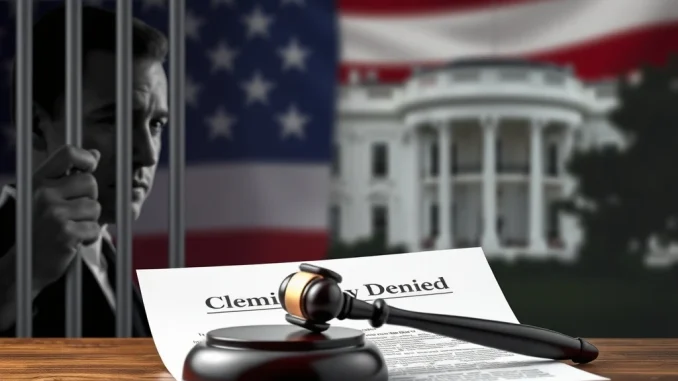
Washington, D.C., March 2025: In a definitive blow to his hopes for early release, former FTX CEO Sam Bankman-Fried has failed to secure support for a presidential pardon from Donald Trump. The White House has publicly confirmed it does not anticipate granting clemency to the convicted cryptocurrency executive, effectively shutting down a high-profile lobbying effort from the disgraced billionaire’s camp. This denial underscores the complex legal and political calculations surrounding presidential pardon powers, especially for figures at the center of one of history’s largest financial frauds.
Sam Bankman-Fried’s Pardon Campaign Meets a Wall of Resistance
Since his conviction and subsequent sentencing to 25 years in prison for orchestrating a massive fraud that led to the collapse of the FTX cryptocurrency exchange, Sam Bankman-Fried and his legal team have explored multiple avenues for appeal and early release. A presidential pardon represents the most direct, albeit politically fraught, path to freedom. Reports indicate that intermediaries for Bankman-Fried have actively sought to lobby the Trump administration, highlighting his previous philanthropic efforts and arguing that his sentence was excessively harsh. However, these efforts have collided with significant legal and reputational headwinds. The scale of the FTX collapse, which resulted in customer losses exceeding $8 billion, created a powerful public narrative of greed and deception. Legal experts note that granting clemency in such a prominent case of financial crime, before all standard appeals are exhausted, would be highly unusual and politically risky, potentially seen as favoring the wealthy and connected.
The White House’s Calculated Clemency Stance
The Trump administration’s public denial of anticipated clemency for Sam Bankman-Fried is a strategic move that aligns with historical precedent and current political optics. Presidential pardons are an executive power with few constraints, but their application often follows specific patterns. Historically, pardons for federal financial crimes of this magnitude are exceptionally rare before a significant portion of the sentence is served. The White House statement, which cited broad “legal and reputational concerns,” signals a desire to distance the administration from the toxic fallout of the FTX scandal. This decision also reflects the ongoing scrutiny of the cryptocurrency industry by regulators and lawmakers. Granting a pardon could be interpreted as a softening stance on crypto fraud enforcement, a message the current administration appears unwilling to send. The table below outlines key factors influencing the denial:
| Factor | Description | Impact on Pardon Decision |
|---|---|---|
| Magnitude of Crime | One of the largest financial frauds in U.S. history. | Creates immense public and political pressure against clemency. |
| Victim Count | Millions of retail investors and customers globally. | Makes a pardon socially untenable and a potential political liability. |
| Legal Process | Direct appeals are still pending in federal court. | Undermines the judicial process if executive action is taken prematurely. |
| Industry Signal | Crypto sector is under intense regulatory scrutiny. | A pardon could be seen as leniency towards bad actors in the space. |
The Historical Context of High-Profile Pardons
To understand the denial, one must examine the history of presidential clemency in controversial cases. Pardons for figures convicted of financial crimes, such as financier Michael Milken or media mogul Conrad Black, were typically granted after years of imprisonment and often accompanied by substantial restitution and public expressions of remorse. Bankman-Fried’s case is unique in its digital, global scale and the speed with which a pardon bid emerged. Furthermore, the political landscape surrounding Donald Trump’s use of pardon power has been closely watched. While he has pardoned several high-profile individuals, they often shared political connections or aligned causes. Bankman-Fried, a notable political donor primarily to Democratic causes before his arrest, lacks that direct political alignment, making his case a lower priority and a higher risk for the administration.
Implications for Crypto Regulation and Executive Power
This failed pardon bid carries significant implications beyond Sam Bankman-Fried’s personal fate. For the cryptocurrency industry, the White House’s stance is a stark reminder that the era of operating in a regulatory gray area is over. The denial reinforces the message that severe consequences will follow egregious violations of financial law, regardless of the technological platform. It may bolster ongoing efforts by the Securities and Exchange Commission (SEC) and the Department of Justice to pursue enforcement actions against other alleged bad actors in the crypto space. Regarding executive power, the case highlights the self-imposed limits presidents often observe. Even with broad constitutional authority, political calculus, public perception, and institutional norms heavily influence clemency decisions. The denial demonstrates that some cases are considered “too hot to handle,” where the political cost of intervention outweighs any potential benefit.
Conclusion
The definitive rejection of Sam Bankman-Fried’s plea for a presidential pardon from Donald Trump marks a critical juncture in the aftermath of the FTX collapse. It affirms the principle that unprecedented financial crimes will likely face unprecedented legal consequences, with little recourse to short-circuit the judicial process through executive action. For Bankman-Fried, the path forward now rests solely with the federal appellate courts. For the public and the crypto industry, the White House’s denial serves as a powerful symbol that the legal system, however slowly, is holding even the most prominent and wealthy individuals accountable. This outcome matters because it reinforces the bedrock idea that no one is above the law, a principle essential for maintaining trust in both financial markets and democratic institutions.
FAQs
Q1: What was Sam Bankman-Fried convicted of?
Sam Bankman-Fried was convicted on seven federal counts, including wire fraud, conspiracy to commit wire fraud, conspiracy to commit securities fraud, conspiracy to commit commodities fraud, and conspiracy to commit money laundering, related to the collapse of the FTX cryptocurrency exchange.
Q2: Can Donald Trump still pardon Sam Bankman-Fried in the future?
Yes, the presidential pardon power is broad and can be exercised at any time. The White House statement indicates no *anticipated* clemency, but it does not permanently foreclose the possibility, however unlikely it currently appears.
Q3: How long is Sam Bankman-Fried’s prison sentence?
He was sentenced to 25 years in federal prison. His current release date, with standard good behavior, is projected around 2046.
Q4: Have other cryptocurrency executives received presidential pardons?
No major cryptocurrency executive convicted of fraud at the federal level has ever received a presidential pardon. This area of law and executive clemency is still very new.
Q5: What are Bankman-Fried’s remaining legal options besides a pardon?
His primary legal avenue is to pursue his direct appeal through the U.S. Court of Appeals for the Second Circuit. If unsuccessful there, he could petition the U.S. Supreme Court to hear his case, though such petitions are rarely granted.
This article was produced with AI assistance and reviewed by our editorial team for accuracy and quality.