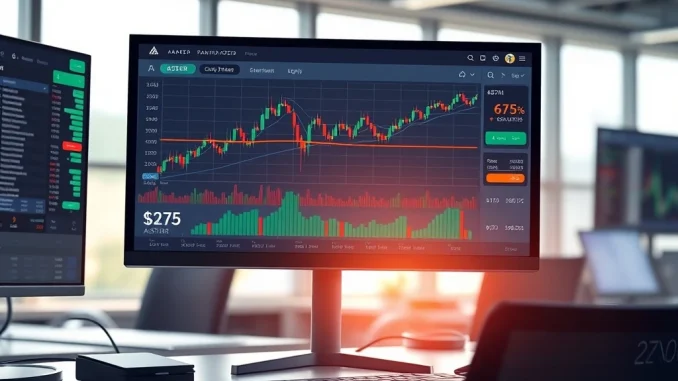
NEW YORK, March 21, 2026 — The ASTER cryptocurrency has entered its longest recorded consolidation period, creating a tense stalemate for traders fixated on a decisive move above the critical $0.75 resistance level. As of this morning, the digital asset continues to trade within a tight three-week range, bounded by key support and a macro pivot point near $0.81. This prolonged period of price compression, accompanied by a notable decline in trading volume, signals a potential inflection point that could trigger significant volatility. Market analysts are now parsing whether this pattern represents strategic accumulation or the calm before a bearish breakdown.
ASTER Consolidation Reaches Historic Duration
The current ASTER consolidation phase, now exceeding 21 consecutive days, marks an unprecedented event in the token’s trading history. Data from CoinMarketCap and TradingView charts confirms the asset has oscillated between a well-defined support zone and the $0.75 resistance ceiling. “We are witnessing a textbook compression,” stated Maya Chen, a senior market analyst at Digital Asset Research Group. “The duration itself is a key metric. Historically for ASTER, consolidations beyond two weeks have preceded moves of 15% or more.” The declining volume profile during this phase particularly draws attention. Typically, falling volume during a sideways trend can indicate a loss of interest, but in cryptocurrency markets, it often precedes a sharp, high-volume breakout as liquidity re-enters rapidly.
This pattern diverges from ASTER’s typically volatile behavior observed throughout late 2025. The token’s 30-day historical volatility has plummeted from a peak of 85% to just 22%, according to metrics from analytics platform IntoTheBlock. This extreme suppression of price movement concentrates latent energy in the market, analogous to coiling a spring. The immediate catalyst for the consolidation appears to be a rejection from the $0.81 level in late February, a price point that acted as both support and resistance throughout the previous quarter.
Implications of the $0.75 Breakout or Breakdown
The focal point for the entire ASTER trading community remains the $0.75 price level. A confirmed daily close above this resistance, preferably on expanding volume, would invalidate the bearish structure of the past month. Technical analysts project an initial target near the $0.81 pivot, with a potential run toward $0.90 if bullish momentum sustains. Conversely, the risks are equally pronounced. A breakdown below the consolidation range support, currently around $0.68, could trigger a cascade of automated selling. “The leverage in the ASTER perpetual swap markets is elevated,” warned David Park, head of derivatives at the crypto exchange Vertex. “A swift move below $0.67 could liquidate over $12 million in long positions within hours, accelerating the decline.”
- Bullish Scenario: A breakout above $0.75 targets $0.81 and potentially $0.90, fueled by short covering and renewed investor interest.
- Bearish Scenario: A breakdown below $0.68 support risks a rapid drop toward $0.60, driven by liquidations and stop-loss orders.
- Neutral Scenario: The consolidation extends further, eroding trader patience and leading to a volatility spike on lower timeframes.
Expert Analysis on Market Structure
Institutional perspectives highlight the macroeconomic backdrop influencing this micro-level price action. A report published this week by the Blockchain Transparency Institute noted that broader crypto market capitalizations have also entered a period of low correlation with traditional equities, a condition that often precedes idiosyncratic, asset-specific moves. “ASTER’s standalone behavior suggests its price is being driven by project-specific developments and on-chain activity, not just beta to Bitcoin,” the report concluded. Chen from Digital Asset Research Group corroborates this view, pointing to a 30% increase in unique active addresses on the ASTER network over the consolidation period as a fundamentally positive sign that contrasts with the stagnant price. This on-chain/data divergence often resolves with price catching up to network growth.
Comparative Context in Cryptocurrency Markets
How does ASTER’s situation compare to other digital assets? Such prolonged consolidations are not uncommon in cryptocurrency but often signal major trend changes. For instance, Ethereum experienced a 28-day consolidation in Q3 2023 before launching a 120% rally. Conversely, similar patterns in lower-liquidity tokens have sometimes resolved with catastrophic breakdowns. The key differentiator often lies in development activity and liquidity depth.
| Cryptocurrency | Consolidation Duration (Past Example) | Subsequent Move |
|---|---|---|
| Ethereum (2023) | 28 days | +120% Rally |
| Solana (2024) | 19 days | -40% Breakdown |
| Cardano (2025) | 24 days | +65% Breakout |
| ASTER (Current) | 21+ days (ongoing) | TBD |
This historical precedent underscores why traders are watching the $0.75 breakout level with such intensity. The resolution of this pattern will likely provide a template for mid-cap altcoins currently in similar technical positions, making ASTER a bellwether for a segment of the market.
What Traders and Investors Should Watch Next
The immediate future hinges on two key factors: volume and catalyst alignment. First, any price move must be validated by a significant surge in trading volume, ideally 150-200% above the 20-day average, to confirm genuine participation. Second, the ASTER project team has a mainnet upgrade scheduled for early April. Historically, such fundamental events have acted as catalysts to resolve technical indecision. Market makers and large holders (“whales”) are likely positioning themselves in anticipation of this event, which could explain the current accumulation-like volume profile. Traders are advised to monitor order book depth around the $0.75 and $0.68 levels for clues about institutional intent.
Community and Social Sentiment Reaction
Across social trading platforms and Discord communities, sentiment is bifurcated. Technical traders are predominantly leaning bearish, citing the “lower highs” structure within the consolidation range. However, long-term holders and community members point to the robust on-chain metrics and upcoming development milestones as reasons for optimism. This divergence in perspective between short-term price action and long-term fundamental belief is classic during extended consolidation phases and often resolves violently when one narrative is proven correct.
Conclusion
The ASTER cryptocurrency stands at a critical technical juncture, trapped in its longest-ever consolidation as the market awaits a decisive break. The $0.75 resistance level is the clear line in the sand, with a breakout offering a path to recovery and a breakdown threatening accelerated losses. While declining volume suggests accumulation, the high leverage in derivatives markets introduces significant downside risk. Investors should prioritize confirmation through volume and watch for the upcoming mainnet upgrade as a potential fundamental catalyst. The resolution of this historic ASTER consolidation will not only determine the token’s near-term trajectory but also offer valuable insights into the behavior of similar assets in the current market environment.
Frequently Asked Questions
Q1: What does consolidation mean for a cryptocurrency like ASTER?
Consolidation refers to a period where the price trades within a relatively narrow range, following a prior trend. For ASTER, this indicates a balance between buying and selling pressure, often preceding a significant price move in either direction as this equilibrium breaks.
Q2: Why is the $0.75 price level so important for ASTER right now?
The $0.75 level has acted as a key resistance ceiling throughout the three-week consolidation. A sustained break above it would signal that buyers have overcome selling pressure, potentially triggering a rally toward the next resistance near $0.81.
Q3: What could cause a breakdown below ASTER’s current range?
A breakdown could be triggered by a broader market sell-off, negative project-specific news, or a wave of liquidations from over-leveraged long positions if price falls below the range support near $0.68.
Q4: How does low trading volume during consolidation affect the price?
Low volume often indicates indecision and a lack of strong conviction from both buyers and sellers. However, in crypto markets, it can also signal that large players are accumulating positions quietly before a major move, making the subsequent volume spike critical to watch.
Q5: How does ASTER’s current pattern compare to its past behavior?
This 21+ day consolidation is the longest in ASTER’s recorded trading history. Previous consolidation phases typically lasted 10-14 days, making the current setup more extreme and increasing the potential energy for a large subsequent move.
Q6: What should a retail investor do during this ASTER consolidation?
Retail investors should avoid making large directional bets until the price breaks conclusively from the range with high volume. Managing risk by setting stop-losses and watching for confirmation from both price and volume is the prudent strategy during such uncertain technical periods.
Updated insights and analysis added for better clarity.
This article was produced with AI assistance and reviewed by our editorial team for accuracy and quality.