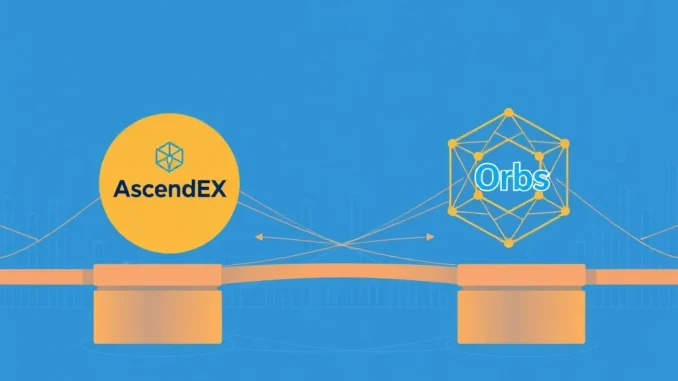
Global, May 2025: The landscape of digital asset trading is undergoing a significant structural shift. In a move signaling deeper convergence between centralized and decentralized finance, cryptocurrency exchange AscendEX has announced a strategic partnership with the Orbs Network, a layer-3 blockchain infrastructure project. This collaboration aims to directly uplift the capabilities and user experience of on-chain trading, specifically targeting advanced order execution and the underlying infrastructure for decentralized derivatives. The initiative represents a tangible step toward solving long-standing limitations in Web3’s financial tooling.
AscendEX and Orbs Network: A Partnership for On-Chain Trading Infrastructure
The core objective of the AscendEX and Orbs alliance is to enhance liquidity and execution quality for trades that settle directly on the blockchain. Traditionally, centralized exchanges (CEXs) like AscendEX offer superior liquidity and sophisticated order types but custody user assets. Decentralized exchanges (DEXs) offer self-custody and transparency but often suffer from fragmented liquidity, high slippage, and basic order book functionality. This partnership seeks to blend the strengths of both models. AscendEX brings its established user base, deep liquidity pools, and market expertise to the table. Orbs contributes its layer-3 technology, designed to operate as a decentralized execution layer between base blockchains (like Ethereum or BNB Chain) and applications, enabling more complex, gas-efficient smart contracts.
Decoding the Technical Ambitions: Advanced Orders and Derivatives
The announcement highlights two primary technical frontiers: advanced order types and decentralized derivatives infrastructure. For users, this translates to potential access to familiar, powerful trading tools in a non-custodial environment.
- Advanced Order Types: Moving beyond simple market and limit orders, the collaboration will focus on implementing conditional orders—such as stop-loss, take-profit, and trailing stops—directly via smart contracts. This requires sophisticated off-chain computation and on-chain settlement coordination, a technical challenge Orbs’s architecture is built to address.
- Decentralized Derivatives Infrastructure: Derivatives, like perpetual swaps and options, represent a massive market in traditional and centralized crypto finance. Building a robust, decentralized version requires reliable oracles for price feeds, robust margin and liquidation engines, and cross-margin capabilities. The partnership will work on standardizing and securing these core building blocks, making it easier for developers to launch compliant derivative DApps.
The Historical Context: The Long Road to Hybrid Finance
This partnership is not an isolated event but part of a broader industry trend often termed “CeDeFi” or hybrid finance. Since the advent of decentralized finance (DeFi) in 2020, the industry has grappled with the trade-offs between centralization and decentralization. Major CEXs have increasingly integrated with DeFi protocols for yield generation, while DeFi has slowly incorporated more complex financial instruments. The AscendEX-Orbs move is notable for its explicit focus on the trading execution layer itself, aiming to make the on-chain experience rival its off-chain counterpart. It follows similar exploratory efforts by other exchanges but with a defined technological partner in a layer-3 specialist.
Implications for Liquidity and Web3 User Experience
The potential consequences of successful integration are multifaceted. For liquidity, the goal is to create a more seamless flow between AscendEX’s order books and on-chain liquidity pools. This could reduce slippage for large on-chain trades and improve price discovery across venues. For the Web3 user, the implications center on experience and security. A trader could potentially manage a portfolio using advanced strategies without relinquishing asset custody, executing trades that are both sophisticated and transparently verifiable on the blockchain. This addresses a key demand from institutional and sophisticated retail participants who require complex tools but are increasingly wary of counterparty risk on centralized platforms.
Expert Analysis on Technical and Market Viability
Blockchain infrastructure analysts point to the critical role of execution layers like Orbs. “The bottleneck for advanced on-chain trading has rarely been the idea, but the execution cost and speed,” notes a researcher from a blockchain analytics firm. “Layer-3 solutions that handle computation off-chain before posting final proofs on-chain are essential for making limit orders and derivatives economically viable. A partnership with a liquidity provider like AscendEX provides the real-world market depth needed to test and scale these solutions.” The success of the initiative will depend on measurable metrics: reduced gas costs for complex orders, latency comparable to centralized systems, and demonstrably tighter bid-ask spreads on the integrated on-chain order books.
Conclusion: A Building Block for the Next Trading Era
The partnership between AscendEX and Orbs Network represents a concrete attempt to bridge a persistent gap in the crypto ecosystem. By focusing on the fundamental on-chain trading infrastructure for advanced orders and derivatives, the collaboration moves beyond theoretical DeFi benefits to address practical trader needs. Its progress will be a key indicator of how quickly hybrid finance models can mature, potentially setting a new standard for how liquidity, sophistication, and self-custody coexist in the Web3 financial stack. The evolution of this partnership will be closely watched by developers, traders, and competing platforms alike.
FAQs
Q1: What is the main goal of the AscendEX and Orbs partnership?
The primary goal is to enhance on-chain trading by developing infrastructure for advanced order types (like stop-loss orders) and decentralized derivatives, aiming to combine the liquidity of a centralized exchange with the security and transparency of decentralized settlement.
Q2: How does Orbs Network’s technology contribute to this?
Orbs operates as a layer-3 blockchain, acting as a decentralized execution layer. It is designed to perform complex, gas-intensive computations off-chain before settling final results on a base chain (like Ethereum), which is crucial for making advanced trading features cost-effective.
Q3: What are “advanced order types” in this context?
These refer to conditional orders beyond simple buy/sell limits, such as stop-loss orders (to limit losses), take-profit orders (to secure gains), and trailing stops. Currently, these are staples of centralized exchanges but are complex and costly to implement reliably on-chain.
Q4: Why is decentralized derivatives infrastructure important for Web3?
Derivatives are a major part of global finance, enabling hedging and speculation. A secure, decentralized infrastructure for them allows users to access these tools without relying on a centralized intermediary, reducing counterparty risk and increasing market accessibility and transparency.
Q5: Does this mean AscendEX is becoming a decentralized exchange?
Not exactly. The partnership suggests AscendEX is working to integrate decentralized settlement and execution capabilities into its ecosystem. It represents a hybrid model where centralized liquidity and user experience can interact with decentralized, on-chain finality, offering users more choice and control.
Updated insights and analysis added for better clarity.
This article was produced with AI assistance and reviewed by our editorial team for accuracy and quality.