In a historic departure from its core business model, Arm Holdings has unveiled its first internally developed semiconductor, the Arm AGI CPU, marking the end of the company’s 35-year exclusive focus on intellectual property licensing. The San Francisco announcement on March 24, 2026, represents a fundamental strategic shift for the UK-based company, positioning it as a direct competitor to many of its longstanding partners in the fiercely competitive AI hardware market.
Arm AGI CPU Redefines Data Center Processing
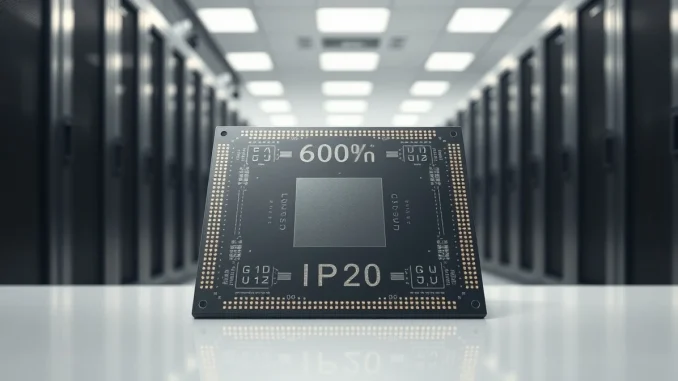
The newly revealed Arm AGI CPU is a production-ready processor specifically engineered for running artificial intelligence inference workloads in data center environments. Arm developed this chip using its proprietary Neoverse family of CPU intellectual property cores. Furthermore, the company established a significant partnership with Meta, which serves as the chip’s inaugural customer. This processor is designed to integrate seamlessly with Meta’s existing training and inference accelerator infrastructure.
Arm has also secured several prominent launch partners for this venture, including OpenAI, Cerebras, and Cloudflare. This collaborative approach suggests Arm aims to establish its silicon within established AI ecosystems rather than operating in isolation. The company’s transition to manufacturing its own chips has been anticipated within industry circles for some time. According to previous CNBC reporting, internal development of these processors began back in 2023.
A Strategic Pivot Decades in the Making
This move constitutes a monumental deviation for Arm, a company founded in 1990 that built its global dominance by licensing chip architecture designs to other manufacturers. Companies like Apple, Qualcomm, and Nvidia have historically licensed Arm’s designs to power billions of devices, from smartphones to servers. By entering the chip manufacturing arena, Arm, which is majority-owned by Japanese conglomerate SoftBank Group, now competes directly with many of these same partners.
The decision to produce a CPU, rather than a GPU, is particularly noteworthy. Graphics processing units have captured significant market attention due to their critical role in training complex AI models. However, central processing units remain equally vital components within data center infrastructure. In its technical presentation, Arm emphasized the CPU’s role in managing thousands of distributed tasks. These tasks include memory and storage management, workload scheduling, and data movement across large-scale systems.
The Critical Role of CPUs in Modern AI Infrastructure
Arm argues that the CPU has evolved into the “pacing element of modern infrastructure.” The company states these processors are now responsible for maintaining efficient operation of distributed AI systems at scale. Consequently, this places new, demanding requirements on CPU design and necessitates continuous processor evolution. The growing complexity of AI workloads, which often involve coordinating vast arrays of specialized accelerators, has elevated the importance of the host CPU.
Market dynamics also support Arm’s strategic focus. A global CPU shortage has created significant supply chain pressures. In March 2026, major suppliers like Intel and AMD informed customers in China about extended product wait times, as originally reported by Reuters. This shortage has subsequently contributed to rising prices for computers and servers worldwide, highlighting the strategic importance of a diversified supply of high-performance processors.
The key technical and market factors driving Arm’s decision include:
- AI Workload Specialization: The need for CPUs optimized for inference rather than general-purpose computing.
- Supply Chain Diversification: Reducing industry reliance on a limited number of CPU vendors.
- Vertical Integration: Controlling both architecture and implementation to optimize performance.
- Ecosystem Demand: Partner companies seeking tightly integrated hardware-software solutions.
Analyzing the Competitive Landscape
Arm’s entry into the chip market intensifies competition in the already crowded data center processor sector. The company now faces established players like Intel with its Xeon processors and AMD with its EPYC lineup, alongside various Arm-based designs from partners like Ampere Computing and Amazon’s Graviton. However, Arm’s deep architectural expertise and existing software ecosystem provide unique advantages. The company’s intimate knowledge of its own Neoverse designs could enable optimization levels that third-party licensees cannot easily match.
The partnership with Meta is strategically crucial. Meta operates some of the world’s largest data centers, and its endorsement serves as a powerful validation of the Arm AGI CPU’s capabilities. If successful, this deployment could encourage broader adoption across the hyperscaler market. For other partners like OpenAI and Cloudflare, access to a purpose-built inference CPU from the architecture’s creator could offer performance or efficiency benefits for their specific services.
Implications for the Semiconductor Industry
Arm’s strategic shift signals a broader trend toward vertical integration in the semiconductor industry. Large technology companies increasingly seek to design their own silicon to gain competitive advantages in performance, power efficiency, and cost. Apple’s successful transition to its M-series processors for Mac computers demonstrated the potential of this approach. Similarly, Google developed its Tensor Processing Units, and Amazon created the Graviton CPU family.
For Arm’s traditional licensing business, this move creates a complex new dynamic. While the company will continue to license its IP to hundreds of partners, it now also competes with them in a specific, high-value market segment. How partners like Nvidia, which has its own Grace CPU based on Arm Neoverse, respond to this development remains a key question for the industry. Some analysts suggest Arm may reserve its most advanced implementations for its own products, potentially creating a two-tier ecosystem.
Technical Specifications and Market Availability
While Arm has not released exhaustive technical specifications for the AGI CPU, the company confirmed the processors are already available for customer orders. The use of Neoverse IP cores indicates the chip likely leverages the latest V-series cores designed for maximum single-threaded performance or N-series cores optimized for density and throughput. The “AGI” designation, referring to Artificial General Intelligence, is primarily a marketing term highlighting the chip’s focus on advanced AI workloads rather than a claim about achieving AGI itself.
The development timeline, beginning in 2023, aligns with typical semiconductor design cycles, which often span multiple years from initial architecture to production silicon. The fact that Arm has reached the production-ready stage within approximately three years demonstrates significant internal investment and execution capability. This rapid progress was likely accelerated by the company’s deep existing knowledge base and its partnership with Meta, which provided a clear use-case and validation target.
Conclusion
The launch of the Arm AGI CPU represents a watershed moment for the 35-year-old semiconductor design firm. By manufacturing its own silicon, Arm is not just entering a new market; it is fundamentally redefining its relationship with the global technology ecosystem. This strategic pivot, driven by the unique demands of AI data centers and ongoing supply chain pressures, positions Arm as both a partner and a competitor in the high-stakes world of server processors. The success of this venture will depend on technical performance, partner adoption, and the company’s ability to navigate the complex new dynamics it has created. The industry will now watch closely as the first Arm AGI CPU chips are deployed in Meta’s data centers, testing whether Arm’s architectural expertise can translate into a competitive, production-scale product.
FAQs
Q1: What is the Arm AGI CPU?
The Arm AGI CPU is the first semiconductor chip designed and sold directly by Arm Holdings. It is a production-ready processor built specifically for running AI inference workloads in data centers, based on Arm’s Neoverse CPU architecture.
Q2: Why is Arm making its own chips now after 35 years of licensing?
Arm is transitioning to capitalize on the specific demands of AI data center infrastructure, diversify the CPU supply chain amid global shortages, and leverage its architectural expertise through vertical integration for optimized performance.
Q3: Who is the first customer for the Arm AGI CPU?
Meta is the inaugural customer. The chip is designed to work with Meta’s existing AI accelerator infrastructure for training and inference tasks.
Q4: Does this mean Arm will stop licensing its designs to other companies?
No. Arm has stated it will continue its core intellectual property licensing business. The AGI CPU represents a new, additional product line where Arm competes in a specific market segment.
Q5: How does a CPU for AI differ from a standard data center CPU?
An AI-optimized CPU like the Arm AGI CPU is designed with features to better manage the distributed tasks, data movement, and workload scheduling inherent in large-scale AI systems, acting as the coordinating “pacing element” for arrays of AI accelerators.
Updated insights and analysis added for better clarity.
This article was produced with AI assistance and reviewed by our editorial team for accuracy and quality.