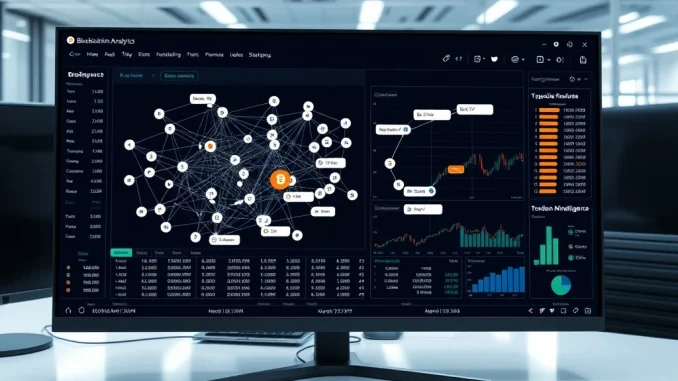
Global, May 2025: Arkham Intelligence, a leading entity in blockchain intelligence, has officially launched its next-generation Intel API, a pivotal development designed to fundamentally enhance fund-flow tracking, entity labeling, and institutional-grade analytics across the cryptocurrency ecosystem. This release marks a significant evolution in the tools available for traders, compliance officers, and financial institutions navigating the complex on-chain landscape.
Arkham’s Next-Gen Intel API: A Deep Dive into Enhanced Capabilities
The newly unveiled Arkham Intel API represents a substantial upgrade over previous blockchain data interfaces. Traditional on-chain analysis often involves piecing together data from disparate explorers and tools, a process that is time-consuming and prone to gaps in visibility. Arkham’s platform addresses this by aggregating and structuring data from multiple blockchains into a unified, queryable system. The next-gen API expands this core functionality with several critical enhancements. First, it introduces more granular and real-time fund-flow tracking, allowing users to trace the movement of assets with greater precision and speed. Second, it significantly improves entity labeling, using advanced heuristics and attribution models to identify wallets belonging to exchanges, investment funds, protocols, and other known entities with higher confidence. Finally, it packages this data in formats specifically tailored for institutional use cases, such as compliance reporting and systematic trading strategies.
The Critical Role of Advanced Fund-Flow Tracking in Modern Crypto Markets
Accurate fund-flow tracking is no longer a niche interest but a foundational requirement for professional participation in digital asset markets. The movement of large capital sums, often signaled by transactions from known “whale” wallets or institutional entities, can have immediate and profound impacts on market sentiment and price action. For example, tracking inflows to and out of centralized exchanges can serve as a proxy for market sentiment—accumulation versus distribution. The Arkham Intel API provides this intelligence programmatically. Traders can integrate these data streams into their own models to identify trends, while risk managers can monitor for unusual activity. The API’s enhanced capabilities allow for filtering flows by size, asset, time frame, and originating or destination entity type, transforming raw blockchain data into actionable market intelligence.
From Anonymity to Accountability: The Power of Entity Labeling
A blockchain address is inherently pseudonymous, a string of characters that reveals nothing about its owner. This anonymity is a double-edged sword, enabling privacy but also obscuring illicit activity and market-moving behavior. Arkham’s next-gen API tackles this through sophisticated entity labeling. By correlating on-chain transactions with off-chain data, exchange announcements, protocol treasury movements, and public disclosures, Arkham assigns human-readable labels to addresses. This process turns an opaque transaction between two unknown wallets into a clear event, such as “Venture Fund A deposits 5,000 ETH to Exchange B.” For compliance teams, this is invaluable in conducting due diligence and monitoring for transactions involving sanctioned entities or high-risk jurisdictions. The improved accuracy and breadth of these labels in the new API reduce false positives and increase the reliability of automated monitoring systems.
Meeting the Demand for Institutional-Grade Blockchain Analytics
The entry of traditional finance (TradFi) institutions into the cryptocurrency space has created a surge in demand for data products that meet enterprise standards for reliability, scalability, and integration. These institutions require analytics that fit seamlessly into existing workflows for trading, portfolio management, and regulatory compliance. The Arkham Intel API is engineered specifically for this environment. It offers:
- High Reliability & Uptime: Enterprise-grade infrastructure ensuring data feeds are consistently available.
- Standardized Data Schemas: Clean, well-documented data outputs (like JSON) that are easy for developers to integrate into internal systems.
- Audit Trails: Features that support compliance requirements by providing a verifiable record of data queries and alerts.
- Customizable Alerts: Programmable notifications for specific on-chain events relevant to an institution’s portfolio or risk parameters.
This shift from ad-hoc analysis to systematic, API-driven intelligence is a hallmark of the market’s maturation.
Implications for Crypto Trading and Compliance Operations
The practical applications of this technology are vast. For quantitative trading firms, the API can feed real-time data into algorithms that execute trades based on signals like large exchange inflows, smart contract interactions, or treasury movements of decentralized autonomous organizations (DAOs). Compliance officers at crypto-native firms or traditional banks offering digital asset services can use the API to automate aspects of their Anti-Money Laundering (AML) and Counter-Financing of Terrorism (CFT) programs. They can screen transactions against Arkham’s labeled entity database to identify counterparties and monitor for patterns indicative of market manipulation or fraud. This not only increases efficiency but also enhances the defensibility of their compliance programs to regulators.
The Evolving Landscape of On-Chain Intelligence and Competitive Context
Arkham operates in a competitive field alongside other blockchain intelligence providers like Chainalysis, Nansen, and Etherscan. Each platform has its strengths, with some focusing heavily on law enforcement and compliance (Chainalysis) and others on DeFi analytics for traders (Nansen). Arkham’s strategic positioning with this API update appears to bridge these worlds, offering robust tools for both security/compliance and financial analysis. The development of such advanced APIs reflects a broader industry trend: the professionalization of on-chain data. As blockchain activity grows, the value is shifting from simply accessing raw data to interpreting it through powerful software layers that provide context, attribution, and predictive insights. Arkham’s next-gen Intel API is a direct response to this market evolution.
Conclusion
The launch of Arkham’s next-generation Intel API is a landmark event in the development of institutional-grade cryptocurrency infrastructure. By significantly enhancing fund-flow tracking, refining entity labeling, and packaging blockchain analytics for enterprise consumption, Arkham is providing the critical tools needed for the next phase of crypto market growth. This technology empowers traders with deeper market intelligence, equips compliance teams with stronger monitoring capabilities, and ultimately contributes to a more transparent, efficient, and secure digital asset ecosystem. The continued advancement of such analytics platforms will be fundamental to building trust and facilitating broader institutional adoption of blockchain technology.
FAQs
Q1: What is the Arkham Intel API?
The Arkham Intel API is a programming interface that provides programmatic access to Arkham Intelligence’s blockchain data platform. It allows developers and institutions to integrate advanced on-chain analytics, including fund-flow tracking and entity labeling, directly into their own applications and workflows.
Q2: How does fund-flow tracking with the API benefit crypto traders?
Traders can use the API to receive real-time data on large capital movements, exchange inflows/outflows, and activity from labeled entities like investment funds. This intelligence can inform trading decisions, help identify market trends, and provide early signals for potential price movements.
Q3: What is entity labeling and why is it important?
Entity labeling is the process of attaching identifiable information (e.g., “Binance Hot Wallet,” “Venture Fund X”) to otherwise anonymous blockchain addresses. It is crucial for compliance, risk assessment, and understanding the real-world actors behind market-moving transactions.
Q4: Is the Arkham Intel API designed for institutional use?
Yes, a primary focus of the next-generation API is to meet institutional requirements. It emphasizes reliability, scalable data delivery, standardized formats for easy integration, and features that support regulatory compliance and audit trails.
Q5: How does this development impact cryptocurrency compliance?
The API provides compliance teams with automated tools to screen transactions against a database of labeled entities, monitor for suspicious patterns, and generate reports. This increases the efficiency and effectiveness of Anti-Money Laundering (AML) and sanctions monitoring programs within the crypto industry.