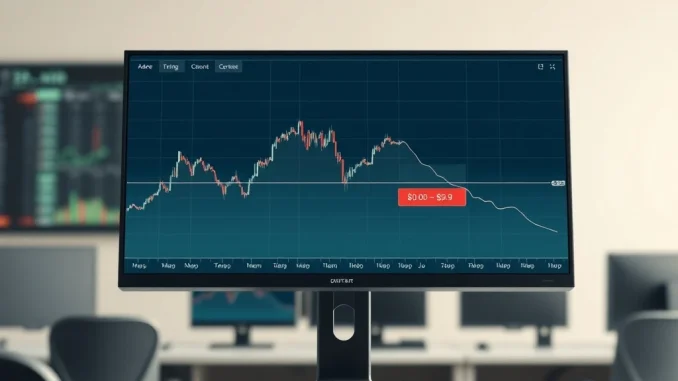
NEW YORK, March 15, 2026 — The Arbitrum (ARB) token, a leading Ethereum layer-2 scaling solution, is trading at a staggering 96% discount from its 2024 all-time high, entering a technical zone that veteran chart analysts identify as a potential generational buying opportunity. As of this morning, ARB fluctuates between $0.06 and $0.09, a region market technicians classify as a historic demand zone. This price action coincides with the formation of a classic Wyckoff Phase C accumulation structure, a pattern historically preceding significant bullish reversals. A confirmed breakout above the $0.23 resistance level could initiate the first major structural shift, with long-term cycle projections extending toward the $5.00 mark per token.
Arbitrum’s 96% Discount and the Wyckoff Accumulation Thesis
Market data from CoinGecko and TradingView confirms ARB’s current price represents a near-total retracement from its January 2024 peak of $2.425. The token now consolidates within the $0.06–$0.09 band, a range last tested during its initial distribution phases in early 2023. According to a technical report published by K33 Research on March 10, on-chain metrics show clear signs of seller exhaustion. Exchange outflow data from CryptoQuant indicates whales are absorbing supply at these levels, a hallmark of the absorption phase in the Wyckoff method. “The volume profile in this zone shows consistent buying on dips,” notes David Alexander, Senior Analyst at K33. “It’s a textbook setup where weak hands have capitulated, and stronger, patient capital is establishing positions.”
The Wyckoff method, developed by early 20th-century trader Richard Wyckoff, outlines market cycles of accumulation, markup, distribution, and markdown. Phase C, often called the “spring” or “test,” involves a final shakeout of retail holders before a sustained uptrend. Blockchain analytics firm Nansen reported a 15% increase in ARB holdings among addresses labeled “Smart Money” over the last 30 days, adding empirical weight to the technical pattern. This confluence of price action and on-chain behavior has drawn intense scrutiny from institutional and retail desks alike.
The Path Forward: Key Levels and $5.00 Cycle Targets
The immediate technical roadmap for ARB hinges on several clearly defined price levels. The current demand zone between $0.06 and $0.09 must hold to validate the accumulation thesis. A breakdown below $0.06 would invalidate the Wyckoff structure and likely lead to a retest of all-time lows. Conversely, analysts at Glassnode identify $0.23 as the first major bullish inflection point. This level represents the upper boundary of the multi-month consolidation range and the 200-day simple moving average on weekly charts. A weekly close above $0.23 with high volume would confirm a structural shift from accumulation to markup, according to their March 12 market update.
- Immediate Support ($0.06–$0.09): The critical demand zone where accumulation is theorized to occur. A loss here suggests deeper fundamental issues.
- Initial Resistance ($0.23): The breakout level that would signal the end of the accumulation phase and the beginning of a new bullish cycle.
- Cycle Target ($5.00): A long-term Fibonacci extension target derived from the depth of the preceding bear market. This represents a potential 8,000% return from current levels but is contingent on broader crypto market recovery and Arbitrum ecosystem growth.
Expert Analysis on the Broader Layer-2 Landscape
The setup for ARB cannot be divorced from the competitive dynamics of the layer-2 (L2) scaling sector. “Arbitrum remains the dominant force in total value locked (TVL) and developer activity,” states Elena Torres, Head of Research at Blockworks. “However, its token price has suffered from the same macro pressures affecting all crypto assets, combined with unlocks from early investors and teams.” Data from L2Beat shows Arbitrum One holds a 35% market share in TVL among all L2s, maintaining a lead over rivals like Optimism and Base. Torres emphasizes that the network’s fundamental health—measured by daily active addresses and transaction volume—remains robust despite the token’s price depreciation. This divergence between network utility and token price is a central pillar of the bullish accumulation argument.
Historical Context and Comparative Token Performance
Such deep discounts are rare but not unprecedented in cryptocurrency markets. Major assets like Ethereum and Solana experienced drawdowns exceeding 90% in previous cycles before embarking on historic rallies. The current ARB setup bears similarities to Ethereum’s consolidation between $80 and $120 in late 2018, which preceded its climb to over $4,800. The key differentiator is the maturity of the underlying ecosystem at the time of the low. Arbitrum’s developer community and dApp landscape are significantly more advanced now than Ethereum’s were during its 2018 accumulation phase.
| Cryptocurrency | Maximum Drawdown from ATH | Accumulation Zone | Subsequent Rally |
|---|---|---|---|
| Ethereum (2018-2020) | 94% | $80–$120 | Over 5,800% |
| Solana (2022-2023) | 96% | $8–$12 | Over 900% |
| Arbitrum (2024-2026) | 96% (Current) | $0.06–$0.09 | Projected: TBD |
What Traders and Investors Are Watching Next
The coming weeks will be decisive. Market participants are monitoring two primary catalysts: broader Bitcoin and Ethereum price action, and specific Arbitrum ecosystem developments. A failure of Bitcoin to hold above its key support levels could drag the entire altcoin market lower, overwhelming any individual token’s technical setup. On the protocol side, the success of upcoming Arbitrum Stylus upgrades and new major dApp launches could provide fundamental justification for a re-rating. The Offchain Labs team has scheduled the Arbitrum Orbit mainnet launch for Q2 2026, which will allow developers to launch custom chains, potentially driving new demand for ARB tokens for governance and fees.
Community and Institutional Sentiment Divergence
Sentiment within the crypto community is bifurcated. On social platforms, retail traders express extreme fear and capitulation, with many declaring the token “dead.” Conversely, institutional commentary has grown cautiously optimistic. In a recent investor note, Grayscale Research highlighted the risk-reward asymmetry at current prices, stating, “The combination of peak pessimism, strong fundamentals, and a clear technical narrative makes ARB a high-conviction watch item for Q2.” This divergence between retail despair and institutional interest is another characteristic often observed at major market bottoms.
Conclusion
The Arbitrum (ARB) token presents a compelling, high-stakes technical setup, trading at a 96% discount within a defined demand zone. The emerging Wyckoff Phase C accumulation pattern, supported by on-chain data showing supply absorption, has captured the attention of sophisticated market participants. While the immediate future depends on holding the $0.06–$0.09 support, a confirmed break above $0.23 could signal the start of a new bullish cycle with historically significant upside targets. Investors should watch for confirmation through volume and weekly closes, while acknowledging that macro crypto market trends will ultimately play the decisive role. The next four to six weeks will test whether this is a genuine accumulation springboard or merely another pause in a longer bear trend.
Frequently Asked Questions
Q1: What does a 96% discount mean for Arbitrum (ARB)?
It means the token’s price is currently 96% below its highest recorded value of $2.425, reached in January 2024. This represents a massive decline, placing it back near its initial trading ranges and creating what analysts call a deep-value or accumulation zone.
Q2: What is a Wyckoff Phase C accumulation structure?
It’s a technical analysis pattern indicating large investors are quietly buying an asset after a prolonged decline. Phase C involves a final price shakeout to exhaust remaining sellers before a sustained upward trend begins. It is characterized by low volatility and trading within a tight range.
Q3: What price level must ARB break to confirm a bullish trend change?
Analysts point to $0.23 as the key resistance level. A sustained breakout above this price, especially on high trading volume and a weekly closing basis, would be the first major technical signal that the accumulation phase has ended and a new markup (bullish) phase may be starting.
Q4: Is the $5.00 price target realistic for ARB?
The $5.00 target is a long-term, cyclical projection based on technical extensions, not a short-term forecast. Its achievement would require a combination of a successful breakout from accumulation, a sustained bull market across the entire cryptocurrency sector, and continued growth and adoption of the Arbitrum network itself.
Q5: How does Arbitrum’s fundamental health compare to its token price?
There is a significant divergence. Fundamentally, Arbitrum remains the leading Ethereum layer-2 by total value locked and developer activity. Its network usage and ecosystem are robust. The token price, however, has been heavily impacted by broader market sell-offs and token unlocks from early investors, creating this valuation disconnect.
Q6: What are the biggest risks to this bullish accumulation thesis?
The primary risks are a breakdown below the $0.06 support level, which would invalidate the Wyckoff structure, and a severe downturn in the broader cryptocurrency market led by Bitcoin. Additionally, negative developments within the Arbitrum ecosystem or increased competition from other layer-2 solutions could undermine the fundamental case for a price recovery.
Updated insights and analysis added for better clarity.
This article was produced with AI assistance and reviewed by our editorial team for accuracy and quality.