
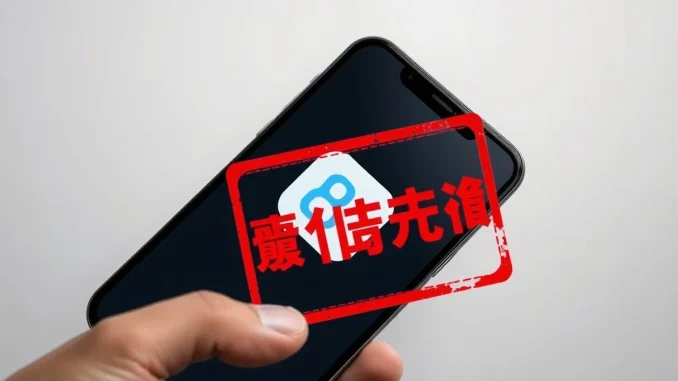
Apple has removed the decentralized messaging app Bitchat from its App Store in China. The action, taken in February 2026, came at the direct request of the country’s internet regulator. This move highlights the ongoing tension between global tech platforms and China’s strict digital controls.
Apple Bitchat Removal Follows Direct Government Order
Block CEO Jack Dorsey confirmed the removal in a social media post on March 29, 2026. He shared a screenshot from Apple’s app review team. The notification stated Bitchat was pulled from the China App Store in February. Furthermore, its TestFlight beta version would also become unavailable.
Also read: Anthropic Claude AI Model Pressured to Lie, Cheat, and Blackmail in Alarming Experiments
The message cited a request from the Cyberspace Administration of China (CAC). According to the notification, Apple stated all apps on its store must comply with local laws. “We know this stuff is complicated,” the Apple team wrote. “But it is your responsibility to understand and make sure your app conforms with all local laws.”
This isn’t Apple’s first compliance action in China. The company has previously removed other apps, including VPN services and news outlets, following similar requests. Apple’s operational presence in China, including manufacturing and a significant market, creates complex pressures.
Also read: Quantum-Resistant Blockchain: Circle's Urgent Plan for Arc as Google Sounds Q-Day Alarm
Why China’s Internet Regulator Targeted Bitchat
The CAC argued Bitchat violated specific provisions of China’s internet regulations. The regulator pointed to Article 3 of rules governing online services with public opinion capabilities. These rules took effect in 2018.
Under these provisions, services that could influence public opinion or enable social mobilization must conduct a security assessment before launch. They must also “be responsible for the assessment results.” Bitchat’s technical design likely triggered these concerns.
The app is a peer-to-peer encrypted messaging service. It runs over Bluetooth and mesh networks, operating without a traditional internet connection. This design makes it difficult for authorities to monitor or block communications. In nations with internet restrictions, such tools can become vital for dissent.
Data shows Bitchat’s use surged during protests. It was utilized in Madagascar, Uganda, Nepal, Indonesia, and Iran when governments restricted internet access. Its functionality in offline scenarios directly challenges state-controlled information flows.
A Technical Challenge to State Control
Bitchat’s architecture represents a fundamental shift. Unlike WeChat or WhatsApp, it doesn’t rely on centralized servers. Messages hop between devices via Bluetooth or local Wi-Fi mesh networks. This creates a resilient, decentralized communication web.
For regulators, this poses a significant problem. There is no single entity to pressure or server to shut down. The network exists wherever users’ devices are in proximity. Industry watchers note this technology inherently conflicts with censorship models that depend on controlling internet gateways.
“Apps like Bitchat are designed to circumvent traditional network shutdowns,” said a researcher specializing in digital rights, who requested anonymity due to the sensitivity of the topic. “Their removal from major app stores is a predictable step for any jurisdiction prioritizing information control.”
The Scale of Bitchat’s User Base and Market Context
Public download statistics provide some insight into Bitchat’s reach. Chrome download stats indicate the app has been downloaded more than three million times globally. Over 92,000 downloads occurred in the week preceding late March 2026. The Google Play Store recorded over one million registered downloads.
These figures, however, do not specify regional breakdowns. The number of users in China before the removal remains unclear. What is clear is the dominant local alternative.
WeChat, operated by Chinese tech giant Tencent, boasts an estimated 810 million users in China. The app is deeply integrated into daily life, handling payments, social interaction, and official communications. WeChat operates under strict Chinese regulations, with content moderation and user data subject to state oversight.
The contrast between WeChat’s permissible ecosystem and Bitchat’s banned status is stark. It underscores a central tenet of China’s internet policy: platforms must align with state objectives.
Global Implications for Decentralized Technology
Bitchat’s removal from one of the world’s largest app markets signals a broader trend. Governments are increasingly scrutinizing decentralized and encryption-focused tools. The European Union’s Digital Services Act and various national laws are creating new compliance hurdles.
For tech companies, this creates a dilemma. Adhering to one country’s laws may mean violating another’s principles or user expectations. Apple’s statement to Dorsey frames it as a straightforward legal obligation. But the implications are far-reaching.
This event could influence how other platforms handle similar apps. Google’s Play Store and other distribution channels may face parallel pressures. The precedent suggests that decentralized apps with anti-censorship features will struggle to access mainstream app stores in restrictive markets.
What this means for investors is increased attention on regulatory risk. Technologies promising user autonomy may face significant market access barriers. This could affect valuation models for startups in the privacy tech sector.
Conclusion
The Apple Bitchat ban in China demonstrates the hard limits of digital openness within the country’s borders. The removal, executed at the CAC’s request, reinforces China’s firm control over its information space. For decentralized apps, China’s market remains largely inaccessible if their design challenges state oversight. This incident is a single data point in a wider global struggle between network freedom and state sovereignty online.
FAQs
Q1: What is Bitchat and who created it?
Bitchat is a decentralized, peer-to-peer messaging application. It was developed by Block, Inc., led by CEO Jack Dorsey. The app uses Bluetooth and mesh networks to send encrypted messages without an internet connection.
Q2: Why did Apple remove Bitchat from the China App Store?
Apple removed Bitchat in February 2026 following a direct request from China’s Cyberspace Administration of China (CAC). The regulator stated the app violated local internet regulations concerning services that can influence public opinion.
Q3: Can users in China still access Bitchat?
No. The app is no longer available for download from the official Apple App Store in China. Its TestFlight beta version was also disabled. Users who previously installed it may still have it, but they cannot receive updates through official channels.
Q4: Is Bitchat available in other countries?
Yes. According to Apple’s communication, Bitchat remains available on the App Store in other countries outside of China. Its global download numbers indicate continued use elsewhere.
Q5: How does China’s approach differ from other countries regarding such apps?
China employs a proactive, pre-emptive censorship model, often requiring security assessments before launch. Other democracies typically react to illegal content after publication. China’s system is designed to prevent the dissemination of content deemed harmful by the state from the outset.

This article was produced with AI assistance and reviewed by our editorial team for accuracy and quality.





Be the first to comment