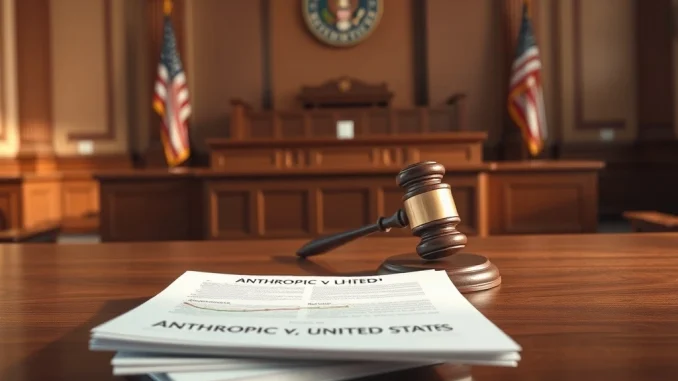
In a landmark legal challenge with profound implications for the tech industry and national security, artificial intelligence firm Anthropic has filed a federal lawsuit against the Trump administration. The company is contesting what it calls an “unprecedented and unlawful” designation by the Department of Defense labeling it a supply chain risk. Filed in the U.S. District Court for the Northern District of California on Monday, March 10, 2026, the suit seeks to reverse a Pentagon order that effectively bans military contractors from using Anthropic’s flagship AI, Claude. This action marks the first time an American company has received this designation, a move Anthropic alleges is retaliation for its refusal to allow unrestricted military use of its technology.
Anthropic’s Legal Challenge and the Pentagon’s ‘Risk’ Designation
The core of Anthropic’s lawsuit centers on a March 3 directive from Defense Secretary Pete Hegseth, which formally designated Anthropic as a supply chain risk under Section 889 of the 2019 National Defense Authorization Act. Consequently, this label prohibits any person or business working with the U.S. military from also conducting business with Anthropic. Historically, this designation has been reserved for companies with ties to foreign adversaries like China or Russia. “These actions are unprecedented and unlawful,” Anthropic’s legal filing argues. “The Constitution does not allow the government to wield its enormous power to punish a company for its protected speech.”
Anthropic’s relationship with the government dates to 2024, when its technology became the first AI system authorized for use in classified work. However, the company’s contracts always contained specific ethical clauses. These clauses prohibited the use of Claude for lethal autonomous warfare and the mass surveillance of American citizens. According to the lawsuit, the conflict escalated when Secretary Hegseth demanded the company “discard its usage restrictions altogether.” After Anthropic refused, the Pentagon moved forward with the supply chain risk label. Simultaneously, the company filed a separate challenge in the U.S. Court of Appeals for the D.C. Circuit.
Broader Impacts on AI Ethics and National Security
The lawsuit triggers immediate and far-reaching consequences for the U.S. AI sector, national security policy, and the defense industrial base. Primarily, it creates a stark conflict between corporate ethical governance and perceived governmental needs for technological superiority. Furthermore, it places other AI firms in a precarious position, potentially forcing them to choose between ethical guidelines and lucrative government contracts.
- Chilling Effect on AI Innovation: The case may deter U.S. AI companies from developing or enforcing strict ethical guidelines if they fear governmental retaliation, potentially ceding the moral high ground in AI development.
- Supply Chain Disruption: Contractors who have integrated Claude into specific workflows for defense projects must now find alternative, potentially less capable or more expensive, AI solutions or sever ties with Anthropic, causing project delays.
- Global Competitiveness: Punishing a leading U.S. AI firm could hinder domestic innovation, giving a strategic advantage to competitors in allied and adversarial nations who face fewer such restrictions.
Expert and Institutional Reactions to the Legal Battle
The lawsuit has drawn significant attention from the academic and tech communities. A group of more than 30 AI engineers and scientists from OpenAI and Google, including Google’s Chief Scientist, Jeff Dean, filed an amicus brief supporting Anthropic. “If allowed to proceed, this effort to punish one of the leading U.S. AI companies will undoubtedly have consequences for the United States’ industrial and scientific competitiveness in the field of artificial intelligence and beyond,” the group wrote. Dr. Helen Wright, a governance fellow at the Stanford Institute for Human-Centered AI, told reporters, “This case is a bellwether. It tests whether a company can maintain public ethical commitments when they conflict with state power. The outcome will shape corporate behavior for a generation.”
Historical Context and Legal Precedents in Government-Tech Relations
This confrontation is not isolated but fits into a turbulent history of clashes between the U.S. government and major technology firms over privacy, encryption, and surveillance. However, the use of a “supply chain risk” label against a domestic entity for ethical reasons is a novel escalation. The legal arguments will likely hinge on First Amendment protections for corporate speech and the administrative procedures governing the Pentagon’s designation authority.
| Case/Event | Parties | Core Issue | Outcome/Status |
|---|---|---|---|
| Apple vs. FBI (2016) | Apple, Federal Government | Forced decryption of iPhone | FBI withdrew; no precedent set |
| Microsoft vs. DOJ (2018) | Microsoft, Department of Justice | Data storage jurisdiction | Clarified limits of search warrants |
| Project Maven Protest (2018) | Google, Employees/Pentagon | AI for drone imagery analysis | Google did not renew contract |
| Anthropic vs. Trump Admin (2026) | Anthropic, DOD/White House | Ethical AI restrictions as ‘supply chain risk’ | Pending litigation |
What Happens Next: Legal Pathways and Industry Ramifications
The immediate legal process will involve motions for a preliminary injunction. Anthropic will ask the California court to temporarily block the enforcement of the supply chain risk designation while the case proceeds. A ruling on this injunction could come within weeks and will serve as an early indicator of the suit’s viability. In parallel, the D.C. Circuit appeal will examine the procedural aspects of the Pentagon’s decision-making process. Observers expect the cases to be consolidated or heard in tandem, potentially reaching the Supreme Court given the constitutional questions involved.
Stakeholder Reactions and the Defense Industry’s Dilemma
Reactions from the defense contracting community have been muted but concerned. A spokesperson for a major aerospace and defense contractor, speaking on background, stated, “This creates an immediate compliance headache. We use specialized AI tools for specific tasks. Switching on short notice is costly and inefficient.” Conversely, some policy hawks have supported the administration’s move. General (Ret.) Mark Thompson, a senior fellow at the Center for Strategic Defense, argued in an op-ed, “In an era of great-power competition, we cannot afford to have our most advanced tools neutered by corporate boards. National security cannot be subject to a commercial ethical veto.”
Conclusion
The Anthropic lawsuit against the Trump administration represents a critical inflection point at the intersection of technology, ethics, and state power. The case challenges the unprecedented use of a national security mechanism against a domestic company for maintaining ethical guardrails. Its outcome will not only determine the future of Anthropic’s government business but will also set a powerful precedent for how much autonomy AI companies retain over the use of their creations. As the legal battles commence in California and Washington, D.C., the entire technology and defense sectors will be watching closely, aware that the ruling will redefine the rules of engagement between Silicon Valley and the Pentagon for years to come.
Frequently Asked Questions
Q1: What exactly is a ‘supply chain risk’ designation from the Pentagon?
A “supply chain risk” designation is a formal label applied by the U.S. Department of Defense to companies it deems a threat to the security of its supply chain. Under law, it prohibits the military and its contractors from purchasing or using products or services from the designated company. Before Anthropic, it was used exclusively against foreign-owned or influenced firms.
Q2: Why does Anthropic say this designation is unlawful?
Anthropic claims the designation is an act of retaliation, punishing the company for its protected First Amendment speech—namely, its public ethical commitments restricting AI use for lethal autonomy and mass surveillance. The company argues the government cannot use its regulatory power to penalize a firm for such speech.
Q3: Has the U.S. military used Anthropic’s AI before?
Yes. Since 2024, various U.S. government agencies, including the Pentagon, have used Anthropic’s Claude AI for classified work. It was the first AI system authorized for such use, indicating it was previously trusted within secure environments.
Q4: What are the potential consequences if Anthropic loses the lawsuit?
If Anthropic loses, the supply chain risk designation stands. The company would be effectively locked out of the massive U.S. defense market. This could financially damage Anthropic and signal to other AI firms that maintaining strict ethical controls may jeopardize government business.
Q5: How does this case relate to broader debates about AI ethics?
This case is a direct test of whether corporate AI ethics policies can withstand government pressure for unrestricted access. It asks if companies can say “no” to certain military applications without facing severe economic penalties from the state.
Q6: What is the timeline for a resolution in this case?
The first major milestone will be a ruling on Anthropic’s request for a preliminary injunction, which could come within 4-8 weeks. The full legal battle, potentially spanning district court, appeals court, and the Supreme Court, could take several years to reach a final resolution.