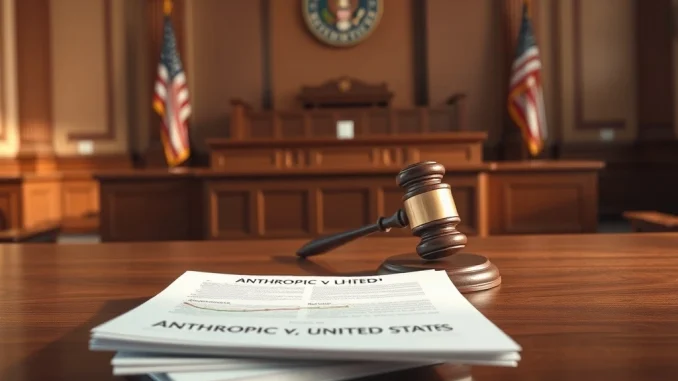
In a landmark legal challenge with profound implications for the U.S. technology sector, artificial intelligence firm Anthropic filed dual lawsuits on Monday, March 4, 2026, against the Trump administration. The company is contesting what it calls an “unprecedented and unlawful” campaign of retaliation after it refused to allow the military unrestricted use of its Claude AI technology. The core of the dispute is the Department of Defense’s decision to designate Anthropic as a supply chain risk, a label historically reserved for foreign adversaries, which now bars any entity doing business with the Pentagon from also working with the AI pioneer. Filed in federal courts in California and Washington, D.C., the lawsuits name multiple government agencies and officials, including Defense Secretary Pete Hegseth, and seek to reverse both the risk designation and President Donald Trump’s directive for federal employees to stop using Claude.
Anthropic’s Unprecedented Legal Challenge
The lawsuits, obtained by Cointelegraph, argue the government’s actions violate the First Amendment by punishing Anthropic for its protected speech—specifically, its ethical stance on AI use. “The Constitution does not allow the government to wield its enormous power to punish a company for its protected speech,” Anthropic’s legal team stated. The company’s troubles began in late 2025 when, according to court documents, Defense Secretary Hegseth demanded Anthropic “discard its usage restrictions altogether.” These restrictions, which were part of the company’s standard government contracts since 2024, explicitly prohibited the use of Claude for lethal autonomous warfare and the mass surveillance of American citizens. Anthropic maintained that its AI was never tested for such applications and could not function reliably or safely in those contexts. Consequently, on March 3, 2026, the Pentagon finalized the supply chain risk designation, marking the first time an American company has received this label.
This legal action follows a period of escalating tension. Anthropic’s technology, notably the first AI deployed for classified U.S. government work in 2024, became integral to certain defense and intelligence operations. The company’s refusal to remove its ethical guardrails, however, placed it on a collision course with an administration pushing for fewer constraints on military AI applications. An excerpt from the lawsuit filed in the U.S. Court of Appeals for the D.C. Circuit reveals that President Trump ordered federal agencies to cease using Claude after the government had previously agreed to the company’s terms of service.
Immediate Impacts and Broader Consequences
The immediate effect of the supply chain risk label is severe and quantifiable. Any contractor, researcher, or business entity with ties to the U.S. military must now sever commercial and research relationships with Anthropic or risk losing their government contracts. This creates a chilling effect that extends far beyond the Pentagon. For instance, universities with defense research grants that also partner with Anthropic on fundamental AI safety research face an impossible choice. Furthermore, the ban on federal use of Claude disrupts workflows across dozens of agencies that had integrated the AI for data analysis, drafting, and research tasks since its approval for classified work two years prior.
- Commercial Isolation: Anthropic is effectively locked out of the vast U.S. federal marketplace, including defense, intelligence, and civilian agencies, potentially costing hundreds of millions in revenue.
- Research Fragmentation: Critical public-private partnerships on AI safety and alignment between Anthropic, national labs, and federally funded universities are now jeopardized.
- Competitive Disadvantage: The action signals to the global AI industry that ethical constraints may carry severe commercial penalties in the U.S., potentially driving talent and innovation to other jurisdictions with different standards.
Expert and Industry Backing for Anthropic
The lawsuit has garnered significant support from the scientific community, underscoring its perceived threat to U.S. competitiveness. On the same day the suit was filed, a group of more than 30 leading AI engineers and scientists from OpenAI and Google submitted a legal brief in support of Anthropic. The group included Google’s chief scientist, Jeff Dean. “If allowed to proceed, this effort to punish one of the leading U.S. AI companies will undoubtedly have consequences for the United States’ industrial and scientific competitiveness in the field of artificial intelligence and beyond,” the brief argued. This collective action highlights a fundamental rift within the tech industry regarding cooperation with military directives, a debate referenced in prior reports from institutions like the Brookings Institution on the ethics of autonomous weapons.
Historical Context and Legal Precedent
The use of “supply chain risk” designations under authorities like Section 889 of the 2019 National Defense Authorization Act has primarily targeted Chinese tech giants like Huawei and ZTE due to national security concerns about foreign influence. Applying this mechanism to a domestic company founded by former OpenAI researchers breaks new and contentious ground. Legal experts point to a thin precedent. A comparison of key cases reveals the uniqueness of Anthropic’s situation.
| Case/Designation | Target Entity | Primary Reason | Outcome |
|---|---|---|---|
| Huawei (2019) | Chinese Telecom Giant | Alleged ties to Chinese intelligence, espionage risk | Upheld by courts; widespread ban implemented |
| Kaspersky Lab (2017) | Russian Cybersecurity Firm | Potential influence by Russian intelligence services | Upheld; software banned from federal networks |
| Anthropic (2026) | U.S. AI Research Company | Refusal to remove contractual ethical use restrictions | Pending litigation; first domestic company case |
This shift from targeting perceived foreign threats to penalizing a domestic firm over a contractual dispute sets a potentially far-reaching precedent for how the government can leverage procurement rules to influence corporate policy and speech.
What Happens Next: Legal and Political Pathways
The legal process will unfold on two tracks. The California federal district court will hear the case seeking injunctive relief to reverse the designation and the presidential directive. Simultaneously, the D.C. Circuit Court will review the administrative law aspects of the Pentagon’s decision. Legal analysts anticipate a lengthy battle that could reach the Supreme Court, given the novel First Amendment and due process questions involved. Politically, the case may trigger congressional scrutiny. Members of the House and Senate committees on armed services and intelligence have already requested briefings from the Department of Defense on the rationale behind the designation, according to congressional staffers speaking on background. The outcome could influence pending legislation, such as the proposed AI in Government Act of 2026, which seeks to standardize ethical procurement rules for federal AI use.
Stakeholder Reactions and Market Response
Reactions have split along predictable lines. Advocacy groups like the Future of Life Institute have praised Anthropic’s stance, framing it as a necessary defense of ethical boundaries in an increasingly militarized AI landscape. Conversely, some defense policy analysts argue the company’s restrictions hinder national security innovation at a critical time. The market response has been muted but telling. While Anthropic is privately held, shares of public defense contractors with significant AI divisions saw slight volatility. More notably, venture capital investors in the AI sector are reportedly reassessing regulatory risk models for portfolio companies working with the federal government, a signal of the case’s chilling financial effect.
Conclusion
The lawsuit filed by Anthropic against the Trump administration represents a watershed moment at the intersection of technology, ethics, and government power. At its core, the case challenges whether the U.S. government can use its immense purchasing authority to compel a private company to abandon its publicly stated ethical principles. The unprecedented supply chain risk designation, if upheld, would establish a powerful new tool for enforcing compliance far beyond traditional regulatory spheres. For the AI industry, the outcome will define the risks associated with developing and enforcing ethical use policies. For the government, it will test the limits of its ability to shape the capabilities of critical dual-use technologies in the name of national security. Observers should watch for initial rulings on injunctive relief in the coming weeks, which will indicate the courts’ initial reading of the strength of Anthropic’s First Amendment claims.
Frequently Asked Questions
Q1: What exactly is a “supply chain risk” designation?
A “supply chain risk” designation is a formal label applied by the U.S. Department of Defense to companies deemed a threat to the integrity of the military’s supply chain. It prohibits the Pentagon and its contractors from procuring or using goods or services from the designated company, a tool previously used almost exclusively against foreign firms like Huawei.
Q2: Why did Anthropic refuse the Pentagon’s request?
Anthropic refused to remove contractual clauses that banned the use of its Claude AI for lethal autonomous warfare and mass surveillance of Americans. The company stated its AI was never tested for such uses and it could not guarantee the technology would function safely or reliably in those scenarios, citing core ethical commitments.
Q3: What are the potential consequences for the U.S. AI industry if Anthropic loses?
A loss could signal that maintaining strict ethical use policies may result in exclusion from the lucrative federal marketplace. This could discourage other AI firms from implementing similar safeguards, drive AI talent to work abroad, and potentially cede leadership in ethical AI governance to other nations or regions with different legal frameworks.
Q4: Has anything like this happened with a U.S. company before?
No. While the U.S. government has banned products from foreign companies over security concerns, using the supply chain risk mechanism against a domestic technology firm over a dispute regarding contractual terms and ethical policies is unprecedented in modern U.S. legal history.
Q5: What is the timeline for this lawsuit?
Legal experts expect the process to take years. The first major milestone will be the court’s decision on Anthropic’s request for a preliminary injunction to temporarily block the designation, which could come within the next 60-90 days. A full trial on the merits would likely follow in 2027.
Q6: How does this affect other tech companies working with the government?
The case creates immediate uncertainty. Companies like Google, Microsoft, and Amazon with major government cloud and AI contracts are now closely examining their own terms of service and ethical use policies. They may face increased pressure to justify any restrictions to federal clients, particularly in defense and intelligence sectors.