Revolutionary: Anchorage Digital’s Stablecoin Hub Unlocks Global Banking for the Digital Age
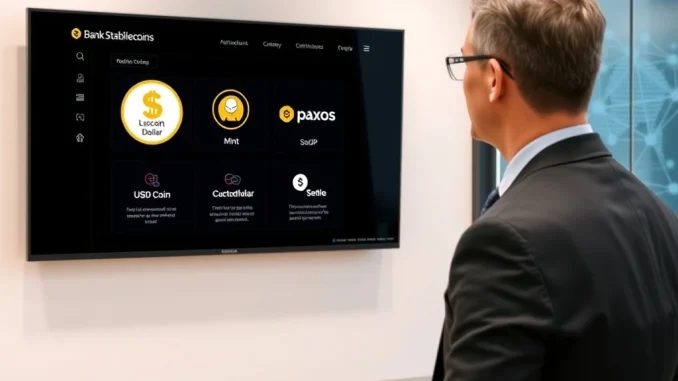
San Francisco, April 2025: In a landmark move poised to reshape cross-border finance, federally chartered digital asset bank Anchorage Digital has launched a comprehensive stablecoin platform explicitly designed for traditional financial institutions. Dubbed “Stablecoin Solutions,” this one-stop hub provides banks with the regulated infrastructure to mint, custody, redeem, and settle transactions using major USD-pegged stablecoins. This initiative marks a pivotal moment in the convergence of traditional banking and blockchain technology, offering a compliant pathway for institutions to leverage the speed and efficiency of digital dollar rails.
Anchorage Digital’s Stablecoin Hub: A Bridge for Traditional Finance
Anchorage Digital’s new platform directly addresses a critical pain point for banks: accessing the benefits of blockchain-based payment systems within a fully regulated framework. For years, financial institutions have observed the rapid settlement and global reach of stablecoin transactions but have been hesitant to engage due to regulatory uncertainty and operational complexity. Stablecoin Solutions consolidates the entire lifecycle of stablecoin operations into a single, audited service. Banks can now initiate transactions where U.S. dollars are converted into a regulated stablecoin like USDC or USDP, transmitted anywhere in the world in minutes, and seamlessly redeemed back into fiat currency—all while Anchorage handles the underlying blockchain custody and compliance. This turnkey approach significantly lowers the technical and regulatory barrier to entry.
Deconstructing the Platform: Minting, Custody, and Settlement
The core value proposition lies in integrating three complex functions. First, the minting and redemption service allows a bank to deposit U.S. dollars into a designated account, triggering the creation of an equivalent amount of stablecoins held in their name on the platform. Conversely, presenting stablecoins results in a fiat payout. Second, institutional-grade custody is provided by Anchorage’s bank charter, which requires it to maintain rigorous capital reserves, undergo regular audits, and comply with the Bank Secrecy Act. This offers a trust layer familiar to regulated entities. Third, the platform manages fiat settlement through its existing banking partnerships, ensuring smooth conversion at both ends of a transaction. The table below outlines the key components:
| Platform Component | Function | Benefit to Banks |
|---|---|---|
| Minting/Redeeming Engine | Converts USD to/from selected stablecoins (e.g., USDC, USDP). | Eliminates need for direct smart contract interaction. |
| Qualified Custody | Safeguards private keys under federal banking oversight. | Mitigates counterparty and technological risk. |
| Integrated Settlement | Connects blockchain transactions to traditional bank accounts. | Provides end-to-end fiat clarity and reconciliation. |
| Regulatory Compliance Suite | Embedded AML/KYC and transaction monitoring. | Simplifies adherence to financial crime regulations. |
The Regulatory Imperative and the Federal Charter Advantage
Anchorage Digital’s status as a federally chartered digital asset bank, granted by the Office of the Comptroller of the Currency (OCC) in 2021, is not merely a credential; it is the foundational element enabling this service. This charter places Anchorage under the same federal regulatory umbrella as national banks, subjecting it to examinations, consumer protection laws, and liquidity requirements. For partner banks, this means they are engaging with a regulated entity rather than a tech startup. The oversight provides a comfort level that has been largely absent in crypto-native services. This move can be seen as a direct response to regulatory guidance from bodies like the OCC and the Federal Reserve, which have clarified that banks can engage in certain crypto activities, including stablecoin custody, provided they manage risks effectively.
Implications for Global Payments and Banking Competition
The launch has immediate and long-term consequences for the financial industry. In the short term, it provides a viable alternative to slower, more expensive correspondent banking networks for cross-border USD transfers. A mid-sized bank in Asia or Europe can potentially offer near-instant USD settlement to its corporate clients using this rail. In the long term, it accelerates the institutional adoption of blockchain infrastructure. As more banks utilize such platforms, it creates network effects, potentially driving down costs and increasing standardization. Furthermore, it positions Anchorage not just as a custodian, but as a critical infrastructure provider—a “bank for banks” in the digital asset economy. This could intensify competition among other regulated crypto custodians and traditional financial messaging networks like SWIFT, which is itself piloting blockchain interoperability.
Historical Context: The Evolution from Niche to Mainstream
This development is a culmination of a decade-long evolution. Following the creation of Bitcoin, the emergence of stablecoins like Tether (USDT) and later USDC provided the price-stable medium of exchange blockchain needed for practical finance. However, their use remained dominated by crypto traders and decentralized finance (DeFi) applications. The entry of PayPal with its PYUSD stablecoin in 2023 signaled a shift toward mainstream consumer and merchant use. Anchorage Digital’s move represents the next logical phase: formalizing the infrastructure for the world’s largest financial intermediaries. It mirrors the historical pattern of technological adoption, where disruptive tools are first used at the edges of an industry before being productized and packaged for its core institutions.
Conclusion
Anchorage Digital’s launch of its Stablecoin Solutions hub is a definitive step toward the maturation and integration of digital asset technology within the global banking system. By offering a federally regulated, one-stop platform for stablecoin operations, it removes significant hurdles for traditional banks seeking efficiency in global USD transfers. The success of this initiative will be closely watched, as it could serve as a blueprint for how legacy finance adopts blockchain rails, ultimately making cross-border payments faster, cheaper, and more accessible. The Anchorage Digital stablecoin hub may well be remembered as the pivotal infrastructure that brought blockchain in from the cold for the world’s banks.
FAQs
Q1: What exactly is Anchorage Digital’s Stablecoin Solutions?
It is a unified platform that allows traditional banks to mint, custody, redeem, and settle transactions using major U.S. dollar-pegged stablecoins, all within a federally regulated framework.
Q2: Why is Anchorage Digital’s federal bank charter important for this service?
The charter means Anchorage is regulated by the OCC, subject to the same strict oversight as national banks. This provides partner institutions with regulatory certainty and a trusted, compliant counterparty for handling digital assets.
Q3: Which stablecoins are supported on the platform?
While the official announcement did not specify an exhaustive list, it indicated support for “multiple USD stablecoins.” These are expected to include major, regulated options like Circle’s USDC and Paxos’s USDP.
Q4: How does this benefit a traditional bank’s customers?
End customers, particularly businesses engaged in international trade, could experience significantly faster and potentially cheaper U.S. dollar cross-border payments compared to traditional wire transfers that can take days.
Q5: Does this mean banks are directly holding cryptocurrency?
Through the platform, a bank’s exposure is to a stablecoin, a digital token pegged 1:1 to the U.S. dollar and held in regulated custody by Anchorage. The bank itself does not need to manage blockchain wallets or private keys directly.
Q6: What are the main risks banks should consider with this platform?
Key risks, which Anchorage’s model aims to mitigate, include regulatory changes, the stability of the underlying stablecoin assets (e.g., reserve quality), and operational reliance on a third-party technology provider, albeit a regulated one.
Related News
- Ethereum On-Chain Metrics Reveal Surprising Strength: Analysis Points to Potential $3,300 Rebound
- Solana Price Is Stabilizing – Flagship SOL Layer 2 Meme Coin ICO Approaching 24 Million
- BitGo Moves $2 Billion Of Mt. Gox Bitcoin
Related: White House Stablecoin Meeting Update: Critical Shift in Regulatory Control Emerges
Related: IPO Genie ($IPO) Presale Analysis: Unpacking Tokenomics, Utility, and Market Traction
Related: Mystery Whale Withdraws 7,000 ETH From Binance: Decoding the $13.5M Signal