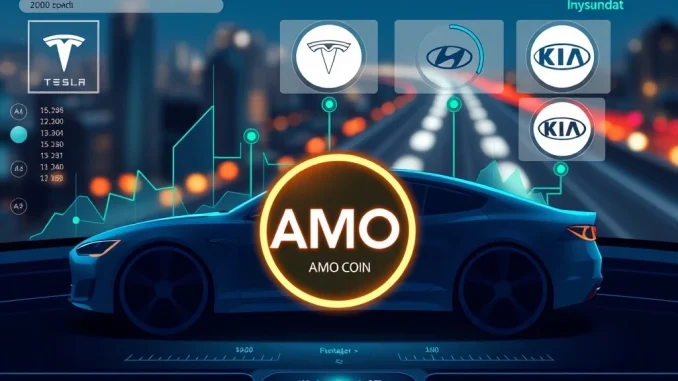
Seoul, South Korea, April 2025: AMO Block, the pioneering developer behind the vehicle data trading platform and its native cryptocurrency AMO Coin (AMO), has formally unveiled its strategic roadmap for 2026. This comprehensive plan signals a significant maturation phase for the project, moving beyond foundational infrastructure to deploy advanced, real-world applications. The announced initiatives, which include the development of Drive-to-Earn (D2E) 2.0 leveraging Tesla vehicle data, the launch of an AMO Live Data Center, the release of a Full Self-Driving (FSD) mining mode, and explorations into API integration with major automakers like Hyundai and Kia, represent a concerted push to bridge blockchain technology with the core mechanics of the modern automotive industry. The announcement provides a critical look into how cryptocurrency projects are seeking tangible utility within established technological ecosystems.
AMO Block 2026 Roadmap: A Strategic Pivot to Applied Data Utility
The release of a multi-year roadmap is a standard yet critical practice in the cryptocurrency and technology sectors, serving to align community expectations, attract development talent, and signal long-term viability to potential partners. For AMO Block, the 2026 roadmap functions as a pivotal document that transitions the project’s narrative from theoretical potential to specific, scheduled deployments. The core premise of AMO Coin has always been to tokenize and create a marketplace for vehicle-generated data—a resource often described as “the new oil.” This data encompasses everything from routine telematics like speed and location to more advanced sensor readings from cameras, LiDAR, and radar systems. The 2026 initiatives directly target the monetization and application layers for this data, addressing both individual vehicle owners (through D2E and FSD mining) and enterprise-level data consumers (through the Live Data Center and OEM integrations).
Deconstructing the Drive-to-Earn 2.0 Initiative with Tesla Data
The most prominent feature of the roadmap is the evolution of its Drive-to-Earn model. The original D2E concept, analogous to move-to-earn models in other crypto projects, rewarded users in AMO tokens for sharing basic driving data. The proposed D2E 2.0 aims for a qualitative leap by specifically integrating with Tesla’s rich data ecosystem. Tesla vehicles generate an unparalleled volume and variety of data due to their integrated sensor suites and constant connectivity. AMO Block’s development target suggests a technical collaboration or data-access agreement that would allow Tesla owners to contribute more valuable datasets. This could include detailed information on battery performance, autonomous driving disengagement events, sensor health, and real-time traffic interaction patterns. The shift from generic data to branded, high-fidelity Tesla data could significantly increase the value of the data pool on the AMO marketplace, attracting premium buyers from insurance, urban planning, and automotive research sectors.
The Technical and Regulatory Hurdles of Vehicle Data Access
Successfully implementing D2E 2.0 hinges on navigating complex technical and regulatory landscapes. Vehicle data ownership and access rights are contentious issues. While Tesla owners generate the data, Tesla Inc. controls the gateway. Any integration would require a formal API partnership or the use of third-party dongles that interface with the vehicle’s onboard diagnostics port, which may provide less granular data. Furthermore, data privacy regulations like GDPR in Europe and various state laws in the U.S. impose strict requirements on the collection, anonymization, and sale of personal data, including location history. AMO Block’s roadmap implicitly acknowledges these challenges, positioning the 2026 timeline as a period for developing compliant data-handling frameworks and securing the necessary technical partnerships.
Enterprise Expansion: The AMO Live Data Center and OEM API Ambitions
Parallel to consumer-facing features, AMO Block is targeting the B2B market with two key infrastructure projects. The proposed AMO Live Data Center is envisioned as a centralized portal for enterprises to query, purchase, and analyze aggregated, anonymized vehicle data in real-time. This moves the platform beyond a simple transactional marketplace to a full-service data analytics provider. Potential clients could include logistics companies optimizing fleet routes, municipal governments studying traffic flow, or automotive parts manufacturers monitoring real-world component wear. The development of such a center requires robust backend architecture, advanced data visualization tools, and stringent security protocols to protect the integrity of the data stream.
The roadmap’s mention of exploring API integrations with Hyundai Motor Company and Kia Corporation is particularly strategic. As major global automakers headquartered in AMO Block’s home country of South Korea, they represent ideal flagship partners. A direct API integration would allow data from future Hyundai and Kia vehicles to be seamlessly uploaded to the AMO platform, bypassing the need for aftermarket hardware. This kind of factory-level integration is the holy grail for data marketplaces, as it ensures data quality, volume, and consistency. It would also serve as a powerful validation case, potentially encouraging other automakers to follow suit. The use of the term “exploring” indicates these discussions are in early stages, but their inclusion in the public roadmap suggests a degree of preliminary engagement.
Introducing Full Self-Driving (FSD) Mining: A Novel Consensus Concept
Perhaps the most technically ambitious item on the roadmap is the “FSD mining mode.” This concept proposes a novel twist on cryptocurrency mining. Traditional mining secures a network by solving complex, arbitrary cryptographic puzzles, consuming substantial energy. FSD mining, as conceptualized by AMO Block, would instead leverage the computational process of autonomous driving. Vehicles engaged in FSD mode process vast amounts of sensor data to make real-time navigation decisions. The proposal suggests that this valuable computational work—verifying the vehicle’s perception of the environment—could be packaged as a proof-of-work that secures the AMO network and earns tokens for the contributor. In theory, this aligns incentives: the network gains security from a useful, real-world task, and users are rewarded for contributing to the advancement of autonomous driving data validation. However, this presents immense technical challenges in standardizing, verifying, and securely transmitting this computational proof without interfering with the primary safety-critical function of the vehicle’s FSD system.
Historical Context: The Long Road to Data Monetization in Automotive
AMO Block’s efforts are part of a broader, decade-long trend in the automotive industry. Since the early 2010s, connected car services from manufacturers like GM’s OnStar and BMW’s ConnectedDrive have collected data primarily for diagnostic and customer service. The rise of over-the-air updates, pioneered by Tesla, turned cars into updatable software platforms. Blockchain projects like AMO Block, IOTA, and others are now attempting to build the economic layer on top of this connected infrastructure, creating a decentralized market where the value of data flows back to the generator (the car owner) rather than being siloed by the manufacturer. The 2026 roadmap is AMO Block’s specific blueprint for capturing a segment of this emerging market.
Conclusion: A Roadmap Grounded in Ambitious Integration
The AMO Block 2026 roadmap outlines a clear, ambitious strategy to evolve the AMO Coin ecosystem from a conceptual data marketplace to an integrated layer within the global automotive data economy. By targeting specific, high-value applications like Tesla data utilization, enterprise data services, and innovative consensus mechanisms like FSD mining, the project is attempting to carve out a defensible niche. The success of this AMO Block roadmap will depend less on cryptocurrency market cycles and more on the project’s ability to execute complex technical integrations, forge strategic partnerships with automotive giants like Hyundai and Kia, and navigate the stringent global regulatory environment governing data privacy and vehicle safety. If successful, it could provide a compelling template for how blockchain technology can create transparent, user-centric economies for the data generated by our increasingly intelligent machines.
FAQs
Q1: What is the primary goal of AMO Block’s 2026 roadmap?
The primary goal is to transition the AMO Coin platform from foundational development to real-world utility by launching specific applications that monetize vehicle data, including advanced consumer reward programs and enterprise data services.
Q2: How does Drive-to-Earn 2.0 differ from the original concept?
D2E 2.0 aims to integrate specifically with Tesla vehicle data, which is considered more granular and valuable, moving beyond rewarding basic mileage to rewarding the contribution of rich datasets related to performance, autonomy, and battery analytics.
Q3: What is the purpose of the AMO Live Data Center?
The Live Data Center is designed as a B2B portal where companies and researchers can access, analyze, and purchase aggregated, real-time vehicle data for applications in logistics, urban planning, market research, and automotive development.
Q4: What are the main challenges for the FSD mining mode?
The main challenges are technical and safety-related: creating a standardized method to prove a vehicle’s FSD computational work without compromising the safety-critical nature of autonomous driving, and doing so in an energy-efficient and secure manner for the blockchain.
Q5: Why are potential integrations with Hyundai and Kia significant?
Integrations with major original equipment manufacturers (OEMs) like Hyundai and Kia would enable factory-level, seamless data flow from vehicles to the AMO platform. This provides higher data quality and volume, validates the project’s credibility, and could encourage wider industry adoption.