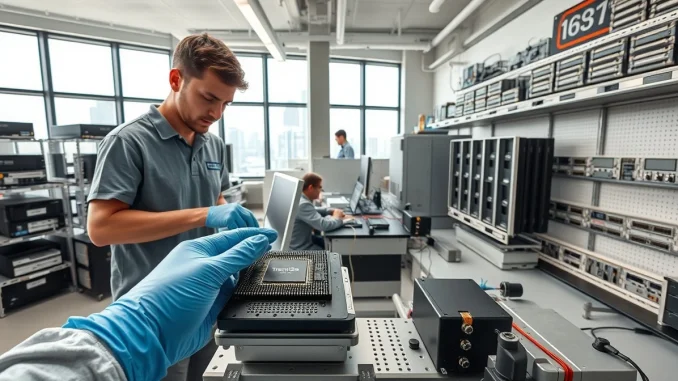
AUSTIN, Texas — In a nondescript building in Austin’s upscale Domain district, Amazon Web Services operates one of the most consequential semiconductor development facilities in artificial intelligence. This laboratory designs the Trainium chips now powering major AI systems from Anthropic’s Claude to OpenAI’s Frontier platform, representing Amazon’s strategic push to challenge Nvidia’s dominance in AI hardware. The facility’s work has accelerated following AWS’s landmark $50 billion investment agreement with OpenAI announced in late 2025, which includes supplying 2 gigawatts of Trainium computing capacity to the AI pioneer.
Amazon Trainium Chip: From Lab to AI Powerhouse
Amazon’s custom chip unit originated with its 2015 acquisition of Israeli designer Annapurna Labs for approximately $350 million. Over a decade later, the team has evolved into a critical component of AWS’s AI infrastructure strategy. The Austin lab serves as the development and testing hub where engineers validate chip designs before mass production at TSMC’s advanced 3-nanometer fabrication facilities.
Industry analysts monitor Trainium’s progress closely because it represents one of the few credible alternatives to Nvidia’s GPU ecosystem. The chip’s architecture addresses two key industry challenges: reducing AI inference costs and providing reliable supply amid global semiconductor shortages. According to market research firm Omdia, the AI accelerator market reached $45 billion in 2025, with Nvidia controlling approximately 80% of that segment.
The Technical Breakthrough
Trainium3, released in December 2025, incorporates several innovations that differentiate it from competing solutions:
- Liquid cooling technology replacing traditional air cooling systems
- Neuron switching fabric enabling mesh communication between chips
- PyTorch framework compatibility through minimal code changes
- 3-nanometer process technology from TSMC for improved efficiency
These advancements translate to tangible performance benefits. AWS claims Trainium3 systems offer up to 50% lower operating costs for comparable performance versus traditional cloud servers running Nvidia hardware. The chips now handle the majority of inference traffic on Amazon’s Bedrock service, which supports enterprise AI application development.
Strategic Partnerships and Industry Impact
Amazon’s chip strategy extends beyond hardware development to encompass strategic ecosystem partnerships. The company has cultivated relationships with multiple AI leaders, creating a diversified customer base that validates Trainium’s capabilities.
| Organization | Chip Generation | Deployment Scale | Primary Use |
|---|---|---|---|
| Anthropic | Trainium2 | Over 1 million chips | Claude model inference |
| Amazon Bedrock | Trainium3 | 400,000+ chips | Enterprise AI services |
| Project Rainier | Trainium2 | 500,000 chips | AI compute cluster |
| OpenAI Frontier | Trainium3 | Initial deployment | AI agent platform |
Kristopher King, director of the Austin lab, explained the growth trajectory: “Our customer base is expanding as fast as we can get capacity out there. Bedrock could be as big as EC2 one day.” This reference to AWS’s flagship Elastic Compute Cloud service underscores Amazon’s ambitions for its AI infrastructure business.
The OpenAI Agreement
The AWS-OpenAI partnership announced in late 2025 represents a significant validation of Trainium technology. Under the agreement, AWS becomes the exclusive provider for OpenAI’s Frontier AI agent builder platform. However, industry observers note potential complications, as Microsoft’s existing partnership with OpenAI includes provisions for technology access. The Financial Times reported in March 2026 that Microsoft might view the Amazon deal as conflicting with its own agreements.
Engineering Innovation in Austin
The Austin laboratory operates as a hybrid workspace combining office environments with specialized testing facilities. The actual chip lab occupies approximately 2,000 square feet filled with custom testing equipment, welding stations for microscopic component repair, and generations of server sled prototypes.
Mark Carroll, director of engineering, described the “bring-up” process when new chips arrive from fabrication: “A silicon bring-up is when you get the chip for the first time, and it’s like a big overnight party. You stay here, like a lock-in.” This critical phase involves activating prototype chips to verify functionality, often requiring 24/7 work for three to four weeks to resolve issues before mass production.
During Trainium3 development, engineers encountered a cooling system compatibility issue. King recalled the improvisation: “The dimensions for how the chip attached to the air-cooling heat sink were off. The team immediately got a grinder and started grinding off the metal.” This hands-on problem-solving characterizes the lab’s engineering culture.
Beyond Trainium: A Complete Hardware Ecosystem
Amazon’s chip team designs more than just AI accelerators. Their portfolio includes:
- Graviton processors: ARM-based server CPUs praised by Apple in 2024 for efficiency
- Inferentia chips: Dedicated inference accelerators
- Nitro system: Hardware-software virtualization technology
- Custom server sleds: Modular tray systems for chip deployment
- Networking components: Specialized interconnects for data centers
This comprehensive approach allows AWS to control performance and cost throughout the hardware stack. The company also partners with other chip designers, recently announcing integration with Cerebras Systems’ inference technology for enhanced AI performance.
Market Context and Competitive Landscape
The AI hardware market has evolved significantly since Trainium’s initial development focused primarily on model training. Today, inference workloads dominate industry demand, creating different technical requirements. Trainium3 reflects this shift with optimizations specifically for running trained models efficiently.
Amazon faces the classic challenge of any new entrant in an established ecosystem: switching costs. Applications developed for Nvidia’s CUDA platform typically require re-architecture for alternative hardware. However, AWS engineers emphasize their progress in compatibility. Carroll noted: “The transition requires basically a one-line change, and then recompile, and then run on Trainium.” This simplification targets the vast library of PyTorch models available on platforms like Hugging Face.
Environmental Considerations
The shift to liquid cooling represents both a technical and environmental advancement. The closed-loop system reuses coolant continuously, reducing water consumption compared to traditional data center cooling methods. As AI compute demands grow exponentially—with some estimates suggesting AI could consume 3-4% of global electricity by 2028—such efficiency improvements become increasingly important for sustainable scaling.
Conclusion
Amazon’s Trainium chip development represents a strategic long-term investment in AI infrastructure independence. From its Austin laboratory to global data center deployments, the technology has gained validation through partnerships with industry leaders including Anthropic and OpenAI. While Nvidia maintains dominant market position, Trainium’s growing adoption demonstrates viable competition is emerging. As AI workloads continue expanding across industries, the availability of efficient, cost-effective alternatives like Trainium will play a crucial role in determining how broadly artificial intelligence technologies can be deployed and accessed.
FAQs
Q1: What makes Amazon Trainium different from Nvidia GPUs?
Trainium chips are specifically designed for AI workloads with optimizations for both training and inference. They feature custom Neuron switches for chip-to-chip communication, liquid cooling for efficiency, and compatibility with popular frameworks like PyTorch through minimal code changes.
Q2: How significant is the OpenAI partnership for AWS?
The $50 billion agreement represents major validation of Trainium technology. AWS becomes the exclusive provider for OpenAI’s Frontier platform, though industry observers note potential complications with Microsoft’s existing OpenAI partnership terms.
Q3: What companies currently use Trainium chips?
Major deployments include Anthropic’s Claude models (over 1 million Trainium2 chips), Amazon’s own Bedrock service, the Project Rainier AI cluster (500,000 chips), and initial deployments for OpenAI’s Frontier platform.
Q4: Where are Trainium chips manufactured?
Trainium3 utilizes TSMC’s 3-nanometer fabrication process, while other chips in the portfolio are produced by Marvell. The Austin lab handles design, testing, and validation before sending designs to fabrication partners.
Q5: How does Trainium address environmental concerns about AI computing?
The chips incorporate liquid cooling in closed-loop systems that reuse coolant, reducing water consumption. The 3-nanometer manufacturing process and architectural efficiencies also improve performance per watt compared to previous generations.
Updated insights and analysis added for better clarity.
This article was produced with AI assistance and reviewed by our editorial team for accuracy and quality.