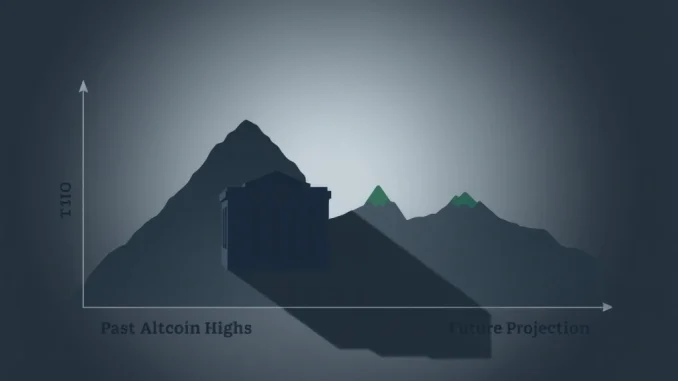
Global, May 2025: A sobering analysis from a prominent crypto market observer is challenging a core tenet of digital asset investment. Market analyst known as “Inmortal” has issued a stark warning that the vast majority of alternative cryptocurrencies, or altcoins, may never again reach the price peaks they achieved in previous market cycles. This prognosis marks a fundamental shift from the retail-driven patterns that once defined the sector, pointing to the profound and lasting impact of institutional capital on market structure.
Altcoins Confront a New Market Reality
For years, the crypto market cycles followed a recognizable, if volatile, playbook. Periods of explosive growth, often catalyzed by Bitcoin’s halving events and fueled by retail investor enthusiasm, would lift nearly all digital assets. This phenomenon, colloquially known as “altseason,” saw hundreds of tokens achieve staggering all-time highs. However, analysts now argue this pattern has fractured. The influx of regulated institutional investment—through spot Bitcoin ETFs, corporate treasuries, and sophisticated funds—has introduced a new dynamic. Capital is becoming more selective, flowing toward assets with clear utility, robust governance, and institutional-grade infrastructure, leaving many legacy altcoins behind.
The Evolving Structure of Crypto Market Cycles
The traditional cycle was heavily influenced by the Bitcoin halving, an event that reduces the rate of new Bitcoin creation approximately every four years. Historically, this supply shock preceded major bull runs. In past cycles, the rising tide of Bitcoin’s price would lift the entire market, with capital cascading from Bitcoin into large-cap altcoins like Ethereum and then into smaller, riskier tokens. This created a predictable, if speculative, wealth generation pattern for retail investors. The current landscape shows a deviation. While Bitcoin continues to influence market sentiment, its price action no longer guarantees universal altcoin prosperity. The correlation between Bitcoin and altcoin prices has shown signs of weakening as the market matures and differentiates.
- Past Cycle (Pre-2021): High correlation; retail-driven momentum spreads across all market caps.
- Transition Phase (2021-2023): Institutional entry begins; mega-cap altcoins (e.g., ETH) decouple slightly, while smaller tokens remain highly correlated.
- Current Cycle (2024-2025): Significant decoupling; capital concentrates on assets with proven technology, regulatory clarity, and institutional backing.
The Institutional Capital Effect
The entry of large-scale, long-term institutional capital is the primary catalyst for this structural change. Unlike retail traders, institutions conduct rigorous due diligence. Their mandates often prohibit investment in highly speculative, low-liquidity assets. Consequently, capital is funneled into a narrower band of cryptocurrencies. This creates a “quality over quantity” market where a handful of projects accrue most of the value and attention. For the hundreds of altcoins created during previous hype cycles—many of which lack active development, clear use cases, or sufficient decentralization—this means a potential permanent loss of relevance and liquidity. They become, in effect, digital ghost towns, unlikely to ever attract the capital needed to challenge their former peaks.
Historical Context and Market Darwinism
The analyst’s warning reflects a broader trend of consolidation seen in other technological revolutions. The early internet era featured thousands of dot-com companies, only a fraction of which survived the bust to become today’s giants. The cryptocurrency market appears to be entering a similar phase of maturation and shakeout. Data from coin tracking websites shows that a significant percentage of altcoins that reached all-time highs in 2017 or 2021 are now down over 95% from those peaks, with many having negligible trading volume. This isn’t merely a bear market trough; it is evidence of a fundamental repricing based on sustainable value rather than speculative narrative.
| Metric | Previous Cycle (e.g., 2021 Peak) | Current Analyst Outlook |
|---|---|---|
| Number of Tokens at ATH | Widespread across top 500+ | Concentrated in top 20-50 |
| Primary Driver | Retail FOMO, social media hype | Institutional adoption, protocol revenue, regulatory status |
| Market Correlation | Extremely High | Moderate to Low |
| Likelihood of Legacy ATH Reclaim | Expected in next cycle | Unlikely for majority of projects |
Conclusion
The warning that 99% of altcoins may never reach new highs again serves as a critical inflection point for cryptocurrency investors. It underscores the market’s evolution from a uniform, speculation-driven arena to a complex, tiered ecosystem where fundamental analysis is paramount. While this shift may dampen the prospects for countless legacy tokens, it also signals the growing maturity of the digital asset class. The future appears to belong not to the sheer number of projects, but to those demonstrating real-world utility, resilient tokenomics, and the ability to attract sustained institutional and developer interest. For market participants, this necessitates a more discerning investment strategy focused on long-term viability over short-term cyclical momentum.
FAQs
Q1: What does the analyst mean by “99% of altcoins”?
This is a rhetorical figure highlighting the vast majority. It refers to the hundreds of alternative cryptocurrencies outside of Bitcoin and a select few major assets (like Ethereum) that lack strong fundamentals, ongoing development, or clear utility, making a return to past speculative highs improbable.
Q2: Does this mean all altcoin investment is bad?
No. The analysis suggests a shift from broad, indiscriminate altcoin speculation to targeted investment based on fundamentals. Projects with strong technology, active ecosystems, and real-world adoption potential are still positioned to succeed, but they may represent a much smaller percentage of the total market.
Q3: How has institutional capital changed the crypto market?
Institutions bring large-scale, regulated capital that prioritizes security, compliance, and long-term value. This capital tends to flow into more established, liquid, and fundamentally sound assets, increasing market efficiency but reducing the “rising tide lifts all boats” effect for lower-quality tokens.
Q4: Will Bitcoin halvings still affect the market?
Yes, Bitcoin halvings remain a significant macroeconomic event for the crypto asset class due to Bitcoin’s dominant market position. However, their effect may become more nuanced, potentially boosting Bitcoin and a handful of top-tier assets rather than triggering a universal altcoin bull run.
Q5: What should an investor do in this new environment?
Investors are encouraged to conduct deeper due diligence, focusing on a project’s technology, tokenomics, development activity, and regulatory trajectory. Diversification remains important, but the strategy may shift from collecting numerous small-cap tokens to building a concentrated portfolio in assets with demonstrable, sustainable value propositions.