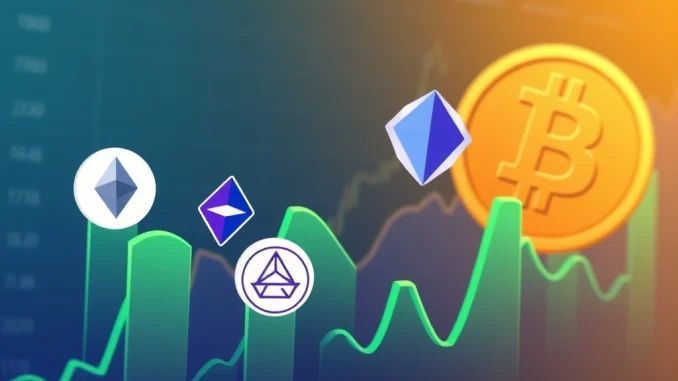
Global cryptocurrency markets are witnessing a subtle but significant shift, as evidenced by CoinMarketCap’s latest data. The Altcoin Season Index, a critical barometer for market sentiment, has climbed to 27, marking a one-point increase from the previous day. This movement, while incremental, provides a vital data point for analysts tracking the perennial tug-of-war between Bitcoin and the broader altcoin universe. The index serves as a foundational metric for understanding capital rotation and investor behavior within the digital asset space.
Decoding the Altcoin Season Index and Its Rise to 27
CoinMarketCap’s Altcoin Season Index functions as a sophisticated market thermometer. Specifically, it measures whether 75% of the top 100 cryptocurrencies, excluding stablecoins and wrapped tokens, have outperformed Bitcoin over a rolling 90-day period. A score approaching 100 strongly suggests an altcoin season is underway, where alternative cryptocurrencies collectively generate higher returns than the market pioneer. Conversely, a low score indicates a Bitcoin-dominant market phase. The recent rise to 27, therefore, signals a minor but measurable increase in altcoin outperformance relative to Bitcoin over the observed timeframe. This metric is calculated daily, providing a near-real-time pulse on market dynamics.
Historically, the index operates within a clear cyclical pattern. Analysts from firms like Glassnode and CryptoQuant have documented that sustained readings above 75 often precede or confirm robust altcoin rallies. For context, during the major altcoin season of 2021, the index frequently hovered above 80. The current reading of 27, while far from that threshold, represents a move away from extreme Bitcoin dominance. It suggests a nascent, though not yet decisive, rotation of interest and capital. This movement often correlates with increased trading volume for major altcoins like Ethereum (ETH), Solana (SOL), and Cardano (ADA).
The Mechanics and Historical Context of Market Cycles
Understanding this index requires examining typical cryptocurrency market cycles. These cycles often begin with Bitcoin leading a bullish charge, followed by capital flowing into large-capitalization altcoins, and finally into smaller-cap projects. The Altcoin Season Index is designed to capture the second phase of this sequence. A rising index can reflect several underlying factors, including renewed developer activity on alternative blockchains, successful protocol upgrades, or shifting macroeconomic narratives that favor specific crypto sectors like Decentralized Finance (DeFi) or Non-Fungible Tokens (NFTs).
For instance, the surge towards an altcoin season in early 2024 was partially driven by the successful implementation of Ethereum’s Dencun upgrade, which reduced transaction costs for layer-2 networks. Consequently, the current uptick to 27 may be linked to similar fundamental developments or anticipatory trading ahead of known network events. It is crucial to analyze this data alongside other on-chain metrics, such as exchange flows and network growth, to form a complete picture.
Comparative Analysis with Previous Market Phases
Placing the current index value of 27 into a historical framework offers valuable perspective. The following table compares key index levels with corresponding market phases:
| Index Range | Market Phase Interpretation | Typical Investor Sentiment |
|---|---|---|
| 0-25 | Strong Bitcoin Season | Risk-off, capital seeks safety in BTC |
| 26-50 | Transition / Neutral Zone | Cautious optimism, selective altcoin accumulation |
| 51-75 | Early Altcoin Season | Increasing risk appetite, broader altcoin interest |
| 76-100 | Full Altcoin Season | High risk-on sentiment, “froth” in small-cap assets |
As shown, a value of 27 sits firmly in the lower end of the transition zone. This indicates the market is in a state of flux, not firmly committed to either pole. During similar historical periods, market volatility often increases as traders reposition portfolios. Furthermore, sector-specific performance becomes critical; while the aggregate index is 27, certain sectors like AI-driven tokens or DeFi bluechips may already be exhibiting strong independent trends.
Expert Insights on the Current Metric and Future Trajectory
Market analysts emphasize the importance of trend over a single data point. A sustained, multi-week climb in the index carries more weight than a daily fluctuation. According to methodology referenced by data aggregators, the index’s calculation inherently smooths out short-term noise due to its 90-day window. Therefore, a consistent upward trajectory would be necessary to confirm a genuine shift in market structure.
Several contributing factors could be influencing this mild rise. Firstly, Bitcoin’s consolidation after its recent all-time high often creates a window for altcoins to capture attention. Secondly, institutional product developments, such as the approval of spot Ethereum ETFs in certain jurisdictions, have refocused market discourse on major altcoins. Finally, broader financial conditions, including expectations around interest rate cycles, can impact risk asset correlations, sometimes benefiting altcoins disproportionately.
It is also essential to consider the limitations of the index. By focusing only on the top 100 assets, it may not capture early momentum in emerging sectors or smaller projects. Additionally, the exclusion of stablecoins and wrapped tokens ensures the metric reflects pure speculative performance rather than movements in pegged assets. Analysts therefore recommend using this index in conjunction with other tools like the Bitcoin Dominance chart and fear-and-greed indices for a holistic view.
Potential Impacts on Investors and the Market Ecosystem
The movement of the Altcoin Season Index has tangible implications for different market participants. For retail investors, a rising index often signals a time to review diversification strategies and conduct thorough research on altcoin fundamentals rather than chasing momentum. For institutional players, it can influence asset allocation models within crypto-focused funds, potentially triggering rebalancing activities.
- For Traders: Increased index levels may prompt strategies like pair trading (e.g., going long on a basket of altcoins while shorting Bitcoin) or focusing on altcoins with strong relative strength.
- For Projects: A favorable altcoin environment can improve conditions for fundraising, partnerships, and user acquisition as investor interest broadens.
- For the Network Effect: Successful altcoin seasons historically drive innovation, as capital inflows fund development and attract talent to various blockchain ecosystems beyond Bitcoin.
However, experts consistently warn against overinterpreting a single point of data. The cryptocurrency market remains influenced by macro-economic factors, regulatory news, and technological breakthroughs. A sudden shift in any of these areas could quickly reverse the trend indicated by the index.
Conclusion
The Altcoin Season Index’s rise to 27 represents a noteworthy, though preliminary, signal in the continuous narrative of cryptocurrency market cycles. It marks a cautious step away from pure Bitcoin dominance and into a neutral, transitional phase. While far from indicating a full-blown altcoin season, this movement warrants close observation for trend confirmation. Ultimately, this metric underscores the dynamic and rotational nature of digital asset markets, where capital continuously seeks opportunity across a growing landscape of blockchain innovations. Investors and analysts will monitor the index’s trajectory in the coming weeks for clearer signs of the market’s next major phase.
FAQs
Q1: What exactly does an Altcoin Season Index of 27 mean?
An index value of 27 means that a limited number of the top 100 altcoins have outperformed Bitcoin over the prior 90 days. It places the market in a neutral or transitional zone, indicating neither a strong Bitcoin nor a strong altcoin season is currently dominant.
Q2: How is the Altcoin Season Index calculated?
The index calculates the percentage of the top 100 cryptocurrencies (excluding stablecoins and wrapped tokens) that have outperformed Bitcoin’s price over a rolling 90-day period. That percentage is then used as the index score.
Q3: Does a rising index guarantee that altcoins will go up in price?
No, the index is a descriptive metric, not a predictive one. It reflects past performance over a 90-day window. A rising index suggests a trend of altcoin outperformance, but it does not guarantee future price increases.
Q4: What is considered a “high” score that signals an altcoin season?
Scores consistently above 75 are generally considered strong indicators of an altcoin season. Historically, full altcoin seasons have seen the index sustain levels between 80 and 100.
Q5: Should I change my investment strategy based on this index?
The index is one tool among many for market analysis. Prudent investment strategy should be based on personal risk tolerance, thorough research, and a long-term plan, not on reacting to a single metric. It can, however, inform decisions about portfolio diversification and risk management.