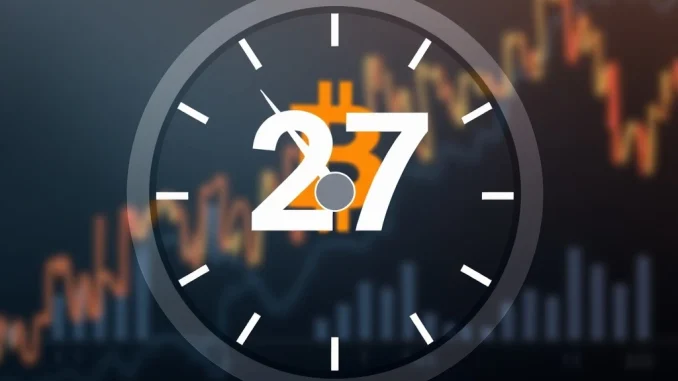
Global, April 2025: The cryptocurrency market’s much-watched Altcoin Season Index, a key barometer for investor sentiment, currently registers at a score of 27 according to data from CoinMarketCap. This crucial figure, far below the threshold that signals a broad altcoin rally, underscores a period of pronounced Bitcoin dominance as traders and analysts assess the conditions for a potential market rotation. The index provides a data-driven snapshot of performance trends, offering a clear, quantitative measure of where capital is flowing within the digital asset ecosystem.
Altcoin Season Index Registers at 27: Decoding the Metric
CoinMarketCap’s Altcoin Season Index functions as a specialized market health indicator. The platform calculates this index by analyzing the 90-day price performance of the top 100 cryptocurrencies by market capitalization, excluding stablecoins and wrapped tokens. The core calculation involves a direct comparison against Bitcoin’s performance over the same three-month window. When 75% or more of these top altcoins outperform Bitcoin, the index crosses a critical threshold, and an official “altcoin season” is declared. A score of 100 represents the peak of such a season, where altcoins collectively and significantly outpace the pioneer cryptocurrency. Conversely, a low score, such as the current 27, signals that Bitcoin is the dominant performer, with most alternative digital assets struggling to keep pace. This methodology provides a standardized, objective lens through which to view often-volatile market cycles.
Historical Context and Market Cycle Implications
Understanding the significance of a score of 27 requires examining historical patterns. Previous bull markets have often followed a recognizable sequence: Bitcoin leads initial charge, capital eventually rotates into large-cap altcoins (Ethereum, Solana, etc.), and finally, a broader “altcoin season” sees gains spread across mid and small-cap projects. The Altcoin Season Index is designed to capture the latter phases of this cycle. For instance, during the 2021 bull run, the index spent sustained periods above 75, with readings occasionally hitting 90 or higher. The current low reading suggests the market remains in, or is transitioning from, a phase where Bitcoin is the primary store of value and risk-off asset within the crypto space. This dynamic is frequently influenced by macroeconomic factors, regulatory developments, and institutional investment flows that traditionally favor Bitcoin first.
The Mechanics of the 90-Day Window and Its Purpose
The choice of a 90-day, or quarterly, performance window is strategic. It smooths out short-term volatility and speculative pumps, focusing instead on sustained trends. A cryptocurrency might spike 50% in a week, but if it fails to maintain outperformance against Bitcoin over a full quarter, it does not contribute to an altcoin season signal. This design helps filter noise and identify genuine, longer-term capital rotation. The exclusion of stablecoins like USDT and USDC is logical, as their price is pegged and does not reflect speculative performance. Similarly, wrapped tokens (e.g., WBTC) are excluded because they are simply Bitcoin on another blockchain and would skew the comparative data. This careful construction aims to measure the performance of genuinely independent, volatile assets against the market benchmark.
Analyzing the Current Bitcoin-Dominant Landscape
A score of 27 paints a clear picture of the present market structure. Several interrelated factors typically contribute to such an environment. First, Bitcoin often acts as a digital safe haven during periods of macroeconomic uncertainty or market indecision. Second, the approval and subsequent inflows into U.S. spot Bitcoin ETFs have created a massive, sustained demand vector unique to Bitcoin, drawing institutional capital that may not yet be allocated to altcoins. Third, the market may be in a consolidation phase after a Bitcoin run, with investors taking profits in altcoins to re-enter Bitcoin or waiting on the sidelines. The performance gap can be visualized by examining recent trends:
- Bitcoin (BTC): Often shows relative strength and lower volatility compared to the altcoin market index.
- Large-Cap Altcoins (ETH, BNB, XRP): May show correlated but weaker performance, failing to decisively break away from Bitcoin’s trend.
- Mid/Small-Cap Altcoins: Typically exhibit the widest performance dispersion, with most lagging significantly, which drags down the aggregate index score.
This hierarchy is characteristic of a market not yet in a risk-on “alt season” mode.
What a Rising Index Would Signal for Traders and Investors
Market participants monitor the Altcoin Season Index for early signs of a shift. A gradual climb from 27 toward 50 would suggest altcoins are beginning to catch up. A surge past 75 would be the technical confirmation of a season change. For portfolio managers, a low index might justify a higher weighting in Bitcoin. For altcoin investors, it might signal a period of accumulation or heightened research into fundamentally strong projects that are undervalued relative to the market leader. It is crucial to remember that the index is a lagging indicator—it confirms a trend already in motion based on 90 days of past data. It does not predict the future but offers a validated framework for understanding the recent past and present state.
Comparison to Other Market Health Indicators
The Altcoin Season Index is not the only tool for gauging market cycles, but its simplicity is its strength. Other common metrics include Bitcoin Dominance (BTC.D), which measures Bitcoin’s share of the total crypto market capitalization. A rising BTC.D often correlates with a low Altcoin Season Index. However, the index provides a more nuanced view than pure market cap share, as it is based on price performance. Another metric is the strength of the Bitcoin vs. Altcoin pairs on exchanges. Furthermore, on-chain data for altcoins, like network growth and active addresses, can provide fundamental context to the price performance measured by the index. The Altcoin Season Index synthesizes a complex market dynamic into a single, comprehensible number, making it a valuable headline gauge for both newcomers and veterans.
Conclusion: Patience and Perspective in a Cyclical Market
The Altcoin Season Index registering at 27 offers a definitive, data-backed conclusion: the cryptocurrency market remains under the strong influence of Bitcoin’s performance. This phase is a normal and historically recurrent part of crypto market cycles. While it may disappoint short-term altcoin speculators, it provides a period of clarity and potential opportunity for strategic asset allocation. The index serves as a reminder that these markets move in epochs—periods of Bitcoin dominance and periods of altcoin explosion. Monitoring the trajectory of this index from its current level of 27 will be critical for identifying when, and if, the next major rotation of capital into the broader altcoin market begins. For now, the data clearly favors the pioneer.
FAQs
Q1: What does an Altcoin Season Index score of 27 mean?
An index score of 27 means that only a small fraction of the top 100 altcoins have outperformed Bitcoin over the past 90 days. It indicates a market phase dominated by Bitcoin’s strength, far from the conditions of an “altcoin season.”
Q2: How is the Altcoin Season Index calculated?
CoinMarketCap calculates it by comparing the 90-day price performance of the top 100 cryptocurrencies (excluding stablecoins and wrapped tokens) against Bitcoin’s performance over the same period. The index moves toward 100 as more altcoins outperform Bitcoin.
Q3: What score signals an official altcoin season?
An official altcoin season is typically declared when the index surpasses 75. This threshold indicates that at least 75% of the top altcoins have outperformed Bitcoin over the preceding quarter.
Q4: Why are stablecoins excluded from the Altcoin Season Index?
Stablecoins are pegged to flat currencies and do not experience volatile price appreciation. Including them would distort the index’s goal of measuring speculative performance and risk-on sentiment against Bitcoin.
Q5: Is a low Altcoin Season Index bad for the crypto market?
Not necessarily. It is a neutral indicator of a current market phase. Low readings often follow or precede Bitcoin-led rallies and are a standard part of market cycles. They can indicate consolidation or a buildup of potential energy for a future altcoin move.
Q6: Can the index predict future price movements?
No, the Altcoin Season Index is a lagging indicator based on 90 days of historical data. It confirms existing trends rather than predicting new ones. However, a sustained change in its direction can signal a shift in market momentum.