
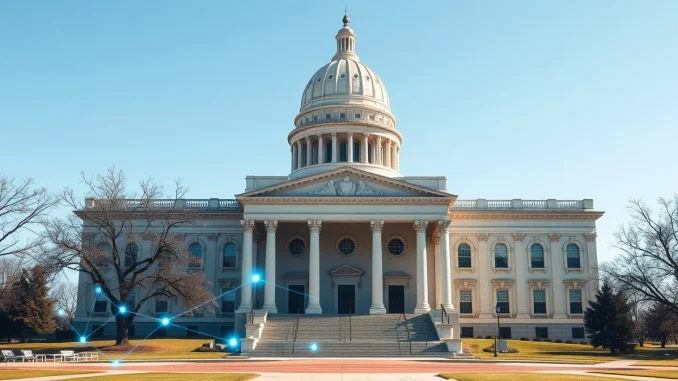
Alabama has formally recognized decentralized autonomous organizations (DAOs) as legal entities, a move that provides critical legal clarity for a core component of the crypto ecosystem. Governor Kay Ivey signed Senate Bill 277, the Decentralized Unincorporated Nonprofit Association (DUNA) Act, into law on April 2, 2026, making Alabama the second U.S. state after Wyoming to establish such a framework. This legislation directly addresses a persistent legal gray area for DAOs, which manage collective treasuries worth billions but have often operated in a jurisdictional void.
Alabama’s DAO Legislation Explained
The DUNA Act grants DAOs legal personhood. This means they can own property, enter into contracts, and sue or be sued in court. Perhaps more importantly, it provides limited liability protection for individual members and administrators. According to the text of SB 277, to qualify, a DAO must have at least 100 members united for a common nonprofit purpose. This purpose explicitly includes governing a blockchain network or a smart contract system.
Also read: Bitcoin Price Surges Over $68,000 as Markets Rally on Potential War Resolution
Governance can occur entirely on-chain. Voting, proposals, and consensus mechanisms recorded on a blockchain are legally recognized. “Decentralized governance is essential to crypto’s future—it’s one of the core constructs in market structure legislation,” said Miles Jennings, head of policy and general counsel at a16z Crypto. Jennings added that the bill gives decentralized communities “the certainty to build, govern, contract, and scale in the real world.”
The National Push for DAO Clarity
Alabama’s action is part of a growing state-level trend. Wyoming pioneered this path, with its DUNA Act signed in March 2024. West Virginia has a similar bill, HB 5060, awaiting the governor’s signature as of early April 2026. This state-by-state approach emerges amid stalled comprehensive federal crypto legislation.
Also read: Bitfarms' Stunning Pivot: $285M Loss Amid Bitcoin Slump Ignites 6.6% Share Surge on AI Bet
Industry watchers note that these state laws create a patchwork of regulations. However, they also establish vital testing grounds for legal frameworks. “As federal crypto market structure legislation moves closer to becoming law, builders need effective domestic legal structures,” Jennings noted. The implication is clear: states are filling a regulatory vacuum, providing models that federal lawmakers may later adopt or reconcile.
Why Legal Status Matters for DAOs
Before laws like Alabama’s, DAOs existed in a precarious legal state. Without formal recognition, every member could theoretically be held personally liable for the organization’s debts or legal judgments. This created a massive deterrent to participation and formal collaboration. The inability to easily open a bank account or sign a simple service contract also hampered operational growth.
Data from CoinLaw shows over 13,000 DAOs existed worldwide as of 2025, with collective treasury assets under their control surpassing $24.5 billion. The average DAO treasury size is around $1.2 million. PatentPC reported in March 2025 that Ethereum and its layer-2 networks host over 85% of these organizations. This scale of economic activity demanded a legal solution. Alabama’s law provides a template for how DAOs can interface with traditional legal and financial systems without sacrificing their decentralized, code-based nature.
Comparing Alabama’s and Wyoming’s DUNA Acts
While similar, there are nuances between the state laws. Both require a nonprofit purpose and provide liability shields. Analysts point out that subtle differences in definitions—such as what constitutes “governance” or “member”—could influence where DAOs choose to domicile. The table below outlines key provisions.
| Provision | Alabama DUNA Act | Wyoming DUNA Act |
|---|---|---|
| Minimum Members | 100 | 100 |
| Liability Shield | Yes, for members & administrators | Yes, for members & administrators |
| On-Chain Governance | Explicitly recognized | Explicitly recognized |
| Legal Capacity | Can sue, be sued, contract, own property | Can sue, be sued, contract, own property |
| First DAO Recognized | N/A (Law is new) | July 2021 |
This suggests a competitive dynamic among states to attract blockchain innovation. By offering clear rules, states like Alabama and Wyoming position themselves as hubs for DAO formation and operation.
Practical Implications and Challenges
The new law solves one problem but may reveal others. For instance, how will courts interpret on-chain actions in a legal dispute? What happens if a DAO’s smart contract executes an action that violates traditional law? These are unresolved questions.
Furthermore, the nonprofit requirement is specific. Many DAOs engaged in investment or for-profit ventures may not qualify under the DUNA framework. They would need to seek other legal structures, like the Limited Liability Cooperative Association (LLCA) model used in some jurisdictions or traditional corporate forms. This creates a bifurcated system for different types of decentralized organizations.
What this means for investors is increased legitimacy for projects governed by qualifying DAOs. The liability shield reduces personal risk for token holders participating in governance. It could also make DAOs more palatable to institutional partners wary of legal uncertainty.
Conclusion
Alabama’s grant of legal status to DAOs under the DUNA Act is a significant step in maturing the cryptocurrency sector. It provides a much-needed legal framework for decentralized governance, protecting participants and enabling real-world operations. Following Wyoming’s lead, Alabama’s move signals a growing acceptance of blockchain-based organizational models at the state level. As West Virginia considers similar action, a state-led blueprint for DAO regulation is taking shape, offering clarity and stability for a key part of the web3 ecosystem.
FAQs
Q1: What is a DAO?
A Decentralized Autonomous Organization (DAO) is an entity governed by smart contracts and member votes on a blockchain, with no central leadership. It operates based on rules encoded in computer code.
Q2: What does the Alabama DUNA Act do?
It grants DAOs that meet specific criteria legal status as unincorporated nonprofit associations. This allows them to contract, own property, and sue/be sued while shielding members from personal liability.
Q3: How is this different from a corporation?
Unlike a corporation with a traditional management hierarchy, a DUNA’s governance is decentralized and can be executed entirely through blockchain-based voting and proposals. Its nonprofit purpose is also a key distinction.
Q4: Can any crypto project become a DAO under this law?
No. To qualify, the DAO must have at least 100 members and be organized for a nonprofit purpose, such as governing a blockchain network. For-profit investment DAOs would not qualify.
Q5: What states have similar DAO laws?
Wyoming was the first, with its DUNA Act signed in March 2024. As of April 2026, West Virginia has a similar bill awaiting the governor’s signature. Other states may follow.

This article was produced with AI assistance and reviewed by our editorial team for accuracy and quality.





Be the first to comment