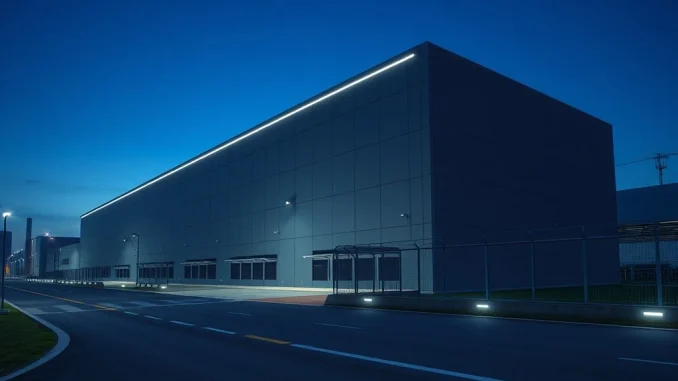
TOKYO, JAPAN — On Tuesday, May 20, 2026, hyperscale data center operator AirTrunk, owned by a consortium led by Blackstone and CPP Investments, secured a landmark 191.6 billion Japanese yen ($1.24 billion) green loan. This record financing, arranged by a consortium of 12 international banks, will refinance and massively expand the company’s TOK1 AI data center campus in the greater Tokyo area. The deal represents the largest single data center financing completed in Japan’s history and directly targets the explosive demand for cloud services and artificial intelligence infrastructure as the nation accelerates its digital computing capacity investments.
Anatomy of a Record-Breaking Data Center Deal
The financing consortium was led by banking giants Sumitomo Mitsui Banking Corporation (SMBC), MUFG, Crédit Agricole CIB, and Société Générale. In total, twelve lenders participated as mandated lead arrangers and bookrunners, signaling overwhelming confidence in Japan’s digital infrastructure trajectory. The capital injection will fund the next development phases of the TOK1 campus, which boasts a master-planned design to scale beyond 300 megawatts (MW) of total capacity. According to the official announcement, construction is already underway to add over 100 MW of IT load in the near term, specifically to address urgent demand from cloud service providers and technology firms establishing AI operations in the region.
This financing follows a strategic pattern for AirTrunk in Japan. The company recently announced a second hyperscale campus in Osaka (OSK2) and plans for a new Japan headquarters. Consequently, AirTrunk’s total committed investment in the Japanese market now exceeds $8 billion. Once its four planned campuses—TOK1, TOK2, OSK1, and OSK2—are fully operational, the platform will deliver approximately 530 MW of combined capacity. This scale will position AirTrunk as one of the largest and most critical hyperscale data center networks in the country, forming a backbone for Japan’s national AI and cloud strategy.
Strategic Impact on Japan’s AI and Cloud Ecosystem
The record loan is not merely a financial transaction but a strategic accelerant for Japan’s entire technology sector. The expansion directly responds to a critical shortage of high-capacity, AI-ready data center space in the Tokyo metropolitan area, which hosts the regional headquarters of nearly every global cloud provider. The deal’s timing aligns with a concerted push by the Japanese government and private industry to build sovereign digital resilience and compete in the global AI race.
- Catalyzing Local AI Development: By providing essential, scalable infrastructure, the TOK1 expansion lowers the barrier for both multinational corporations and domestic Japanese firms to train and deploy large AI models locally, reducing latency and improving data sovereignty.
- Addressing the Power Challenge: The facility’s design and the loan’s green framework mandate strict energy efficiency. This is crucial in a market like Japan, where power grid capacity and sustainability goals are top concerns for regulators and communities hosting data centers.
- Economic and Technological Multiplier Effect: Large-scale data center investments typically attract further technology spending, skilled jobs, and innovation clusters. The TOK1 campus is poised to become a hub for related industries, from semiconductor companies optimizing for AI workloads to software startups building next-generation applications.
Expert Analysis on Market Dynamics
Industry analysts view the deal as a bellwether. “The size and structure of this financing underscore a fundamental shift,” noted Kenji Tanaka, a senior infrastructure analyst at Tokio Marine Asset Management, referencing the broader market context. “Capital is aggressively chasing quality digital infrastructure assets in APAC, especially those tied to AI growth. Japan, with its stable economy, high demand, and supportive policy environment, is now at the forefront.” The loan was issued under AirTrunk’s Green Financing Framework, which requires certified energy efficiency standards, linking financial performance to environmental performance—a key consideration for institutional investors like Blackstone and CPP Investments.
Broader Context: The Global Scramble for AI Infrastructure
AirTrunk’s move is a single data point in a global capital expenditure arms race. Following its acquisition by the Blackstone-led consortium in a deal valued at over $16 billion in 2024, AirTrunk has pursued aggressive expansion across the Asia-Pacific region. The Tokyo financing mirrors similar large-scale investments in markets like Singapore, Sydney, and Hong Kong, where hyperscale operators are racing to build capacity. The table below contextualizes recent major data center financings in the APAC region, highlighting the scale of the TOK1 deal.
| Project / Company | Location | Financing Amount (USD) | Primary Driver |
|---|---|---|---|
| AirTrunk TOK1 Expansion | Tokyo, Japan | $1.24 Billion | AI & Cloud Demand |
| ST Telemedia GDC Facility | Singapore | $850 Million (Est.) | Hyperscale Expansion |
| NextDC S3 Project | Sydney, Australia | $1.1 Billion (Planned) | AI Readiness |
| Chindata Group Capacity Build | Beijing, China | $700 Million (2025) | Domestic Cloud Growth |
Furthermore, the lines between different types of digital infrastructure are blurring. As noted in the source material, cryptocurrency mining firms like CleanSpark and Core Scientific are actively pivoting or expanding into AI data center operations, seeking to repurpose their capital-intensive infrastructure for the AI boom. This convergence highlights how capital is fluidly moving towards any asset capable of supporting high-performance computing.
What Happens Next: Construction Timelines and Market Ripples
With financing secured, the immediate focus shifts to execution. AirTrunk has confirmed that construction to add the initial 100+ MW is already active. Market observers will monitor the supply chain for critical components like transformers, backup generators, and advanced liquid cooling systems, which face global lead time pressures. The successful and timely build-out of TOK1 will likely trigger further investment announcements from competitors and set a new benchmark for project financing in the region. Regulators will also watch the project’s energy consumption and its integration with the local power grid, as data center demand becomes a significant factor in national energy policy discussions.
Stakeholder and Competitive Reactions
The deal places immediate pressure on other data center operators in Japan, including local telecom giants and international players like Digital Realty and Equinix. It may accelerate merger and acquisition activity as smaller players seek scale to compete. Local government officials in the greater Tokyo area have generally welcomed the investment for its job creation and technology leadership, but community dialogues about land use, water for cooling, and grid impact are becoming more nuanced. “We are committed to being a responsible partner,” AirTrunk founder and CEO Robin Khuda stated in the announcement, emphasizing the company’s green framework and community engagement plans.
Conclusion
The record $1.24 billion green loan for AirTrunk’s Tokyo AI data center is a definitive milestone. It validates Japan’s strategic importance in the global AI infrastructure landscape and demonstrates the immense capital appetite for assets that enable digital transformation. The deal, backed by a consortium of global financial institutions and spearheaded by Blackstone, will directly enable the next wave of cloud and artificial intelligence innovation in one of the world’s largest economies. As construction progresses on the TOK1 campus, the industry’s attention will remain fixed on Japan, watching how this massive injection of capital translates into tangible computing capacity that will power the nation’s economic future. The success of this project will likely blueprint future mega-deals in digital infrastructure worldwide.
Frequently Asked Questions
Q1: What is the significance of the AirTrunk loan being a “green loan”?
The loan was issued under AirTrunk’s Green Financing Framework, which mandates that the funded projects meet strict, verifiable energy efficiency standards. This means the TOK1 data center expansion must utilize advanced cooling technologies, optimize power usage effectiveness (PUE), and potentially incorporate renewable energy sources. This structure aligns the project with environmental, social, and governance (ESG) investment criteria, which is increasingly important for large institutional investors and lenders.
Q2: How will this expansion affect businesses and consumers in Japan?
For businesses, it means greater availability, reliability, and potentially lower costs for cloud computing and AI model training services, as more supply comes online. For consumers, it translates to faster, more responsive AI-powered applications and services, from improved language translation tools to more sophisticated recommendation engines, all hosted with lower latency within Japan.
Q3: What is the timeline for the new capacity to become operational?
AirTrunk has stated that construction to add over 100 MW of IT load is already underway to address “near-term demand.” While full build-out to the campus’s 300+ MW potential will occur in phases, the first new capacity from this financing round is expected to come online in stages throughout 2027 and 2028, based on typical construction cycles for hyperscale facilities.
Q4: Why are so many banks involved in a single deal?
The involvement of a consortium of 12 banks mitigates risk for any single lender when financing a project of this enormous scale ($1.24B). It also reflects the strong appetite among international financial institutions to gain exposure to high-quality digital infrastructure assets, which are seen as stable, long-term investments tied to secular growth trends like AI and cloud adoption.
Q5: How does this relate to Blackstone’s overall investment strategy?
Blackstone’s leadership in the consortium that acquired AirTrunk in 2024 and its backing of this loan exemplifies its strategy of identifying and scaling essential infrastructure in high-growth sectors. Data centers, particularly those geared for AI, fit within Blackstone’s themes of investing in assets with inelastic demand, high barriers to entry, and strong pricing power, similar to its past investments in logistics warehouses and life sciences labs.
Q6: Does this investment make Japan a leader in AI infrastructure?
This deal significantly boosts Japan’s position. While the US currently leads in total AI data center capacity, Japan’s combination of strong demand, technological prowess, financial muscle (as shown by this deal), and government support positions it as a clear leader in the Asia-Pacific region and a major global hub. The scale of this single investment is a powerful statement of intent.