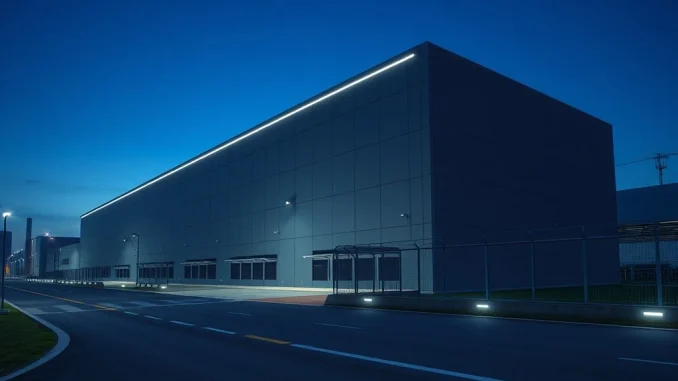
TOKYO, Japan — March 18, 2026: In a landmark deal for Japan’s digital infrastructure, hyperscale data center operator AirTrunk has secured a record 191.6 billion yen ($1.24 billion) green loan to refinance and massively expand its TOK1 campus in the greater Tokyo area. Announced today, this financing represents the largest single data center financing package ever completed in Japan. A consortium of twelve international banks, led by SMBC, MUFG, Crédit Agricole CIB, and Société Générale, arranged the capital. The funds will directly support new construction phases designed to scale the campus beyond 300 megawatts (MW) of total capacity, specifically targeting the explosive demand for cloud services and artificial intelligence (AI) computing power. This move signals a major acceleration in Japan’s investment into next-generation digital infrastructure.
AirTrunk’s Record Financing for AI and Cloud Growth
The financing is not merely a refinancing exercise but a strategic capital injection for aggressive expansion. AirTrunk, owned by a consortium led by global investment giant Blackstone and the Canada Pension Plan Investment Board (CPP Investments), has already broken ground to add over 100 MW of IT load at the TOK1 facility. This construction aims to address what the company calls “near-term demand” from cloud hyperscalers and technology firms. According to the official announcement, the TOK1 campus is a cornerstone of AirTrunk’s Japanese portfolio, which now represents a total investment exceeding $8 billion. The loan was structured under AirTrunk’s Green Financing Framework, mandating that the expanded facilities meet strict energy efficiency standards to minimize power consumption and carbon emissions—a critical factor for environmentally conscious tech clients and regulators.
This deal follows closely on the heels of AirTrunk’s recent unveiling of a second hyperscale campus in Osaka (OSK2) and plans for a new Japan headquarters. When fully developed, AirTrunk’s four Japanese campuses—TOK1, TOK2, OSK1, and OSK2—are projected to deliver approximately 530 MW of combined capacity. Consequently, this would position the platform as one of the largest and most powerful hyperscale data center networks in the country, directly competing with established domestic and international operators.
Strategic Impact on Japan’s AI and Digital Economy
The scale of this financing underscores a pivotal shift. Japan is aggressively positioning itself as a major hub for AI development and cloud computing in the Asia-Pacific region. The demand for high-density, reliable, and scalable data center space has skyrocketed, driven by the computational needs of large language models, machine learning workloads, and sovereign cloud initiatives. This loan enables AirTrunk to build the physical infrastructure required to host these workloads, which in turn attracts global technology firms to establish or expand their operations in Japan.
- Catalyst for Foreign Investment: A project of this magnitude, backed by Blackstone and major global banks, sends a strong signal to international investors about the stability and growth potential of Japan’s tech infrastructure sector.
- Addressing the Power Challenge: The expansion is explicitly designed for high-density AI computing, which consumes significantly more power per rack than traditional enterprise servers. The green loan framework ensures this growth is pursued with energy efficiency as a core design principle, a non-negotiable for sustainable scaling.
- Competitive Market Dynamics: This investment intensifies competition in Japan’s data center market, potentially leading to more innovation in cooling technologies, power procurement, and service offerings for hyperscale customers.
Expert Analysis on the Market Shift
Industry analysts view this transaction as a bellwether. “This isn’t just a real estate play; it’s a direct bet on the future of Japan’s digital economy,” said Kenji Tanaka, a senior infrastructure analyst at Tokio Marine Asset Management, who has covered the Asia-Pacific data center sector for over a decade. “The involvement of a syndicate of top-tier global banks provides more than capital—it offers validation. It shows institutional confidence that the demand for AI-ready capacity in Tokyo is real, durable, and credit-worthy.” Tanaka further noted that the green financing angle is crucial, as reported by the International Energy Agency (IEA) in its 2025 report on data center energy use, which highlighted the sector’s need to decouple growth from emissions. AirTrunk’s commitment to its Green Framework aligns with both investor ESG mandates and potential future regulatory pressures.
Broader Context: The Global Rush for AI Infrastructure
AirTrunk’s move is part of a worldwide scramble to build and fund the data centers that will power the AI era. The acquisition of AirTrunk by Blackstone and CPP Investments in 2024 for over $16 billion was itself the largest data center acquisition globally, highlighting the asset class’s strategic value. Meanwhile, other players are pivoting to capture the same demand. Cryptocurrency mining firms, facing regulatory and economic pressures, have begun diversifying into AI data center operations. For instance, CleanSpark recently announced plans to raise about $1.15 billion to expand its Bitcoin mining and data center infrastructure, while Core Scientific secured a $500 million loan from Morgan Stanley for similar expansion purposes.
| Company/Project | Location | Financing/Cost | Primary Driver |
|---|---|---|---|
| AirTrunk TOK1 Expansion | Tokyo, Japan | $1.24B Green Loan | AI & Cloud Hyperscale Demand |
| CleanSpark Expansion | United States | $1.15B Planned Raise | Bitcoin Mining & AI Data Centers |
| Core Scientific Expansion | United States | $500M Loan (up to $1B) | Bitcoin Mining & Infrastructure |
What Happens Next: Construction and Capacity Race
The immediate next step is the physical build-out. With financing secured, AirTrunk can accelerate construction on the TOK1 campus’s new phases. The company will likely engage with anchor tenants—major cloud service providers (CSPs) like Amazon Web Services, Microsoft Azure, and Google Cloud—to secure pre-lease agreements for the upcoming capacity. Furthermore, the success of this financing could pave the way for similar large-scale debt raises for its Osaka campuses or other projects in AirTrunk’s Asia-Pacific pipeline. Market observers will also watch for reactions from competitors like Digital Realty, Equinix, and local Japanese operators, who may respond with their own capital investment announcements to maintain market share.
Stakeholder and Industry Response
Initial reactions from the financial and tech communities have been positive. The banking consortium’s participation indicates robust appetite for infrastructure debt in the current economic climate. Within Japan, government officials have privately welcomed the investment as it aligns with national strategies to enhance digital sovereignty and technological competitiveness. However, some local community groups in the greater Tokyo area have raised questions about the strain such massive facilities place on regional power grids and water resources for cooling, highlighting the ongoing need for careful site selection and community engagement.
Conclusion
The record $1.24 billion green loan for AirTrunk’s Tokyo AI data center expansion is a definitive milestone. It validates Japan’s strategic importance in the global AI infrastructure landscape and demonstrates the immense capital required to build its foundation. This deal, facilitated by a powerhouse banking syndicate and backed by Blackstone, provides AirTrunk with the firepower to execute a critical expansion, directly addressing the acute demand for high-performance computing space. The focus on green financing also sets a crucial precedent for sustainable growth in an energy-intensive industry. As construction progresses, the TOK1 campus will become a tangible barometer of Japan’s success in attracting and supporting the next wave of technological innovation. The race for AI-ready capacity is on, and with this financing, AirTrunk has secured a leading position at the starting line.
Frequently Asked Questions
Q1: What is the significance of AirTrunk’s $1.24 billion loan?
This loan is the largest single data center financing deal ever completed in Japan. It provides AirTrunk with the capital to significantly expand its TOK1 campus near Tokyo, specifically to meet surging demand for cloud and artificial intelligence (AI) computing infrastructure.
Q2: Who owns AirTrunk and who funded this loan?
AirTrunk is owned by a consortium led by the global investment firm Blackstone and the Canada Pension Plan Investment Board (CPP Investments). The $1.24 billion loan was arranged by a consortium of 12 banks, led by SMBC, MUFG, Crédit Agricole CIB, and Société Générale.
Q3: How will this expansion impact Japan’s technology sector?
The expansion will provide hundreds of megawatts of new, high-density data center capacity. This infrastructure is essential for global cloud providers and AI companies to operate in Japan, potentially attracting more tech investment and fostering local innovation by providing the necessary computational power.
Q4: What is a “green loan” and why does it matter for a data center?
A green loan is financing earmarked for projects that meet predefined environmental sustainability criteria. For this loan, AirTrunk must adhere to its Green Financing Framework, ensuring the expanded data center meets strict energy efficiency standards. This is critical because data centers are major energy consumers, and sustainable design helps manage costs and reduce environmental impact.
Q5: How does this relate to the global trend of AI infrastructure investment?
This deal is a direct part of a worldwide rush to build data centers capable of handling AI workloads, which require far more power and cooling than traditional computing. Similar large investments are being made in North America and Europe, highlighting AI infrastructure as a top priority for both tech companies and investors.
Q6: What should local communities near the data center know?
While the project brings economic investment and tech jobs, large data centers place significant demand on local power grids and water resources for cooling. Responsible development requires ongoing dialogue between the operator, utility providers, and community stakeholders to ensure infrastructure needs are met sustainably.