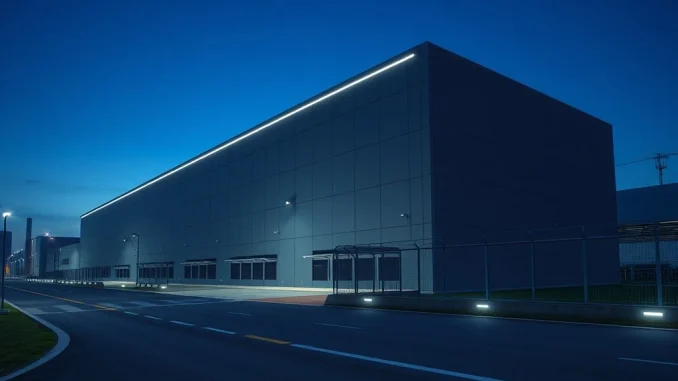
TOKYO, JAPAN — March 26, 2026: In a landmark deal for Japan’s digital infrastructure, hyperscale data center operator AirTrunk has secured a record 191.6 billion yen ($1.24 billion) green loan to refinance and expand its TOK1 campus in the greater Tokyo area. The financing, arranged by a consortium of 12 international banks and announced today, represents the largest single data center financing package ever completed in Japan. This massive investment directly targets the exploding demand for cloud services and artificial intelligence compute capacity, positioning the Blackstone-owned platform at the forefront of Japan’s national digitalization push. The loan will fund development phases designed to scale the TOK1 facility beyond 300 megawatts (MW) of total capacity.
AirTrunk’s Record Financing for AI and Cloud Growth
A consortium led by Sumitomo Mitsui Banking Corporation (SMBC), MUFG, Crédit Agricole CIB, and Société Générale structured the unprecedented financing. In total, twelve global lenders participated as mandated lead arrangers. AirTrunk confirmed construction is already underway to add over 100 MW of IT load at TOK1, a move aimed at addressing what CEO Robin Khuda describes as “near-term demand from cloud and technology customers.” The company’s total committed investment in Japan now exceeds $8 billion. This follows AirTrunk’s recent announcements of a second hyperscale campus in Osaka and plans for a new Japan headquarters, signaling deep, long-term commitment to the region.
The financing’s scale underscores a pivotal shift. Japan, historically cautious in data center development, is now aggressively courting investment to avoid being left behind in the global AI race. Government initiatives like the Digital Garden City Nation concept have created a policy tailwind. Consequently, international investors and operators are mobilizing capital at a pace unseen in the previous decade. This deal is not an isolated event but part of a calculated build-out strategy by financial giants like Blackstone to control essential digital real estate.
Strategic Impact on Japan’s AI and Digital Economy
The expansion of TOK1 carries significant implications for Japan’s technological sovereignty and economic competitiveness. Once fully built out, AirTrunk’s four Japanese campuses—TOK1, TOK2, OSK1, and OSK2—will deliver approximately 530 MW of combined capacity. This will establish one of the largest and most powerful hyperscale data center networks in the country. For global cloud providers like Amazon Web Services, Microsoft Azure, and Google Cloud—key tenants of such facilities—this means drastically increased capacity to host services for Japanese enterprises and government agencies.
- Accelerated AI Adoption: The new capacity provides the foundational compute power required for training and running large language models and AI applications locally, reducing reliance on overseas data centers and improving latency.
- Economic Multiplier Effect: Large-scale data center construction and operation generate hundreds of high-skilled jobs, stimulate local supply chains, and increase municipal tax revenues in host communities.
- Energy and Sustainability Pressures: Each new megawatt of capacity intensifies the focus on Japan’s energy grid stability and its carbon emissions goals, making the green loan aspect critical.
Expert Analysis on the Financing and Market Shift
Industry analysts view this transaction as a bellwether. “This isn’t just a real estate play; it’s a bet on the fundamental plumbing of the 21st-century economy,” said Kenji Sato, a senior infrastructure analyst at Nomura Research Institute, when contacted for perspective. “The involvement of major global banks like Société Générale and Crédit Agricole shows international capital sees Japanese data centers as a secure, long-term asset class with predictable returns, driven by insatiable AI demand.” The loan was issued under AirTrunk’s Green Financing Framework, which mandates strict energy efficiency standards. This aligns with growing investor and regulatory pressure for sustainable infrastructure. A 2025 report from the International Energy Agency highlighted that data centers could consume up to 4% of global electricity by 2030, making efficiency a paramount concern for financiers.
Broker Context: The Global Rush for AI Data Center Capacity
AirTrunk’s deal is a single data point in a worldwide scramble. The 2024 acquisition of AirTrunk by a Blackstone and CPP Investments consortium for over $16 billion signaled the start of this aggressive consolidation phase. Similar patterns are emerging globally. In the United States, companies like Core Scientific have pivoted from cryptocurrency mining, securing a $500 million loan from Morgan Stanley for AI data center expansion. Meanwhile, CleanSpark plans to raise about $1.15 billion to broaden its Bitcoin mining and data center infrastructure. This reflects a broader trend where compute-hungry industries are converging on the same scarce resources: power, land, and cooling.
| Project / Company | Location | Investment Scale | Primary Driver |
|---|---|---|---|
| AirTrunk TOK1 Expansion | Tokyo, Japan | $1.24 Billion | Cloud & AI Demand |
| Core Scientific Expansion | United States | $500M – $1B Loan | AI & HPC |
| New Google Cloud Region | Berlin, Germany | Estimated €1B+ | Data Sovereignty & AI |
| Microsoft Azure UK Expansion | London, UK | £2.5B Committed | AI Infrastructure |
What Happens Next: Construction Timelines and Market Ripples
The immediate next step is the rapid build-out of the additional 100+ MW at the TOK1 campus. Construction timelines in Japan are typically meticulous, with phased completions expected through 2027 and 2028. Market observers will watch for announcements of anchor tenant commitments, which often precede or follow such financings. Furthermore, this deal likely sets a new benchmark for valuation and financing costs for other data center projects in Japan, potentially making capital more accessible—but also more expensive—for competitors. The success of this green financing framework may also become a template, pushing the entire industry toward more transparent sustainability reporting to attract similar loans.
Industry and Government Reactions to the Deal
Reactions have been cautiously optimistic. The Japanese Ministry of Economy, Trade and Industry (METI) has publicly welcomed private investment that aligns with national digital infrastructure goals. However, local community groups in data center host regions continue to voice concerns about massive power consumption and water usage for cooling, ensuring that expansion remains a topic of public debate. Within the financial sector, the deal’s closure is seen as a validation of complex cross-border project finance structures for digital assets, encouraging other banks to establish dedicated infrastructure debt teams focused on technology real estate.
Conclusion
The record $1.24 billion financing for AirTrunk’s Tokyo AI data center is a definitive milestone. It validates Japan’s strategic importance in the global cloud and AI landscape and demonstrates the immense capital flowing into the foundational assets of the digital age. For businesses and policymakers, the message is clear: the race for compute supremacy is accelerating, and it is being funded by unprecedented sums of debt and equity. The expansion, guided by a green financing framework, also sets a crucial precedent, tying massive infrastructure growth to energy efficiency mandates. As construction progresses, the focus will shift to how this new capacity catalyzes Japanese AI innovation and whether the power grid can sustainably support this new wave of digital industrialization.
Frequently Asked Questions
Q1: What is the significance of AirTrunk’s $1.24 billion loan?
It is the largest single data center financing deal ever completed in Japan. The loan provides capital to significantly expand a key Tokyo-area data center campus, directly addressing soaring demand for cloud and artificial intelligence computing power from both domestic and international technology firms.
Q2: Who owns AirTrunk and why does that matter?
AirTrunk is owned by a consortium led by global investment giant Blackstone and the Canada Pension Plan Investment Board (CPP Investments). Their 2024 acquisition for over $16 billion signaled a major bet on data centers as critical infrastructure. This ownership provides AirTrunk with deep capital reserves and financial expertise to pursue large-scale projects like the TOK1 expansion.
Q3: How does this ‘green loan’ differ from regular financing?
The loan was issued under AirTrunk’s Green Financing Framework. This means the funds are specifically tied to projects that must meet strict, pre-defined energy efficiency and sustainability standards. The company must report on key performance indicators like Power Usage Effectiveness (PUE) and water usage, ensuring the expansion minimizes its environmental footprint.
Q4: How will this data center expansion affect ordinary people in Japan?
Indirectly, it will enable faster, more reliable digital services from banks, retailers, and government agencies that use cloud providers hosted in these centers. It also creates high-skilled construction and technical jobs. However, it increases local electricity demand, which can impact grid stability and potentially energy costs if not managed alongside renewable energy investments.
Q5: Is this part of a larger trend in the industry?
Absolutely. There is a global rush to build and finance data centers capable of handling AI workloads, which require vastly more power and cooling than traditional servers. Similar large-scale investments are happening in the United States and Europe, often involving former cryptocurrency mining companies pivoting to AI infrastructure.
Q6: What should local businesses in Japan watch for following this news?
Businesses should monitor announcements from major cloud providers (AWS, Azure, Google Cloud) regarding new service availability or regions in Japan. Increased local data center capacity often leads to better performance, more service options, and potentially competitive pricing for cloud and AI services, enabling smaller firms to leverage advanced technology.