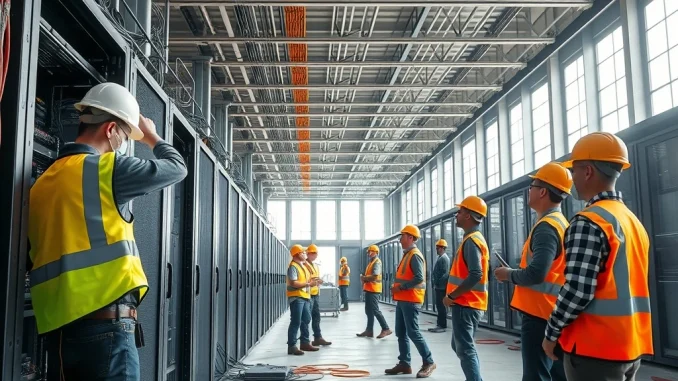
PALO ALTO, California — March 11, 2026: In a definitive counter-narrative to widespread automation fears, Nvidia founder and CEO Jensen Huang declared that artificial intelligence will be a massive net creator of jobs, not an eliminator. His argument, detailed in a comprehensive blog post, hinges on a single staggering figure: the global economy needs to build trillions of dollars worth of new, specialized infrastructure to support AI, a multi-decade project that will demand millions of skilled workers. This perspective arrives as major corporations like Block, Pinterest, and Dow cite AI efficiencies for recent layoffs, creating a tense and polarized debate about the technology’s true impact on the 2026 labor market.
Jensen Huang’s Trillion-Dollar Infrastructure Vision
Huang framed AI not as a standalone software tool but as foundational, essential infrastructure, comparing it directly to electricity grids and the internet. “We have only just begun this buildout,” Huang wrote. “We are a few hundred billion dollars into it. Trillions of dollars of infrastructure still need to be built.” He emphasized that this isn’t a simple upgrade of existing data centers. Because AI generates intelligence on demand rather than retrieving stored data, the entire supporting stack—from energy supply to cooling systems—requires a ground-up reinvention. Consequently, the labor profile shifts dramatically from pure software engineering to heavy industrial and technical trades.
The scale Huang describes is unprecedented. Analysts at Goldman Sachs recently noted that AI investment cycles are longer and more capital-intensive than previous tech booms, with physical build-out timelines stretching 5-10 years. This creates a sustained demand for construction and maintenance labor, contrasting with the more volatile hiring patterns in pure software development. Historical parallels are scarce, but some economists point to the build-out of the interstate highway system in the 1950s or the fiber-optic cable boom of the 1990s as analogous periods of job creation driven by massive public-private infrastructure projects.
The Five-Layer Cake: Deconstructing AI’s Job Creation Engine
Huang conceptualized the required infrastructure as a “five-layer cake,” with each layer generating distinct employment opportunities. This model provides a clear framework for understanding where jobs will emerge beyond the obvious roles in AI research and model development.
- Layer 1: Energy: AI data centers are profoundly power-hungry. This layer demands workers in renewable energy projects (solar/wind farm construction), grid modernization, and nuclear power plant operations—fields facing significant skilled labor shortages.
- Layer 2: AI Chips: While manufacturing is highly automated, this layer requires semiconductor fabrication plant construction, advanced materials science, and complex logistics and supply chain management for global distribution.
- Layer 3: Physical Infrastructure: This is the core of Huang’s jobs argument. It includes electricians, plumbers, steelworkers, and HVAC specialists to build and maintain the massive, specialized data centers. Network technicians are needed to install and manage the immense bandwidth required.
- Layer 4: AI Models: This is the layer most associated with AI—data scientists, machine learning engineers, and ethicists. Demand here is intense but represents a smaller portion of the total labor footprint than the physical build-out.
- Layer 5: Applications: This layer creates jobs in every sector of the economy, as companies integrate AI tools, requiring trainers, implementation specialists, and workflow redesign consultants.
Expert Analysis: Weighing Job Creation Against Displacement
Dr. Lisa Chen, a labor economist at the MIT Initiative on the Digital Economy, offers a nuanced view. “Huang is correct about the scale of complementary job creation in infrastructure,” Chen stated in an interview. “However, the transition is the critical challenge. The electrician wiring a data center in Nevada is not the same person being laid off from a content moderation team in Austin. Geographic and skills mismatches can cause severe localized disruption, even during a net job gain.” Chen’s research indicates that for every AI-driven efficiency layoff in administrative or certain creative functions, 1.2 to 1.5 jobs are created in infrastructure and adjacent fields, but often in different regions and requiring retraining.
This analysis is supported by data from the U.S. Bureau of Labor Statistics, which projects a 5% growth in construction trades and a 15% growth in roles like wind turbine service technicians over the next five years—trends accelerated by AI infrastructure demands. Conversely, Goldman Sachs analysts observed last month that AI-driven job losses, while “visible,” have been “moderate,” contributing slightly to a rising national unemployment rate, which they forecast will tick up from 4.4% to 4.5% by year-end as the economy adjusts.
The Great Disconnect: Corporate Layoffs Amid a Building Boom
The current economic landscape presents a confusing picture. While Huang describes a historic hiring need, headlines in early 2026 have been dominated by AI-related layoffs. This disconnect highlights the uneven and disruptive nature of technological transition.
| Company | Sector | Layoffs (2026) | Stated Reason |
|---|---|---|---|
| Block, Inc. | Financial Payments | 40% of staff | AI-driven operational efficiencies |
| Social Media | ~1,500 employees | AI automation of ad and content operations | |
| Dow Chemical | Industrial Chemicals | ~3,500 employees | AI optimization of R&D and supply chain |
These layoffs represent what economists call “labor shedding” in roles susceptible to automation—often middle-management, routine analytical, and certain customer service positions. Simultaneously, hiring is surging in the industrial and energy sectors. The challenge, as noted by the International Monetary Fund in a recent report, is the “temporal and spatial lag” between job destruction and creation, which can cause significant worker distress and require proactive policy intervention.
The Global Race for AI Infrastructure Sovereignty
Huang’s post carried a significant geopolitical undercurrent: “Every nation will build it.” This statement underscores a new front in global competition—not just for AI algorithms, but for AI infrastructure sovereignty. Nations are now crafting industrial policies to capture the jobs and economic security of building and hosting their own AI capacity.
The European Union’s “AI Factory” initiative, launched in late 2025, allocates €20 billion specifically for constructing sovereign AI data centers, with attached vocational training programs. Similarly, India’s “AI for All” strategy mandates that 50% of the physical infrastructure for government AI projects be domestically built and maintained. This global push turns Huang’s projected job creation into an international race, with nations competing for investment and skilled labor. The U.S., while leading in chip design and model development, faces a documented shortage of skilled tradespeople, creating a potential bottleneck in its own build-out.
Voices from the Ground: The New AI Workforce
Maria Gonzalez, a master electrician recently hired onto a data center project in Phoenix, embodies Huang’s argument. “Two years ago, I was mostly doing residential and commercial work,” Gonzalez said. “Now, my whole crew is on this one site. The specs are different—everything is about redundant power and extreme cooling. They’re paying a premium for this specialized knowledge.” Her experience is echoed by training institutes like the National Electrical Contractors Association (NECA), which reports a 300% year-over-year increase in enrollment for its data center electrical specialist certification.
Conclusion
Jensen Huang’s vision reframes the AI and jobs debate from a simple zero-sum equation to a complex story of simultaneous disruption and creation on a historic scale. The core truth is that AI is not a purely digital phenomenon; it is a physical-industrial one requiring a massive, global build-out. While AI will undoubtedly displace specific job categories, the demand for millions of skilled tradespeople, technicians, and engineers to construct and maintain the “five-layer cake” of infrastructure presents a countervailing force. The critical challenge for 2026 and beyond will be bridging the gap—through targeted education, vocational training, and mobility support—to connect displaced workers with the millions of new, well-paid jobs being created in the trenches of the AI revolution. The nations and companies that master this transition will not only lead in AI capability but will also secure a more stable and prosperous economic future.
Frequently Asked Questions
Q1: What specific jobs is Jensen Huang saying AI will create?
Huang emphasizes roles in building and maintaining AI infrastructure: electricians, plumbers, steelworkers, HVAC specialists, network technicians, data center operators, and renewable energy plant workers. These are skilled, well-paid trades facing current shortages.
Q2: How does this reconcile with companies laying off workers due to AI?
There is a disconnect. AI is eliminating some routine, administrative, and analytical jobs while simultaneously creating demand for industrial and construction jobs. The problem is a skills and location mismatch—the laid-off marketing analyst is not immediately qualified to be a data center electrician.
Q3: What is the “five-layer cake” of AI infrastructure?
Huang’s model describes the stack needed for AI: 1) Energy generation, 2) AI chips (semiconductors), 3) Physical data centers & networking, 4) AI software models, and 5) AI applications. Layers 1-3 require massive physical build-out and labor.
Q4: Is this AI job creation happening now, or is it a future prediction?
It is actively happening now, but at an early stage. Construction starts for major AI data center campuses have surged over 200% since 2024, and unions report skyrocketing demand for skilled trades. However, Huang states trillions more in investment is needed, implying job growth will accelerate over the next decade.
Q5: How does this affect the average person not in tech or construction?
Indirectly, in several ways. Massive infrastructure spending can boost local economies where projects are built. It may also pressure governments to invest in vocational training. Ultimately, reliable AI services (like those in healthcare, transportation, etc.) depend on this physical infrastructure being built.
Q6: What should a worker worried about AI displacement do?
Experts suggest focusing on skills that complement AI (troubleshooting, maintenance, oversight) or are in the physical build-out chain. Exploring certified trade programs in electrical work, plumbing, or data center operations is a direct path to the jobs Huang describes.