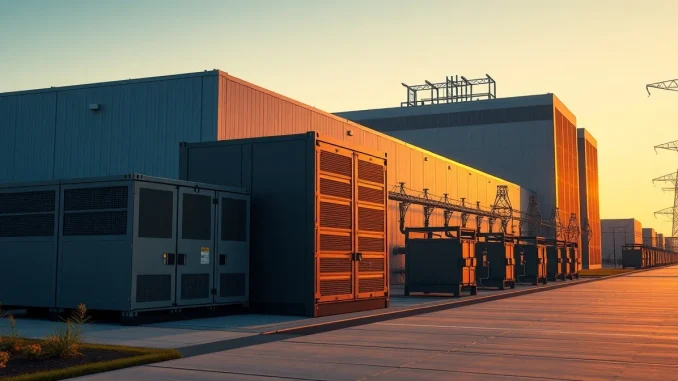
March 20, 2026 — Venture capitalists have poured over half a trillion dollars into artificial intelligence startups during the past five years, but a significant investment pivot is now underway. According to recent industry analysis, the most strategic AI investment opportunity currently lies not in software algorithms, but in the energy technology required to power them. This shift responds directly to a growing crisis: widespread delays in data center construction caused by insufficient electrical power capacity.
Data Center Delays Reveal Power Grid Limitations
Research from Sightline Climate indicates that up to 50% of announced data center projects face potential delays, with power access emerging as the primary constraint. The firm tracks approximately 190 gigawatts of proposed data center capacity across North America and Europe. However, only 5 gigawatts are currently under construction. About 6 gigawatts of projects became operational in 2025, but a concerning 36% experienced timeline slippage that same year.
These delays create a domino effect throughout the technology ecosystem. Large enterprises and companies relying on AI for business operations may eventually face service interruptions or capacity constraints. The supply-demand imbalance presents both a challenge for technology companies and a significant opportunity for investors. This situation has developed because AI computational demands are growing exponentially faster than grid infrastructure can expand.
The Unprecedented Power Demand From Artificial Intelligence
Goldman Sachs research projects AI will drive data center power consumption up by 175% globally by 2030. This surge represents an unprecedented strain on electrical grids that were designed for more predictable, gradual load growth. Consequently, electricity prices have increased substantially in major technology hubs. Many technology companies are now exploring alternative power solutions to ensure operational reliability.
Major technology firms have responded with substantial balance sheet commitments. Google, Meta, Amazon, and Oracle have dedicated billions to develop solar, wind, and nuclear projects. These companies are also supporting emerging technologies through direct investments and utility partnerships. For instance, Form Energy’s 100-hour iron-air battery technology has attracted significant corporate backing for its potential to provide multi-day grid storage.
Investment Flows Into Grid Innovation Startups
Dozens of startups are developing technologies specifically addressing the power bottleneck. Companies like Amperesand, DG Matrix, and Heron Power are pioneering new power conversion technologies. Meanwhile, software platforms from Camus, GridBeyond, and Texture are creating sophisticated systems to manage electron flow across increasingly complex grids. Investment in these areas, while substantial, remains far below the blockbuster funding rounds seen in pure AI companies.
This investment disparity creates opportunity. Energy technology rounds are often more tractable for investors while offering exposure to a fundamental infrastructure need. As the global economy electrifies transportation, heating, and heavy industry, power demand will continue growing regardless of AI market cycles. Consequently, energy tech provides investors with a potential hedge against AI sector volatility.
Beyond Generation: The Critical Role of Power Management
Energy supply represents only part of the challenge. Once electricity reaches the grid or data center, it requires sophisticated management. The humble transformer—a technology largely unchanged for 140 years—has become a critical bottleneck. Traditional transformers use massive iron cores wrapped in copper wire. While reliable, this design becomes prohibitively bulky as data center power densities increase.
Experts note that when server racks reach 1 megawatt power density, the supporting power equipment will occupy twice the space of the rack itself. This physical constraint has driven investor interest in solid-state transformer startups. These companies are developing silicon-based power electronics to replace iron-and-copper systems. Although currently more expensive, solid-state transformers can replace multiple pieces of equipment, potentially achieving cost competitiveness through system simplification.
Corporate Strategies for Energy Independence
Technology giants are actively minimizing grid dependence through innovative approaches. Several new data centers are being designed with on-site power generation or hybrid systems blending on-site and grid power. Currently, less than a quarter of projects with identified power sources will use on-site or hybrid systems, yet these represent 44% of total planned capacity.
Google’s recent agreement for a Minnesota data center illustrates this strategy. The company will combine wind and solar generation with Form Energy’s 30 gigawatt-hour battery system. Google also collaborated with utility Xcel Energy to develop a new rate structure encouraging technological adoption in utility planning. Such partnerships between technology companies and utilities are becoming increasingly common as both sectors recognize their interdependence.
The Battery Storage Revolution Accelerates
Grid-scale batteries are transforming power markets. The U.S. Energy Information Administration reports the nation should have nearly 65 gigawatts of battery storage capacity by the end of 2026. This represents exponential growth from just a few years ago. Form Energy exemplifies this momentum, reportedly seeking a $500 million funding round ahead of a potential initial public offering.
These storage systems address multiple challenges simultaneously. They smooth renewable energy intermittency, provide grid stability services, and offer backup power during outages. For data center operators, batteries provide crucial minutes or hours of uptime during grid disturbances, potentially preventing millions in lost revenue.
Infrastructure Challenges and Political Dimensions
The power shortage stems from multiple factors: shortages in power generation equipment like gas turbines, an aging electrical grid, and lengthy permitting processes. The current U.S. administration has urged technology companies to develop their own power sources, accept higher rates, or pursue both strategies. Most major technology firms had already initiated such plans before this political encouragement.
This situation creates a unique investment landscape. While AI software companies face intense competition and valuation pressures, energy infrastructure companies are addressing a fundamental, physical constraint with fewer competitors. The scale of required investment—trillions globally—ensures multiple companies can succeed simultaneously without zero-sum competition.
Conclusion: Energy as Foundational AI Infrastructure
The investment thesis is clear: artificial intelligence cannot advance without corresponding advances in energy technology. Data center delays demonstrate that computational progress now depends on power availability. Consequently, the most strategic AI investment may not involve AI companies directly, but rather the energy systems that enable them.
Investors are recognizing this relationship. While funding for battery and transformer companies remains smaller than headline AI rounds, it represents more targeted exposure to a critical bottleneck. As the world continues electrifying multiple economic sectors, energy technology offers both growth potential and portfolio diversification. The current data center power crisis ultimately reveals that the most valuable AI investment might be in the electrons that power the algorithms.
FAQs
Q1: Why are data center projects facing delays?
Approximately 50% of announced data center projects face delays primarily due to insufficient electrical power capacity. Grid infrastructure cannot expand quickly enough to meet surging AI demand, creating a fundamental physical constraint.
Q2: How much will AI increase data center power consumption?
Goldman Sachs projects AI will drive global data center power consumption up by 175% by 2030. This represents unprecedented growth that existing grid infrastructure was not designed to accommodate.
Q3: What energy technologies are attracting investment?
Investors are focusing on grid-scale battery storage, solid-state transformers, power conversion systems, and grid management software. Companies like Form Energy, Amperesand, and GridBeyond represent different aspects of this ecosystem.
Q4: How are major technology companies responding?
Google, Meta, Amazon, and Oracle are investing billions in renewable energy projects, battery storage, and innovative utility partnerships. Many are pursuing on-site power generation to reduce grid dependence.
Q5: Why might energy tech offer better investment returns than AI?
Energy technology addresses a fundamental physical constraint with less competition than AI software. It also provides exposure to broader electrification trends beyond AI, potentially offering both growth and portfolio diversification benefits.
Updated insights and analysis added for better clarity.
This article was produced with AI assistance and reviewed by our editorial team for accuracy and quality.