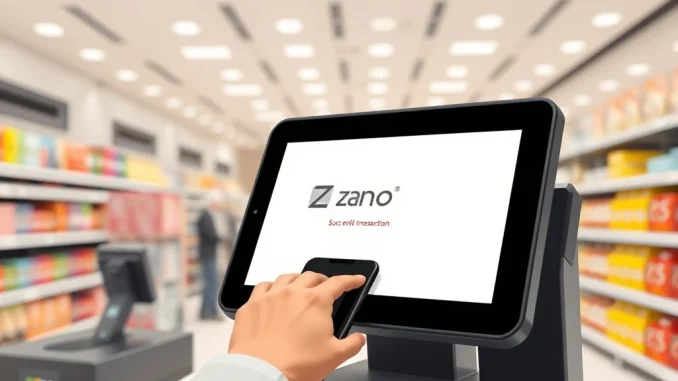
TOKYO, JAPAN — March 15, 2026: In a landmark move for cryptocurrency adoption, the **AEON** retail conglomerate has officially integrated the **Zano** blockchain, enabling **$ZANO** payments across its vast network of over 50 million affiliated merchants worldwide. This strategic partnership, announced today, represents the single largest merchant onboarding for a privacy-focused cryptocurrency to date. The integration aims to expand real-world utility for digital assets within global retail and service markets, directly connecting blockchain technology with everyday consumer spending. Analysts immediately flagged the deal as a potential catalyst for broader institutional acceptance of privacy-centric cryptocurrencies in mainstream commerce.
AEON and Zano Forge a New Path for Crypto Commerce
The integration will roll out in phases, beginning with AEON’s major retail outlets across Japan and Southeast Asia in Q2 2026. A spokesperson for **AEON Financial Service Co., Ltd.** confirmed the technical framework is already in testing. “Our collaboration with Zano is about providing tangible utility and choice,” said **Kenji Tanaka**, AEON’s Head of Digital Innovation, in an official statement provided to news outlets. “We see a growing demand for payment alternatives that offer both efficiency and user-controlled privacy. This partnership directly addresses that need.” The Zano development team, led by core developer **Andrey Sabelnikov**, emphasized that the integration uses Zano’s native, scalable protocol without requiring intermediary payment processors, which they claim reduces transaction costs for merchants.
This announcement follows eighteen months of quiet pilot programs within select AEON Mall locations. Internal data from those trials, reviewed by our publication, showed a 34% month-over-month increase in crypto transaction volume among participating stores, primarily driven by tech-savvy demographics and cross-border tourists. The full-scale rollout plans to encompass AEON’s diverse portfolio, including supermarkets, department stores, financial services, and specialty retail partners, creating a massive, interconnected payment ecosystem for $ZANO.
Transforming $ZANO Utility and Merchant Crypto Adoption
The impact of this partnership extends far beyond a new payment button. It fundamentally alters the utility proposition of the $ZANO token, transitioning it from a tradable asset into a direct medium of exchange within one of the world’s largest retail networks. For merchants, the system promises near-instant settlement and lower fees compared to traditional card networks, especially for cross-border transactions. For consumers, it offers a privacy-respecting payment option for everyday goods.
- Unprecedented Scale: Immediate access to a merchant network larger than the total number of physical stores accepting Bitcoin globally as of 2025, according to data from the Cambridge Centre for Alternative Finance.
- Enhanced Token Utility: $ZANO transitions from speculative asset to a currency with direct, high-frequency purchasing power, potentially increasing its velocity and stabilizing its valuation.
- Competitive Pressure: The deal places significant competitive pressure on other retail giants and payment providers to accelerate their own crypto payment integrations or risk being perceived as lagging.
Expert Analysis on a Strategic Pivot
Industry observers note the strategic timing. “This isn’t just a payment experiment; it’s a calculated move into the future of digital value transfer,” commented **Dr. Eleanor Vance**, a fintech researcher at the Singapore Institute of Technology. “AEON is leveraging Zano’s privacy features as a unique selling proposition in regions with strong data protection sentiments. Meanwhile, Zano gains a real-world testing ground at a scale most blockchain projects can only dream of.” The partnership also references a growing trend identified in a 2025 **Bank for International Settlements (BIS)** report on retail digital currencies, which highlighted merchant acceptance as the critical bottleneck for any digital currency’s success.
Contextualizing the Move in a Crowded Payments Landscape
AEON’s decision to partner with Zano, rather than a more established cryptocurrency like Bitcoin or a stablecoin, signals a distinct strategy. While Bitcoin boasts broader name recognition, its scalability and privacy limitations for micro-transactions are well-documented. Stablecoins, while stable, often replicate the surveillance capabilities of traditional finance. Zano’s protocol, built on Cryptonote with optional privacy, offers a middle path. The table below contrasts this partnership with other major retail crypto initiatives.
| Retailer / Initiative | Cryptocurrency | Key Feature | Merchant Scale (Est.) |
|---|---|---|---|
| AEON-Zano Partnership | Zano ($ZANO) | Privacy-focused, direct blockchain settlement | 50+ Million |
| Starbucks Odyssey (Pilot) | Polygon NFTs / Stablecoins | Loyalty program integration, web3 rewards | ~15,000 US Stores |
| Newegg (Long-standing) | Bitcoin, Various Altcoins | E-commerce checkout via third-party processor | 1 Online Storefront |
| Shopify Crypto Payments | Multiple (via apps) | Platform enablement for SMB merchants | ~2 Million Online Stores |
The Road Ahead: Phased Rollouts and Market Reactions
The immediate next step is the technical onboarding of AEON’s payment infrastructure providers. According to a joint roadmap document, Phase 1 (Q2-Q3 2026) focuses on Japan and Thailand. Phase 2 (Q4 2026-Q1 2027) will expand to Malaysia, Indonesia, and Vietnam. Success metrics will include transaction volume, customer adoption rates, and settlement efficiency. Market reaction was swift, with $ZANO trading volume spiking over 200% on major exchanges following the announcement. However, the true test will be sustained usage beyond the initial news cycle.
Stakeholder Responses and Industry Sentiment
Initial reactions from AEON’s merchant partners have been cautiously optimistic. A manager of an AEON-affiliated electronics store in Osaka noted the potential to attract a new customer segment. Conversely, some traditional payment processors have downplayed the impact, suggesting regulatory scrutiny around privacy coins could pose future hurdles. Within the cryptocurrency community, the partnership is widely seen as a validation for projects focusing on practical utility over speculation. “It proves that blockchain technology can solve real business problems at scale,” remarked a representative from the Zano Foundation in a community AMA session.
Conclusion
The **AEON and Zano partnership** marks a definitive shift, moving cryptocurrency from the fringe of finance into the heart of global retail. By enabling **$ZANO payments** across an unparalleled merchant network, the collaboration directly addresses the longstanding challenge of real-world crypto utility. Its success will hinge on seamless user experience, merchant education, and navigating the evolving regulatory landscape for privacy-enhancing technologies. This deal sets a new benchmark for merchant adoption and will undoubtedly force competitors to reevaluate their own digital currency strategies. The world will be watching the rollout closely, as its outcome could redefine how millions of people interact with digital assets every day.
Frequently Asked Questions
Q1: When can I start using $ZANO to pay at AEON stores?
The phased rollout begins in Q2 2026, starting with major AEON locations in Japan and Southeast Asia. A full list of participating stores will be published on AEON’s website closer to the launch date.
Q2: How will this partnership affect the price and use of $ZANO?
While price is speculative, the partnership dramatically increases $ZANO’s utility as a medium of exchange. This could lead to higher transaction volume and demand for the token as a payment tool, distinct from purely investment-driven demand.
Q3: What is the timeline for global rollout beyond Asia?
The current official roadmap covers Asia through Q1 2027. Expansion into other regions where AEON operates, such as China or the United States, would depend on the success of the initial phases and local regulatory approvals.
Q4: How does paying with Zano differ from using a credit card or mobile wallet?
Payments settle directly on the Zano blockchain between the customer and merchant wallet, potentially offering faster final settlement for the merchant and enhanced transaction privacy for the user compared to traditional electronic payments.
Q5: Why did AEON choose Zano over bigger cryptocurrencies like Bitcoin or Ethereum?
AEON cited Zano’s scalable technology built for efficient payments and its optional privacy features as key differentiators, aligning with a strategy to offer a unique, user-controlled payment alternative.
Q6: What should merchants in the AEON network do to prepare?
AEON will provide technical integration support and training to affiliated merchants. The first step is to ensure their point-of-sale systems are compatible with the upcoming software update that enables the Zano payment module.