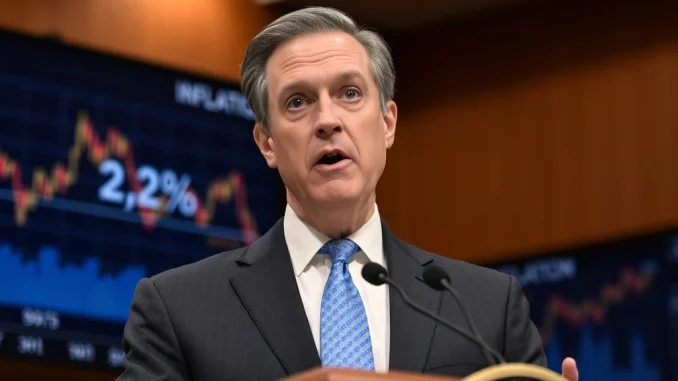
Understanding macroeconomic signals is crucial for anyone navigating financial markets, including the dynamic world of cryptocurrencies. Recently, Federal Reserve Chair Jerome Powell delivered a significant statement. He indicated that the inflation rate, when excluding the impact of tariffs, is approaching the central bank’s long-sought 2% target. This news offers a glimmer of hope for economic stability, directly influencing investor sentiment and broader market conditions.
Jerome Powell Inflation Insights: A Closer Look
Federal Reserve Chair Jerome Powell recently provided a key update on the nation’s economic health. He stated that the **inflation rate**, specifically when tariffs are excluded, stands “not far” from the Federal Reserve’s 2% objective. This assessment offers valuable insight into the central bank’s perspective on current economic trends. Furthermore, Powell noted that the existing **monetary policy** remains “slightly restrictive.” This characterization suggests that the Fed believes its actions continue to exert downward pressure on prices, guiding the economy towards stability. Investors often scrutinize such statements for clues about future policy adjustments.
Excluding tariffs from inflation calculations provides a clearer picture of underlying price pressures. Tariffs represent a direct cost imposed on imported goods. Therefore, their exclusion helps economists differentiate between inflation caused by trade policies and inflation driven by domestic demand or supply chain issues. Powell’s comments suggest that core inflationary pressures are moderating effectively. This distinction is vital for understanding the true trajectory of the economy. His remarks reassure markets about the Fed’s ongoing commitment to price stability.
Understanding the Fed Inflation Target
The Federal Reserve aims for a 2% **Fed inflation target** as a long-term goal. This target helps maintain stable prices and maximize employment. A stable inflation rate prevents both deflation (falling prices, which can stifle economic growth) and excessive inflation (rising prices, which erodes purchasing power). The 2% target provides a clear benchmark for monetary policy decisions. It signals to businesses and consumers what to expect regarding future price levels.
Achieving this target is critical for several reasons:
- It fosters economic predictability.
- It supports sustainable growth.
- It helps anchor long-term interest rates.
When inflation deviates significantly from this target, the Federal Reserve typically adjusts its **monetary policy**. They do this to guide the economy back to equilibrium. Powell’s recent statement suggests that these efforts are yielding positive results, bringing the economy closer to the desired state of price stability. This progress is a positive sign for market participants.
The Impact of Monetary Policy on Markets
Jerome Powell’s assertion that **monetary policy** remains “slightly restrictive” carries significant weight for financial markets. A restrictive policy aims to cool down an overheating economy by making borrowing more expensive. This typically involves raising interest rates. Higher rates can slow consumer spending and business investment, thereby reducing demand and ultimately curbing inflation. However, the term “slightly restrictive” implies that the Fed may not need to tighten policy much further. This nuanced language can influence market expectations for future rate hikes.
The implications of such a policy are widespread:
- **Lending Costs:** Businesses and consumers face higher borrowing costs for loans and mortgages.
- **Investment Decisions:** Companies may delay expansion plans due to increased financing expenses.
- **Asset Valuations:** Higher interest rates can make fixed-income investments more attractive relative to riskier assets like stocks and cryptocurrencies.
Therefore, a shift from “restrictive” to “neutral” or even “accommodative” policy would signal a significant change in the economic landscape. Powell’s current assessment suggests a careful balancing act. The Federal Reserve continues to monitor data closely before making any definitive moves. This cautious approach aims to ensure a soft landing for the economy.
Analyzing the Current Inflation Rate Dynamics
The current **inflation rate** has been a primary concern for economists and policymakers alike. Powell’s distinction regarding “inflation ex-tariffs” highlights the complexities involved in measuring and managing price increases. Tariffs, essentially taxes on imported goods, directly increase the cost of those products. When these costs are passed on to consumers, they contribute to overall inflation. By excluding them, the Fed focuses on underlying inflationary pressures. These pressures stem from factors like:
- Strong consumer demand.
- Tight labor markets.
- Supply chain disruptions.
His statement suggests that these underlying factors are moderating. This is a positive development for the economy. It indicates that the Fed’s previous interest rate hikes are working as intended. Monitoring the various components of the inflation rate allows the Federal Reserve to tailor its responses more precisely. This targeted approach helps avoid over-tightening or under-tightening the economy. Ultimately, it aims for a smoother path towards price stability.
Federal Reserve News and the Economic Outlook
The latest **Federal Reserve news** often shapes market sentiment. Powell’s remarks about the inflation rate nearing its target offer a cautiously optimistic outlook. This news typically boosts confidence among investors and businesses. They see a potential end to aggressive monetary tightening. Such an environment can lead to increased investment and economic activity. However, the Fed remains data-dependent. Any future policy decisions will hinge on incoming economic reports, including employment figures and further inflation data.
Key areas to watch include:
- **Consumer Price Index (CPI):** This report provides a broad measure of goods and services prices.
- **Personal Consumption Expenditures (PCE):** The Fed’s preferred inflation gauge, which often shows different trends than CPI.
- **Job Market Data:** Strong employment figures can indicate persistent wage pressures.
The Federal Reserve’s communication strategy is crucial. Clear and consistent messaging helps prevent market volatility. As the economy evolves, the Fed will continue to adjust its stance. This ensures it achieves both price stability and maximum sustainable employment. These ongoing developments are vital for all market participants to track.
Conclusion: Navigating Towards Stability
Jerome Powell’s recent statements provide valuable clarity on the nation’s economic trajectory. The indication that **inflation ex-tariffs** is nearing the 2% target suggests that the Federal Reserve’s stringent **monetary policy** measures are effectively moderating price pressures. While the policy remains “slightly restrictive,” this progress offers a hopeful sign for sustained economic stability. As the **inflation rate** continues to be monitored, the **Federal Reserve news** will remain a critical guide for markets. This includes the cryptocurrency sector, which often reacts to broader economic shifts. Continued vigilance and data-driven decisions will be essential for the Fed to achieve its dual mandate of price stability and maximum employment.
Frequently Asked Questions (FAQs)
Q1: What does “inflation ex-tariffs” mean?
A1: “Inflation ex-tariffs” refers to the inflation rate calculated without including the price increases caused by import taxes (tariffs). This provides a clearer view of underlying domestic price pressures, excluding trade policy impacts.
Q2: Why does the Federal Reserve target 2% inflation?
A2: The Federal Reserve targets 2% inflation to achieve stable prices and support maximum sustainable employment. This rate is considered optimal for preventing both deflation (harmful price declines) and excessive inflation (eroding purchasing power).
Q3: What does a “slightly restrictive” monetary policy imply?
A3: A “slightly restrictive” monetary policy means the Federal Reserve is actively working to slow economic growth and curb inflation, typically through higher interest rates. The term “slightly” suggests the Fed believes current measures are sufficient, potentially signaling fewer aggressive actions in the near future.
Q4: How does Federal Reserve news impact cryptocurrency markets?
A4: Federal Reserve news, especially on inflation and interest rates, significantly impacts cryptocurrency markets. Higher interest rates can make traditional assets more attractive, potentially reducing demand for riskier assets like crypto. Conversely, signs of economic stability and easing monetary policy can boost crypto investment.
Q5: What is the significance of Jerome Powell’s recent statement?
A5: Jerome Powell’s statement is significant because it indicates that the Fed’s efforts to control inflation are working, bringing the economy closer to its 2% target. This positive development can influence market expectations, investor confidence, and future monetary policy decisions, potentially leading to a more stable economic environment.