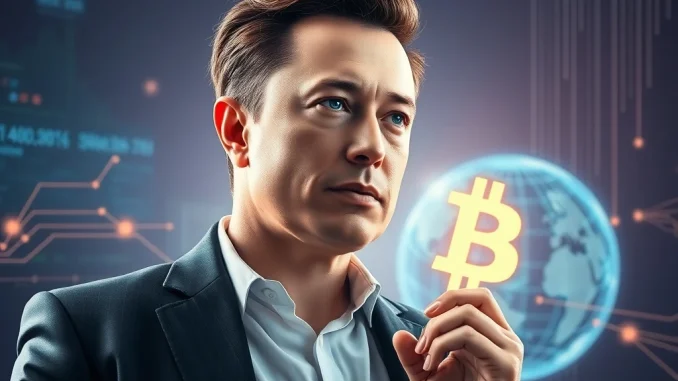
Tesla CEO Elon Musk recently sparked considerable discussion on X, affirming that Elon Musk Bitcoin is fundamentally based on energy. He highlighted a critical distinction: while governments have historically issued counterfeit fiat currency, energy itself cannot be faked. This statement underscores a profound aspect of Bitcoin’s design and value proposition.
Elon Musk Bitcoin: The Unforgeable Energy Foundation
Elon Musk’s recent remarks on X provide significant insight into his understanding of Bitcoin’s intrinsic nature. He clearly stated that Bitcoin energy forms its bedrock. This perspective challenges conventional views of currency. Historically, governments worldwide have often resorted to printing more fiat money. Such actions dilute its value over time. Conversely, Musk argues, energy possesses an inherent, unforgeable quality. This characteristic directly translates into Bitcoin’s robust security model.
Bitcoin’s proof-of-work mechanism requires significant computational effort. This effort consumes real-world energy. Miners compete to validate transactions and add new blocks to the blockchain. This process ensures the network’s integrity. It also prevents double-spending. Consequently, the energy expenditure makes Bitcoin inherently resistant to counterfeiting. No central authority can simply ‘print’ more Bitcoin. Its scarcity is mathematically enforced. This energy-backed foundation distinguishes it from traditional monetary systems.
Understanding Bitcoin’s Intrinsic Value
Many investors seek assets with intrinsic value. Gold, for instance, has long been valued for its scarcity and industrial uses. Musk suggests Bitcoin shares a similar, albeit digital, characteristic. Its value is not merely speculative. Instead, it is tied to the real-world energy required for its creation and maintenance. This energy cost acts as a barrier to manipulation. It ensures the network’s decentralization. Therefore, the more energy expended, the more secure the network becomes. This concept is vital for understanding Bitcoin’s long-term potential.
The Global AI Arms Race and Crypto Liquidity
Musk’s comments came in response to a post by ZeroHedge. The financial news aggregator proposed a compelling link between emerging technologies and global finance. ZeroHedge suggested that artificial intelligence (AI) represents a new global arms race. Both the U.S. and China are poised for massive investments in AI development. This intense competition will likely lead to substantial liquidity expansion. Such expansion often has ripple effects across various asset classes. Consequently, understanding this dynamic is crucial for investors.
The influx of capital into AI research and development is unprecedented. Governments and private entities are pouring billions into this sector. This massive investment creates significant economic activity. It also injects considerable funds into the global financial system. Such an environment naturally leads to increased crypto liquidity. When more money circulates, investors seek opportunities. Digital assets, including Bitcoin, often become beneficiaries of this trend. They offer alternative investment avenues. Furthermore, their decentralized nature appeals to those wary of traditional markets.
Impact on Gold, Silver, and Bitcoin
ZeroHedge specifically highlighted the recent surge in gold, silver, and Bitcoin. They attributed this phenomenon to the liquidity expansion driven by the AI arms race. These assets often act as hedges against inflation or economic uncertainty. Gold and silver are traditional safe havens. Bitcoin, however, has increasingly gained recognition as ‘digital gold.’ Its limited supply makes it attractive during periods of monetary expansion. The aggregator’s point about energy not being printable directly relates to this. Unlike fiat currencies, which can be printed endlessly, energy is a finite resource. This fundamental difference strengthens the case for assets like Bitcoin, which are linked to real-world energy consumption.
Fiat Currency vs. Unforgeable Energy
Musk’s distinction between Fiat currency and unforgeable energy is profound. Governments have historically relied on fiat systems. These systems derive value from government decree. They are not backed by a physical commodity. This allows central banks flexibility in managing economies. However, it also opens the door to potential abuses. Excessive money printing can lead to hyperinflation. It erodes purchasing power. Many nations have experienced this over time. This instability contrasts sharply with Bitcoin’s design principles.
Bitcoin’s architecture prioritizes scarcity and decentralization. Its supply is capped at 21 million coins. This hard limit prevents inflationary practices. The energy required for mining reinforces its value. It makes the network robust against attacks. Therefore, Bitcoin offers an alternative to traditional monetary policies. It provides a censorship-resistant medium of exchange. It also functions as a store of value. This paradigm shift challenges long-held beliefs about money. It promotes a new form of digital economy.
Historical Context of Monetary Systems
Throughout history, monetary systems have evolved significantly. From bartering to commodity-backed currencies like gold, and eventually to fiat money, each transition brought new challenges. The shift to fiat currency provided governments with immense power. They could control money supply. They could influence economic cycles. However, this power also led to periods of instability. The argument for an energy-backed currency like Bitcoin revisits fundamental questions. What truly gives money value? Is it trust in a central authority, or an immutable, verifiable cost of creation?
The Future of Digital Assets and Energy
The intersection of AI, energy, and digital assets presents a complex future. The AI arms race will undoubtedly reshape industries. It will create new economic paradigms. The resulting liquidity expansion could further fuel interest in cryptocurrencies. Bitcoin, with its energy-backed foundation, stands out. It offers a unique proposition in a world grappling with inflation and financial uncertainty. As AI advances, energy demands will also increase. This interplay could further validate Bitcoin’s model. Its reliance on real-world energy provides a tangible link to physical resources.
Ultimately, Musk’s statement highlights Bitcoin’s potential as a truly independent and resilient form of money. Its foundation in unforgeable energy offers a stark contrast to traditional fiat systems. As the global financial landscape continues to evolve, Bitcoin’s unique attributes may become increasingly significant. Investors and policymakers alike are watching these developments closely. The future of finance may indeed be more energy-centric than ever before.
Frequently Asked Questions (FAQs)
Q1: What did Elon Musk say about Bitcoin’s energy basis?
Elon Musk stated on X that Bitcoin is fundamentally based on energy. He emphasized that, unlike government-issued fiat currency which can be counterfeited, energy itself cannot be faked, highlighting Bitcoin’s inherent security and value proposition.
Q2: How does Bitcoin’s energy consumption relate to its security?
Bitcoin’s proof-of-work mechanism requires significant energy expenditure by miners. This energy cost makes the network highly secure and resistant to manipulation. The computational effort ensures transaction validation and prevents counterfeiting, linking its security directly to real-world energy.
Q3: What is the connection between the AI arms race and crypto liquidity?
The financial news aggregator ZeroHedge suggested that the global AI arms race, involving massive investments from the U.S. and China, will lead to significant liquidity expansion. This increased liquidity often flows into various asset classes, including cryptocurrencies like Bitcoin, driving their recent surges.
Q4: Why is “unforgeable energy” a key concept for Bitcoin?
The concept of “unforgeable energy” is key because it differentiates Bitcoin from fiat currencies. Fiat money can be printed by governments, potentially leading to inflation. Bitcoin’s creation, however, is tied to a verifiable, real-world energy cost, making its supply inherently limited and resistant to artificial inflation or counterfeiting.
Q5: How does Bitcoin compare to gold and silver as an investment?
Like gold and silver, Bitcoin is increasingly seen as a hedge against inflation and economic uncertainty. Its limited supply and decentralized nature make it an attractive alternative asset. ZeroHedge noted that all three assets have surged due to global liquidity expansion, suggesting Bitcoin’s growing role as “digital gold.”